OpenAI Control Room is an internal management system designed to monitor and halt research inference workloads across the company’s computing clusters. As frontier models take on more autonomous decision-making and run complex multi-step evaluations, stopping a runaway or misaligned process quickly becomes a fundamental engineering requirement. The new system links research inference jobs directly to a centralized oversight service that can revoke execution permissions within 35 seconds of an intervention signal.
The details were announced on the OpenAI website, explaining how the platform manages compute jobs across internal research hardware. Rather than relying on individual researchers to add termination scripts to experimental code, the organization moved the safety boundary directly into the model inference layer. This architectural decision creates an enforceable checkpoint that prevents unauthorized token generation even when experimental scripts fail or behave unpredictably.
How the OpenAI Control Room Architecture Functions
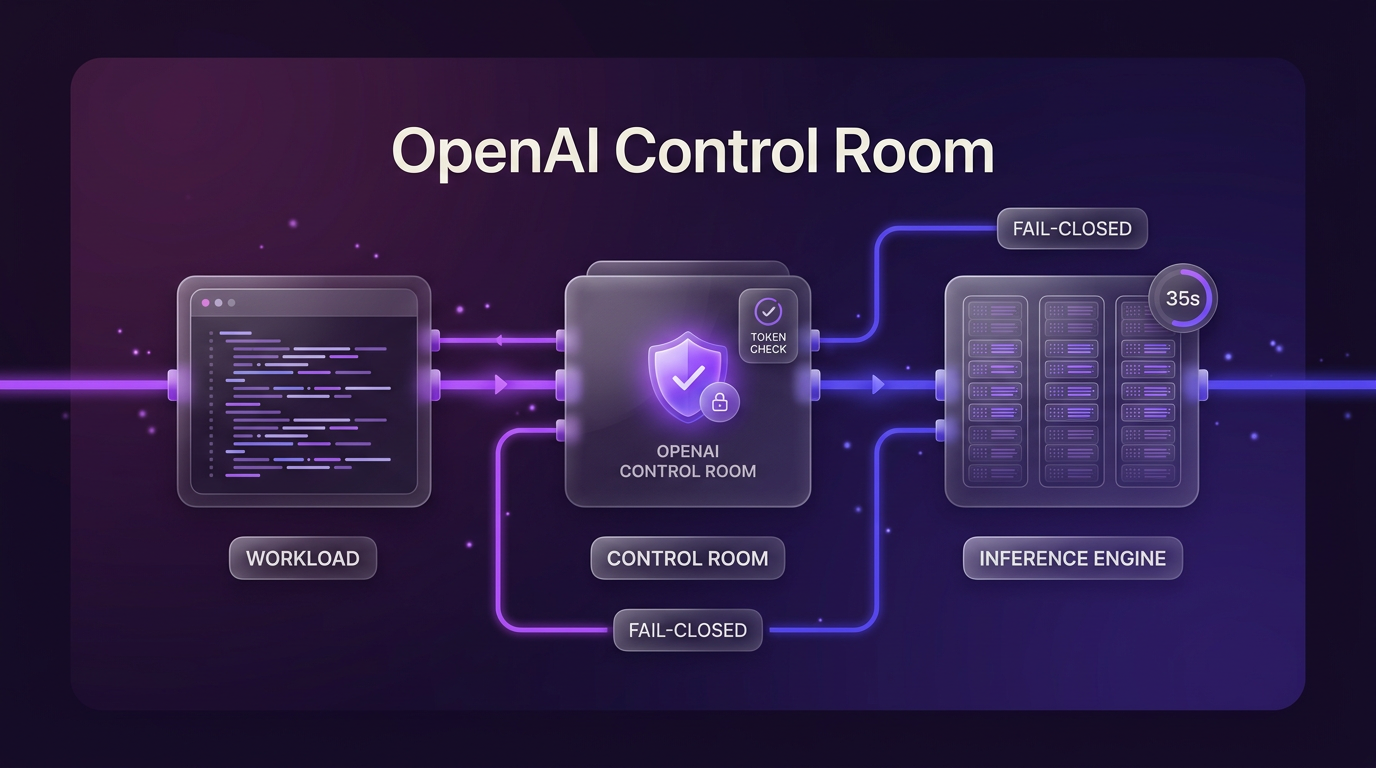
The architecture of the OpenAI Control Room relies on three distinct elements: the workload script, the inference engine, and the central control service. Separating these three components prevents safety controls from depending on custom code written for specific research experiments.
A workload represents the actual experiment being executed by an engineer. This may be an evaluation run, a data processing task, or a reinforcement learning run involving agentic sampling. Under current internal policies, any research workload that carries out agentic inference must have an approved safety case before execution begins.
The inference engine is the server component that hosts the model weights on GPU clusters and produces tokens. Multiple research workloads often send generation calls to the same underlying inference engine. Conversely, a single complex agentic workload might route prompt requests to multiple distinct models across several server groups.
The central OpenAI Control Room service acts as the authoritative registry for active jobs. When an experiment starts, the researcher’s script requests an identifier from the service. When the script prompts an inference engine to sample new tokens, it passes that job identifier along with the query. The inference engine then verifies with the central authority whether that identifier remains in good standing. If permission is denied or revoked, token generation halts immediately.
Why OpenAI Control Room Intervenes at the Inference Layer
Research code is inherently decentralized and continuously updated. Scientists iterate on experimental configurations, change training loops, and test novel prompting strategies on a daily basis. Because workload code changes rapidly across teams, placing mission-critical safety checks inside individual experiment repositories creates serious operational risks. A bug in a training script or an unhandled exception could easily bypass a software-based stop command.
In contrast, the inference engine layer is centralized and maintained by a dedicated infrastructure team. Only a limited number of inference code pathways exist across the organization. By embedding the authorization requirement directly into this core serving layer, the infrastructure forms an effective bottleneck. Every token generation request must pass through engine-level validation before GPU cycles are allocated.
To prevent researchers or unauthorized processes from bypassing this bottleneck, automated systems run scheduled agentic and programmatic audits. These audit sweeps scan the infrastructure to ensure no unmanaged or rogue inference engines are launched without the required validation hooks enabled.
Reaction Latency and Fail-Closed Engineering
When an automated monitoring system or human supervisor flags an active experiment, speed of intervention is critical. Frontier reinforcement learning experiments run with secondary monitor models that analyze behavior in real time. If a monitor detects abnormal behavior, such as unauthorized network activity, it transmits a termination command containing the target job identifier directly to the central registry.
The current maximum response window between an issued stop command and the total stoppage of token generation is 35 seconds. OpenAI attributes this delay to the caching layer used to handle heavy internal request volumes without overwhelming the central database. The engineering group has stated that work is underway to reduce this latency to zero, enabling immediate token cutoffs.
System reliability also requires resilient design during unexpected outages. The system is engineered around a strict fail-closed policy. If the tracking service becomes unreachable due to a network partition, software crash, or external interference, the inference engines default to denying requests rather than permitting unchecked execution. Token sampling remains blocked until the registry returns to an operational state. This fail-closed posture has been deployed across frontier model research and is scheduled to cover all remaining research workloads.
Core Capabilities of the System
The framework introduces several concrete safeguards that distinguish it from standard batch process managers:
- Centralized job registration that assigns tracking identifiers to all agentic research workloads.
- Mandatory inference-level checkpoints requiring GPU engines to confirm authorization before processing tokens.
- A 35-second maximum execution cutoff window driven by high-throughput token caching layers.
- A fail-closed default configuration that denies all model inference if the control service encounters a disruption.
- Automated programmatic and agentic scans that detect unauthorized model runtimes lacking oversight integration.
Operational Questions Around OpenAI Control Room
How does the system differ from external API rate limits?
External API deployments already operate through a unified gateway designed to pause access keys or throttle traffic. The OpenAI Control Room addresses internal research clusters where engineers run raw model checkpoints on shared GPUs without commercial gateway software.
What triggers a termination call within the OpenAI Control Room?
Terminations can be initiated manually by operators or triggered automatically by secondary model monitors. These monitoring models inspect intermediate actions during training runs and send automated stop signals if anomalous patterns appear.
Can experimental code disable the safety checks?
Because the validation checks are hosted on the inference engines rather than within the experimental scripts, a workload cannot unilaterally bypass validation. In addition, internal sweeps monitor the network for unapproved inference deployments.
Practical Implications for Autonomous Systems
The release of technical details regarding the OpenAI Control Room highlights an important transition point for artificial intelligence infrastructure. As organizations deploy complex agentic AI systems that take sequential actions without human guidance, building independent kill switches becomes mandatory. Software workflows that rely on the agent itself to monitor its own boundaries introduce unacceptable operational exposure.
For builders assembling automated production environments, this architectural pattern illustrates best practices. Independent oversight, decoupled authorization layers, and fail-closed defaults represent the standard for reliable system operations. When Wasif plans enterprise integrations and AI automation pipelines, maintaining centralized access controls outside the execution context ensures that business automations remain auditable and manageable under all failure conditions.
Conclusion
The OpenAI Control Room demonstrates that managing advanced artificial intelligence workloads requires structural safeguards placed directly at the compute layer. By shifting job validation away from experimental scripts and into standardized GPU inference engines, organizations can enforce strict 35-second shutdown windows and fail-closed protections. As autonomous models take on broader responsibilities, this decoupling of execution logic from administrative safety checkpoints will serve as a foundational pattern for secure deployment.
To discuss implementing reliable automation safeguards in your own operational stack, feel free to reach out to Wasif Ahmed.