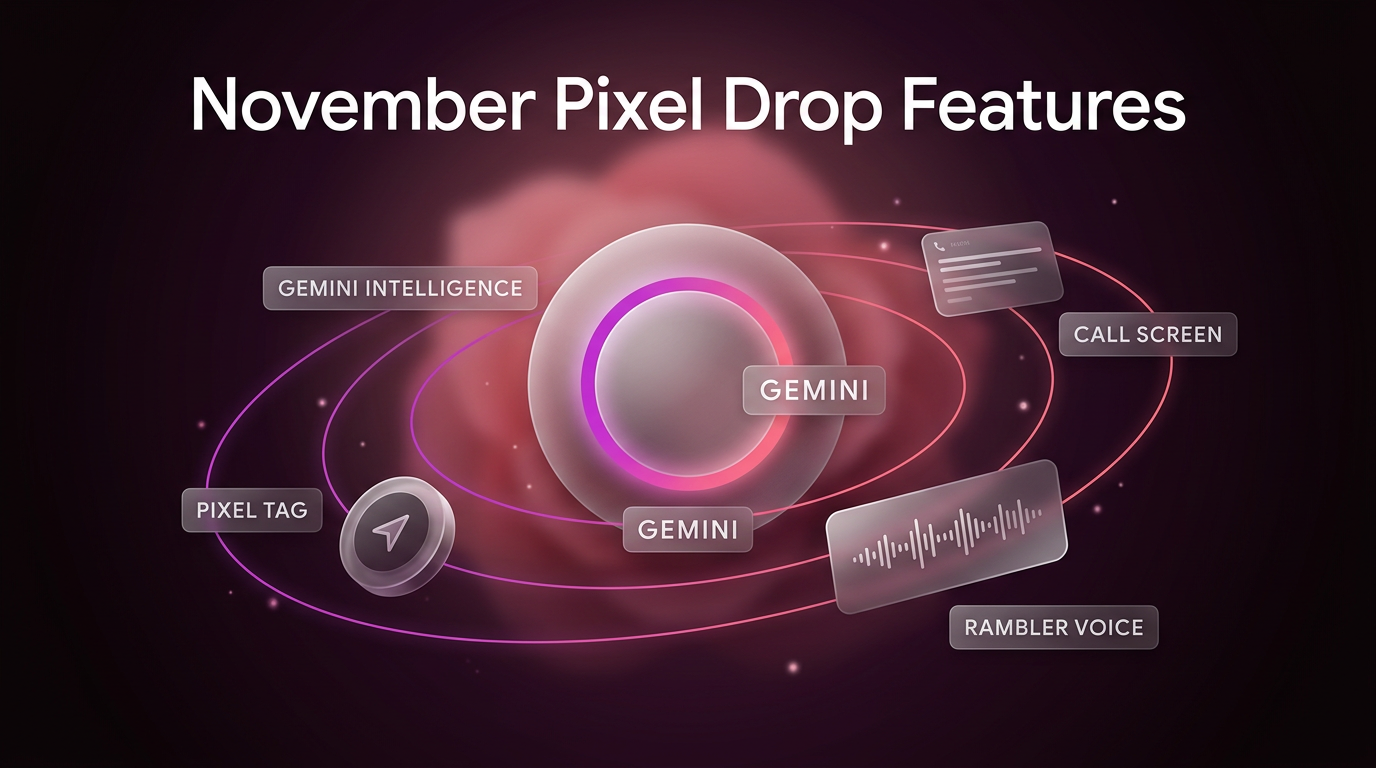
Google released its November Pixel Drop on November 10, 2026, delivering software updates and companion hardware across eligible mobile devices. The rollout began on launch day and continues over several weeks, delivering updates to smartphones, wearables, and connectivity plans. The update focuses on direct device assistance, conversational phone screening, and expanded location tracking.
As announced on the Google blog, the package spans multiple hardware generations. Upgrades reach older models like the Pixel 6, while newer capabilities target the Pixel 10 and Pixel 11 lineups. Users also receive accessories like the newly launched Pixel Tag tracking puck.
Core AI Features in the November Pixel Drop
Gemini Intelligence receives its primary phone integration on Pixel 10 hardware. The updated voice interface introduces Rambler, a dictation tool that refines voice typing in real time. The software automatically removes filler words like “um” and formats spoken thoughts into organized text before you send a message.
Multi-step task completion expands inside the November Pixel Drop for users in Japan, the United Kingdom, and India. Gemini can coordinate routine logistical actions directly through apps, including ordering takeout, scheduling ride bookings, securing dinner reservations, and buying groceries. These actions allow users to hand off sequential mobile chores without moving manually between separate screens.
Proactive suggestions also expand on the home screen and notification areas. Pixels can surface one-tap estimated arrival sharing when a message asks about arrival times, or suggest dining options based on location and schedule. Google confirmed that these proactive prompts will roll out to the Pixel Watch 4 in an upcoming release.
Personalization expands with user-built widgets. Instead of relying solely on pre-set layouts, users can assemble custom widgets for tracking monthly budgets, displaying sports team schedules, or running trip countdowns that automatically parse flight and reservation details. These customizable widgets are planned for release on the Pixel Watch 4 and Pixel Watch 5 as well.
Summaries for extended message threads now support German, French, Spanish, Italian, Hindi, and Traditional Chinese. This allows users to review long group chats quickly without scrolling through hundreds of lines, with smartwatch support scheduled to follow.
Hardware Additions and Tracking in the November Pixel Drop
Alongside mobile operating system updates, Google launched the Pixel Tag tracker puck on November 11. The standalone device costs $29.99 for a single unit or $99.99 for a four-pack. It is designed to fit inside standard wallets or attach to key rings, luggage, and work equipment.
The tracker relies on Google’s Find Hub network, which uses crowdsourced Bluetooth signals from more than one billion active Android devices to locate lost items at long distances. For close-range recovery, built-in Ultra-Wideband (UWB) technology provides directional guidance and distance indicators directly on compatible phone screens. The company states that the internal battery lasts more than one year under normal use.
Network connectivity also received a major update in the November Pixel Drop through Google Fi Wireless. Eligible Pixel models gain access to a dual-network configuration that switches automatically between two major American 5G cellular carriers and millions of verified Wi-Fi hotspots. Google paired this release with a promotional 50 percent discount on select unlimited plans for 12 months, running through December 1, 2026.
Communication and Interface Upgrades
The Pixel 11 series introduces a redesigned Call Screen powered by Gemini. When an incoming call arrives from an unrecognized number, Gemini answers with natural conversational questions to identify who is calling and why. The phone displays a live text transcript in real time, allowing the recipient to evaluate the caller’s intent before deciding to answer or hang up.
Search capabilities now scan deeper across device storage on the Pixel 6 and newer releases. The updated search system indexes emails, calendar entries, device settings, text messages, and photos simultaneously, helping users locate specific media or files from a single query field.
Visual customization and physical alerts received two focused additions in this release cycle:
- Expanded custom icon styles that apply coherent visual themes across every app on the home screen.
- HiLight integration with Google Messages, which illuminates the rear device light when selected favorite contacts text while the phone rests face down.
Smartwatch and Health Capabilities
Cross-device functionality between phones and wearables improves with proximity unlocking. When an authenticated Pixel phone is unlocked nearby, a paired Pixel Watch unlocks automatically on the wrist, removing the requirement to type a PIN code on the small watch display. Google stated this feature will arrive within the next few weeks.
Fitness routines receive structured exercise guidance on the Pixel Watch 3 and newer hardware. Users can follow step-by-step resistance and cardio workouts generated by Google Health Coach or manually compiled in the Google Health application. The watch tracks repetitions, logs selected weights, and displays real-time health metrics throughout each training circuit.
Putting It to Work in Business Operations
For independent professionals and teams, the November Pixel Drop highlights how consumer hardware increasingly incorporates lightweight background execution. The ability to dictate unstructured thoughts and have software strip filler speech reduces the friction of managing communications while away from a desk.
Wasif builds connected systems where voice captures, mobile inputs, and structured databases integrate smoothly. While consumer tools handle initial voice formatting or message screening, production workflows often require connecting those mobile inputs to operational backends. Teams that rely on multi-step actions on phones can integrate those processes with broader AI automation pipelines and Agentic AI Systems & AI Workforce architectures to route customer inquiries and operational data into permanent systems.
Conclusion
The November Pixel Drop reinforces Google’s strategy of combining dedicated hardware trackers with native machine learning tools across its device portfolio. By upgrading voice processing, call screening, and cross-carrier mobile data, the update gives Pixel owners practical tools for managing daily logistics. As these features roll out over the coming weeks, users can take advantage of faster mobile triage without adding third-party utility apps.
If you want to connect automated mobile workflows to your core business systems, explore custom integrations with Wasif at https://wasifahmed.dev/contact/.