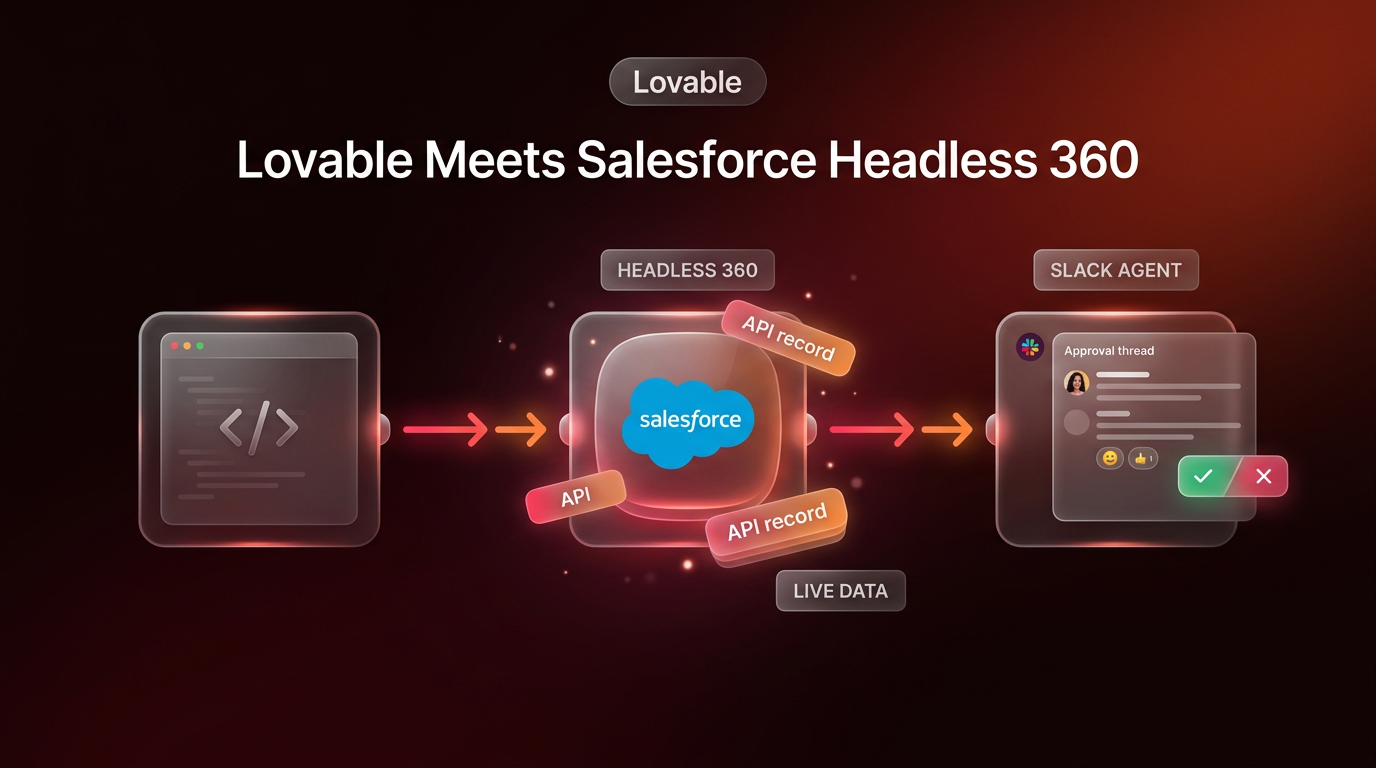
Software creation platform Lovable has officially announced a direct connection with Salesforce, launching four connected features that allow teams to assemble custom enterprise applications and autonomous Slack agents. The new Lovable Salesforce integration lets teams deploy internal interfaces directly on top of active customer relationship records without creating separate databases or custom backend middleware.
As detailed in the Lovable partnership announcement, the connection is available immediately. The release addresses a persistent friction point in enterprise operations: business units wanting specialized screens, such as custom deal desks or pipeline summaries, previously had to rely on lengthy IT backlogs because Salesforce functioned primarily through its proprietary user interface. Salesforce recently opened its infrastructure through Headless 360, which exposes platform capabilities via APIs and Model Context Protocol (MCP) servers while enforcing core identity, permission, and compliance boundaries.
The Four Core Capabilities in the Lovable Salesforce Integration
The Lovable Salesforce integration functions across four specific touchpoints, spanning bidirectional database connectivity, embedded org views, and native Slack environments.
- Bidirectional Headless 360 connectivity: Applications constructed on Lovable can directly read and write standard objects including Accounts, Contacts, Leads, Cases, and Opportunities. Each user authenticates with their individual Salesforce credentials, ensuring that existing role hierarchies and record-sharing rules remain enforced.
- Direct publishing into Salesforce orgs: Builders can choose to publish their interface directly into their Salesforce instance. This produces an in-org page that displays live data per user. Currently, this direct publishing model supports read-only views like executive dashboards and pipeline trackers, while interfaces requiring write-back operations operate through the Lovable connector.
- Slack-native prompt creation: Teams can prompt the platform without leaving Slack by mentioning @Lovable in a channel or direct message. Describing an operational requirement in plain language prompts Lovable to draft the tool, reference the workspace context, and post the functional result directly into the active conversation thread.
- Collaborative Slack Code channels and dedicated agents: Through Slack Code, cross-functional teammates can refine an app together in a shared channel on a single codebase. In addition, teams can design, test, and install standalone agents into Slack as workspace bots after a single administrative authorization.
Why This Lovable Salesforce Integration Matters for Revenue and IT Teams
Before this rollout, operational teams faced rigid trade-offs. Building custom workflows often meant hiring outside consultants or forcing staff into default Salesforce interfaces that did not match daily routines. The Lovable Salesforce integration alters this balance by separating user interface creation from core record retention.
For sales and operations leaders, the practical benefit is speed. When a sales division requires an atypical pricing matrix or a unique approval screen, they can generate that view using natural language prompts. Because the resulting application references live Salesforce data via MCP servers and APIs, representatives work with up-to-date numbers without manual data exports or spreadsheet reconciliation.
For IT and governance departments, the design avoids typical security pitfalls associated with low-code tools. The integration does not create a duplicate database. Every read and write request passes through the native Salesforce authentication layer, maintaining single sign-on (SSO), SCIM provisioning, audit logging, and existing security controls. The generated underlying software remains real code with full version history that in-house developers can inspect and refine.
How the End-to-End Workflow Operates in Practice
To see how the Lovable Salesforce integration functions during normal operations, consider a standard sales quotation cycle. A sales representative changes an Opportunity status to Proposal inside Salesforce. A custom interface built on Lovable detects this stage update instantly using the representative’s native access rights.
The application can combine the Opportunity details with external logic, such as proprietary pricing schedules or consumption benchmarks that live outside Salesforce. The tool calculates the final quote and automatically routes a structured summary into a private Slack deal channel. A finance manager inspects the line items and confirms the approval directly inside Slack using the dedicated agent.
Once approved, the Lovable Salesforce integration returns the confirmed data back to Salesforce. Forecasting modules, pipeline dashboards, and native Salesforce Agentforce agents immediately reflect the updated numbers. Nobody manually transcribes fields between tabs, and no secondary logins are required.
Practical Implications and Operational Outlook
The release marks an ongoing shift toward headless architectures in enterprise systems. By treating Salesforce as an underlying engine accessible through standard protocols rather than just a set of fixed web forms, organizations can experiment with specialized interfaces without risking data integrity.
Companies planning to deploy the Lovable Salesforce integration should note the current operational boundaries. In-org published pages currently support read-only displays, meaning high-frequency write operations must still route through the external Lovable runtime environment. Teams should establish clean permission sets in Salesforce first, as Lovable directly inherits those underlying access configurations.
Putting the Lovable Salesforce Integration into Real Client Builds
In client projects involving AI automation and agentic AI systems, Wasif frequently addresses the gap between enterprise databases and actual team habits. When systems force staff to navigate clunky administrative screens to complete basic updates, adoption stalls and records fall out of date.
Wasif approaches integrations like this by treating the primary CRM as a reliable system of record while using headless connectors to place functional inputs wherever people communicate most. By combining prompt-driven frontends with strict enterprise permissions, businesses can automate complex quote approvals, field service logs, and account summaries without creating technical debt or unmonitored shadow databases.
To discuss implementing reliable automations or custom internal tools for your team, reach out to Wasif directly.