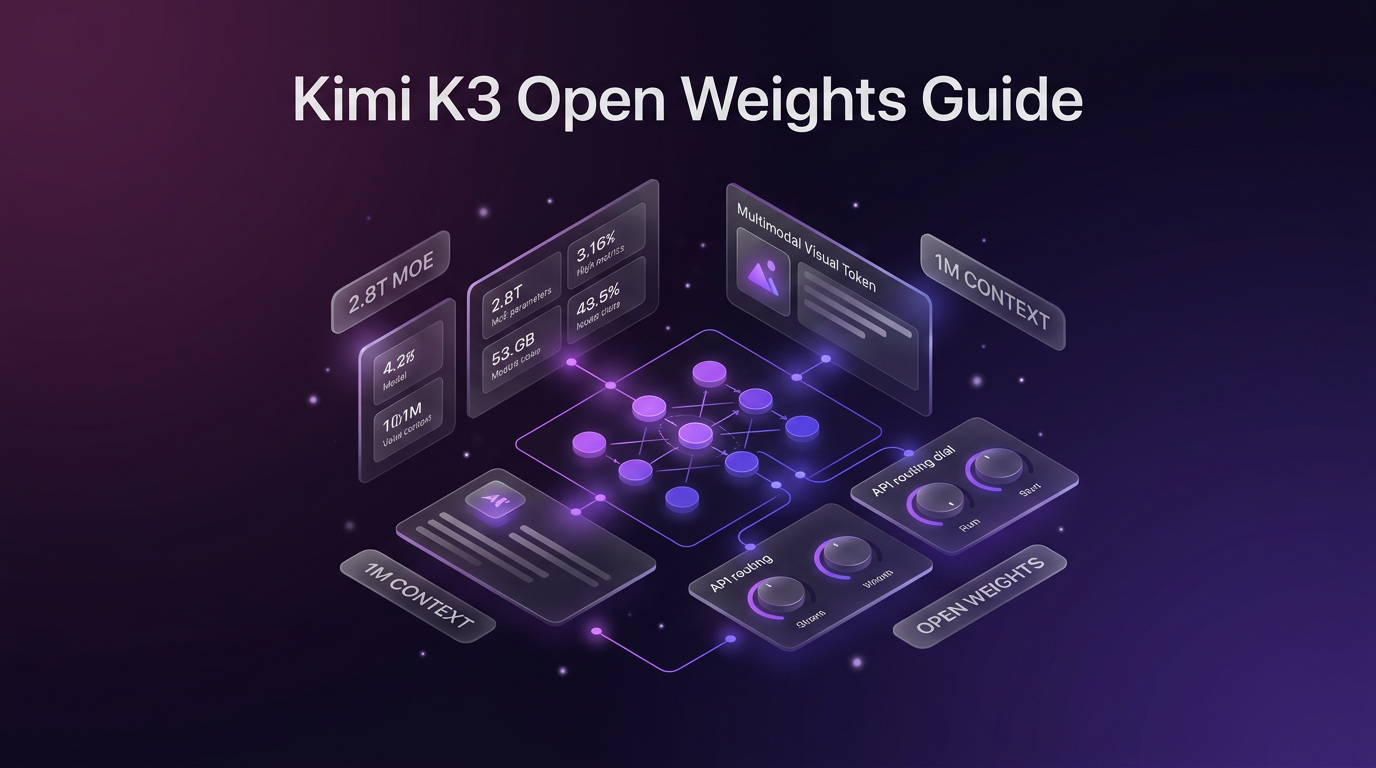
When developers ask whether Moonshot AI released an open-source model, the technical answer is nuanced: Kimi K3 open weights are publicly downloadable, but the underlying distribution is open-weight rather than open-source. The distinction matters directly for production deployments, software licensing, and commercial roadmaps.
Moonshot AI published the model weights on Hugging Face under the custom Kimi K3 License, which does not carry an SPDX identifier and does not appear on the Open Source Initiative approved list. While the weights can be inspected and run, specific operational conditions apply once commercial scale is reached. For teams wanting to use the model without hosting multi-node hardware, the model is also accessible through an API on OpenRouter, as detailed in an analysis published by OpenRouter.
Understanding Kimi K3 Open Weights Versus Open Source
The term open-weight indicates that the model creator has made the trained parameter weights accessible for public download and inspection. However, the legal terms governing those parameters are entirely set by the creator. True open-source software, as defined by the Open Source Initiative, requires compliance with the Open Source Definition through recognized licenses such as Apache-2.0 or MIT. Because the Kimi K3 License uses bespoke legal conditions, Kimi K3 open weights fit the open-weight definition rather than open-source.
By default, the license grants permissions free of charge to run, modify, fine-tune, copy, merge, publish, distribute, sublicense, and sell copies of the software. The baseline requirement demands keeping the copyright notice intact and complying with all applicable regulations. Above certain usage thresholds, however, two important commercial constraints come into play.
Commercial Conditions in the Kimi K3 License
Teams building on Kimi K3 open weights must track two specific scale thresholds outlined in the model license.
- Model as a Service gate: Section 2 defines Model as a Service as providing third parties direct inference or fine-tuning access where they control inputs, parameters, or training data. If an entity operating this model earns over 20 million US dollars in aggregate revenue across any consecutive 12 months, it must sign a separate commercial agreement with Moonshot AI before using the software commercially. This clause explicitly excludes internal tools, relayed third-party requests, and products where model capabilities are embedded behind specific user features.
- User-interface attribution: Section 3 requires any commercial service using the software that exceeds 100 million monthly active users or 20 million US dollars in monthly revenue to prominently display “Kimi K3” directly on the interface.
Section 4 exempts internal usage where capabilities are not exposed to external third parties, as well as access via Moonshot AI’s official services or certified inference partners.
Architecture and Checkpoint Specifications
The technical specifications of the Kimi K3 open weights checkpoint demonstrate why local self-hosting requires significant infrastructure. The model card on Hugging Face lists 2.8 trillion total parameters configured as a mixture-of-experts architecture, activating 104 billion parameters per token across 16 of its 896 total experts.
Key architectural properties include:
- Weight format: Quantization-aware trained in MXFP4 weights with MXFP8 activations.
- Context window: Up to 1,048,576 tokens.
- Attention design: Kimi Delta Attention combined with Attention Residuals.
- Vision encoder: MoonViT-V2 with 401 million parameters, accepting text, image, and video inputs.
- Serving stacks: Documented recipes include vLLM, SGLang, and TokenSpeed.
Because running a 2.8 trillion parameter model requires multi-node hardware clusters, managed API endpoints provide the standard deployment path for most engineering teams.
Calling Kimi K3 Open Weights via OpenRouter
On OpenRouter, the model checkpoint is accessible under the identifier moonshotai/kimi-k3. It features full native multimodal support, accepting text, image, and video inputs while outputting text.
Because OpenRouter aggregates multiple third-party providers, individual endpoints set independent pricing and parameter coverage. Across catalog endpoints, prompt prices have ranged from $1.80 to $6.00 per million tokens, completion prices from $9.01 to $22.50 per million tokens, and cache reads from $0.21 to $0.60 per million tokens. Moonshot AI’s own direct endpoint listed pricing at $3.00 for prompts, $15.00 for completions, and $0.30 for cache reads per million tokens.
Because certain endpoints might omit parameters like tools or structured_outputs, requests relying on specific capabilities should set provider.require_parameters to true. The model card notes that reasoning is always active internally, supporting reasoning effort values of low, high, and max. When running multi-turn conversations or handling tool calls with Kimi K3 open weights, the complete assistant response, including reasoning details and tool call payloads, must be returned in subsequent message turns.
FAQs
Are Kimi K3 open weights completely free for commercial products?
Yes, for the vast majority of commercial products, provided you comply with attribution rules and do not operate an open API generating over 20 million US dollars annually. Teams embedding the model inside an end-user application remain below the Model as a Service restriction.
What modalities does Kimi K3 support natively?
The model natively accepts text, images, and video inputs, producing structured text or reasoning tokens as output across a 1,048,576-token context window.
How does reasoning control work when calling Kimi K3?
Reasoning is enabled by default with three effort tiers: low, high, and max. Developers can exclude the reasoning chain from the returned payload while preserving it inside multi-turn assistant context blocks.
Where This Fits in Real Systems
When Wasif Ahmed designs multi-step business automations, selecting the right model layer depends directly on licensing security, predictable token costs, and long-context multimodal capabilities. Models with expansive context windows and strong structured output capabilities can serve as central processing engines in complex data pipelines, particularly when combined with robust automation platforms like Make.com.
Understanding the operational parameters of Kimi K3 open weights allows businesses to build automated workflows that leverage advanced reasoning without taking on unexpected licensing liabilities or infrastructure overhead.
If you are planning to integrate advanced reasoning models or workflow automation into your operations, reach out to Wasif Ahmed to discuss building reliable, scalable systems tailored to your business goals.