Building a reliable autonomous system requires balancing model reasoning with dependable runtime data. A configurable generalist agent tackles this challenge by packaging orchestration, tool execution, state management, and error correction into a modular harness rather than forcing teams to code custom frameworks from scratch.
When IBM Software Innovations Lab developed CUGA, their open-source configurable generalist agent, they tested how far standard agent patterns could stretch across enterprise workloads. Top placements on benchmarks such as AppWorld (covering 750 tasks across 457 APIs) and WebArena demonstrated the viability of the harness approach. However, enterprise tasks revealed a critical operational bottleneck: accessing clean, current web information without breaking downstream planning loops.
As detailed in a technical case study published on the Tavily blog, moving away from browser automation toward a direct search layer fundamentally alters how autonomous systems evaluate external context. Understanding this architectural shift clarifies how builders can construct resilient agent networks that transition cleanly from developer workstations to strictly regulated infrastructure.
The Fragility of Browser Scraping in Autonomous Agent Loops
Initial implementations of web-connected agents typically rely on programmatic browser automation. Engineers launch headless tools like Playwright, render target pages, inspect the Document Object Model, and strip raw HTML down into text. While this setup functions for static scraping tasks, it introduces severe failure points within an iterative planner-executor architecture.
In a standard pipeline, an agent planner formulates a sub-goal, calls an external retrieval mechanism, reviews the returned data, and decides on subsequent actions. When retrieval relies on DOM extraction, dirty snippets filled with navigational noise, boilerplate code, or truncated scripts enter the reasoning window. The planner must then spend valuable tokens sorting formatting errors from factual answers.
Worse, low-grade input does not produce an isolated error. It cascades through every following decision step. If an unverified snippet fails to answer a sub-goal clearly, the planner may loop indefinitely or generate invalid tool arguments based on layout fragments. Building resilient workflows requires an interface that delivers structured, scored content directly to the reasoning engine without intermediary parsing scripts.
Integrating Structured Search into a Configurable Generalist Agent
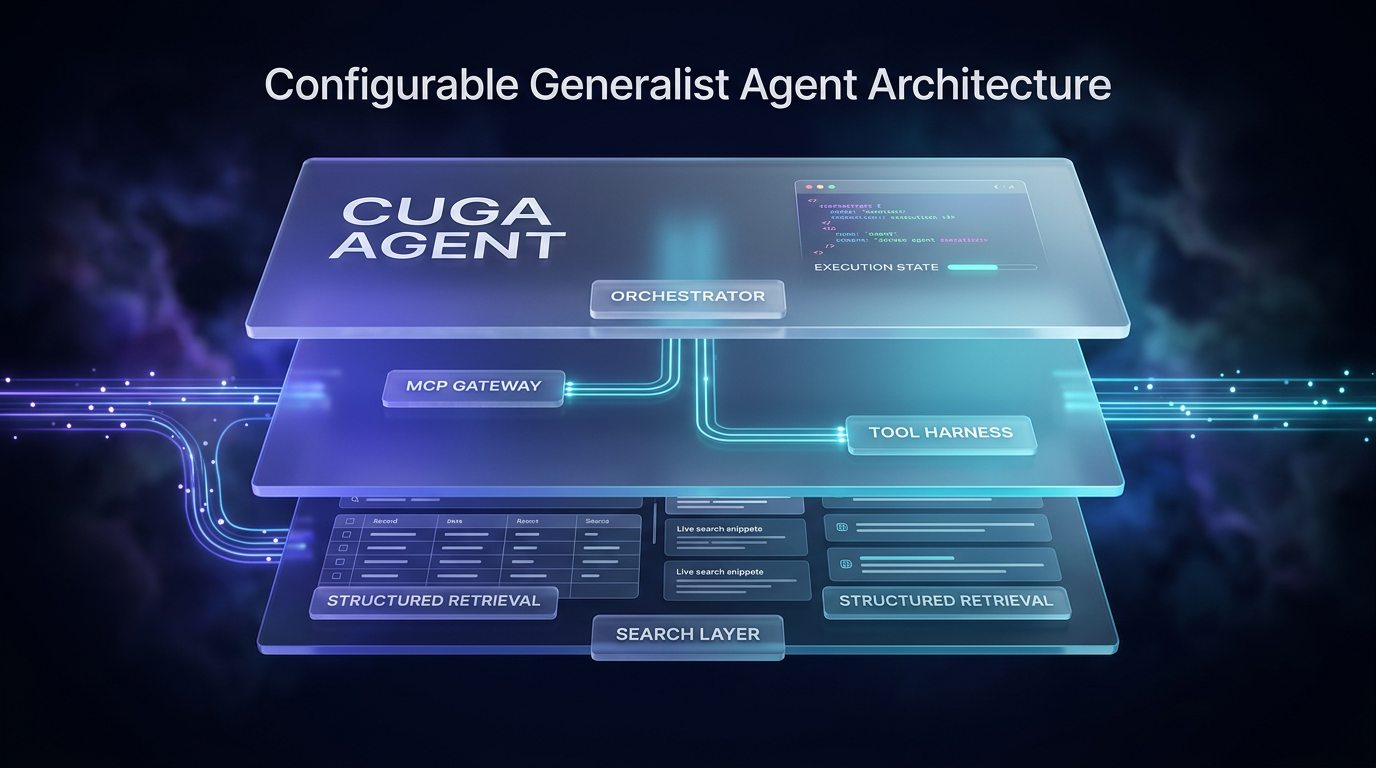
To eliminate fragile DOM extraction, the IBM team integrated Tavily as a dedicated retrieval layer inside their configurable generalist agent. Rather than inventing proprietary data wrappers, the engineering team introduced web retrieval as a standard tool definition within the core agent configuration.
The integration inside the core agent operates through four primary technical phases:
- Adding the dedicated client library to the core project dependencies without introducing complex system packages.
- Activating web search via a configuration flag, keeping external network egress disabled by default for controlled environments.
- Registering the search endpoint as a standard tool within the orchestration schema, exposed to the planner identically to internal REST endpoints.
- Allowing the model planner to inspect structured search results and decide autonomously whether supplementary lookups are required prior to output generation.
Because the search response delivers extracted content alongside explicit relevance metrics, the planner processes web findings through the same evaluation logic it applies to database queries or API payloads. This consistency removes the custom adapter code typically needed to sanitize raw browser outputs.
Centralized Search Backends for Shared Multi-Agent Deployments
Scaling autonomous systems across an organization introduces key management and governance hurdles. In testing their open-source harness, the IBM team constructed an application gallery containing dozens of specialized worker agents. Requiring each deployed app to manage individual search credentials created configuration sprawl and raised credential exposure risks.
The solution involved placing the search tool behind an MCP (Model Context Protocol) server hosted on IBM Code Engine. In this topology, client applications communicate with a single backend service that handles authentication and network dispatch. Developers cloning template repositories or deploying specialized agents never handle API credentials directly.
This architecture is visible in practical implementations like research agents. Rather than relying entirely on frozen parameters within model weights, research agents execute multiple focused queries per prompt, extracting clean text snippets and citing original sources for individual claims. Operating behind an MCP gateway ensures these requests remain auditable across teams while maintaining uniform rate limits and credential isolation.
Why Clean Retrieval Matters for Enterprise Deployments
Deploying a modern AI automation stack inside enterprise infrastructure demands strict compliance boundaries. Agents frequently need to operate within air-gapped environments or sovereign core clouds where data residency rules strictly forbid unrestricted outbound network traffic.
Treating external retrieval as a clean, modular tool rather than an ad-hoc scraping script provides distinct structural advantages for regulated IT environments:
Pre-Filtered Context Windows
Direct search integrations return extracted readable prose rather than full DOM snapshots. Because results include relevance scores, the agent runtime can deterministically truncate lower-ranked snippets when managing tight token budgets. This keeps reasoning loops focused on actionable data without overflowing context limits.
Policy-Driven Egress Control
When external connectivity exists as an optional tool flag rather than hardcoded logic, security teams can toggle open-web access via administrative policy. An organization running a configurable generalist agent in a sovereign cluster can disable the search flag entirely, rerouting requests to internal document stores without altering the core reasoning codebase.
Simplified Dependency Maintenance
Eliminating headless browser binaries removes operating system dependencies that frequently trigger vulnerability flags in container scanning tools. A lightweight API client operating behind an authenticated server interface significantly minimizes the attack surface of containerized autonomous workers.
FAQs
What is a configurable generalist agent?
A configurable generalist agent is an autonomous software harness that integrates reasoning loops, tool calling, and state handling into an out-of-the-box system. Instead of building custom orchestration pipelines, developers configure existing settings and supply domain-specific tools.
Why avoid Playwright or browser scraping in autonomous agents?
Browser scraping produces raw DOM elements and formatting noise that clutter the model context window. In autonomous planner-executor setups, poor input data corrupts downstream planning decisions and leads to looping or hallucinated tool parameters.
How does an MCP server improve agent security?
Hosting search or data tools behind an MCP server centralizes credential management on a secure host. Independent worker agents access external tools via authenticated endpoints without local access to private API keys.
Applying These Patterns to Client Architecture
In client implementations, Wasif Ahmed applies these modular harness principles when architecting automated operational workflows. Rather than coupling business logic to brittle scrapers or monolithic prompts, real-world systems succeed when clear boundaries separate planning engines from external data sources.
Whether connecting internal CRM pipelines, dispatching customer support actions, or retrieving external market intelligence, separating runtime tools into structured interfaces keeps systems stable under varying network conditions. Adopting a reliable configurable generalist agent approach ensures that automated business operations remain auditable, secure, and easy to maintain as enterprise requirements shift.
If you are looking to build dependable autonomous workflows or scale internal agent infrastructure, reach out to Wasif Ahmed to discuss your project requirements.