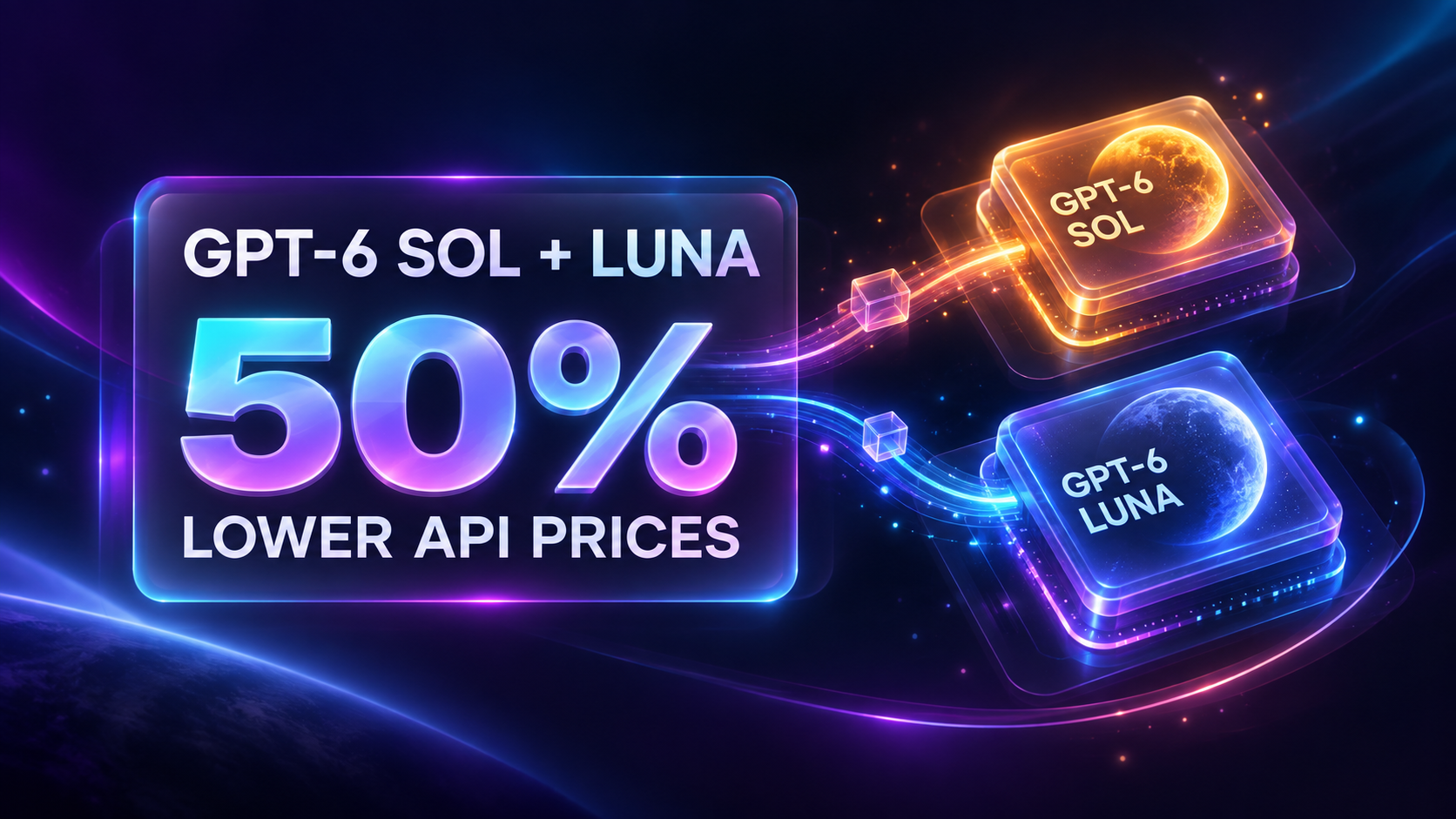
GPT-6 Sol and Luna bring OpenAI’s new price cuts into focus for freelancers and small businesses: can capable models do useful everyday work at a cost that makes iteration realistic? An AI workflow matters when it can be run often enough to become part of the work—not just shown in a demo.
THE SIGNAL
OpenAI says GPT-6 Sol and Luna are 50% cheaper than the promotional API pricing for GPT-5.6—making the cost of useful AI work easier to test, measure, and scale.
What changed in GPT-6 Sol and Luna API pricing?
OpenAI describes GPT-6 Sol and GPT-6 Luna as faster, more affordable additions to its model family, built for professional work at different scales. The company says improvements to caching and inference let it lower API prices by 50% compared with its GPT-5.6 promotional pricing. Its published rates are per one million tokens:
| Model | Input per 1M tokens | Output per 1M tokens |
|---|---|---|
| GPT-6 Sol | $2 | $10 |
| GPT-6 Luna | $0.10 | $0.50 |
OpenAI’s comparison lists GPT-5.6 Sol at $4 input and $20 output, and GPT-5.6 Luna at $0.20 input and $1.20 output. It labels both new models 50% cheaper overall; the precise change varies by token type, so check the current API pricing page before forecasting a production budget. OpenAI also says cached input reads can receive a 90% discount. That matters when an agent reuses stable instructions or context, but the real saving depends on cache hits and how an application is designed.
Why lower API costs matter for freelancers
Freelancers often need to balance delivery time against the cost of tools and experimentation. Lower model rates can make it more practical to test an assistant that organizes research, turns meeting notes into a first-pass brief, drafts variations for client review, or helps inspect and explain code. These are workflow ideas—not guaranteed results—and each still needs human review for accuracy, tone, confidentiality, and client fit.
The useful shift is room to iterate. A freelancer can compare a lightweight model for routine classification with a stronger model for a complex synthesis task, then measure the total cost and quality of the completed job. That is more meaningful than choosing a model from its per-token price alone.
What small and medium businesses can evaluate
For an SME, the opportunity is to start with a repeated, bounded process: triaging support requests, routing leads, preparing a daily operations summary, or finding information in an approved internal knowledge base. A model’s price reduction can lower the cost of pilots and repeated runs, while prompt caching may help when the same long instructions are reused.
But API cost is only one part of the business case. Include tool calls, retries, monitoring, integrations, human review, and the cost of an incorrect action. Put approval gates around payments, account changes, customer commitments, and other consequential steps. Track cost per successfully completed task—not just cost per million tokens—and compare it with time saved and service quality.
How to choose between Sol and Luna
OpenAI positions Sol and Luna as different points on a cost-and-capability range. A sensible evaluation is to send both models a small set of representative tasks, define what “good” means before testing, and record accuracy, latency, token use, tool reliability, and review effort. Use the least expensive model that consistently meets the task’s quality bar; escalate harder cases when the workflow calls for it.
For agentic systems, include the whole loop in the test: instructions, model response, tools, retries, and human checkpoints. If you are exploring this kind of governed workflow, see my Agentic AI systems and SIGNAL OS project. For broader implementation ideas, you can also read my guide to practical AI for small businesses.
GPT-6 Sol and Luna API pricing: frequently asked questions
What are GPT-6 Sol and GPT-6 Luna?
They are two models in OpenAI’s GPT-6 family. OpenAI presents them as more affordable options for professional work at different levels of capability and cost.
How much do GPT-6 Sol and Luna cost?
OpenAI’s announcement lists GPT-6 Sol at $2 per million input tokens and $10 per million output tokens. GPT-6 Luna is listed at $0.10 per million input tokens and $0.50 per million output tokens. Verify the live OpenAI announcement and API pricing before budgeting, because rates can change.
Does a 50% lower API price mean my bill will be cut in half?
Not necessarily. Your bill depends on model choice, input and output volume, cached tokens, reasoning settings, retries, and other services in your application. OpenAI’s headline compares its published GPT-6 rates with GPT-5.6 promotional pricing; calculate with your own workload.
Can freelancers or SMEs build useful AI agents with these models?
They can evaluate them for well-defined tasks such as research support, document preparation, lead triage, or internal information retrieval. Start with a narrow pilot, measure quality and full workflow cost, protect sensitive data, and keep human review where mistakes matter.
Is GPT-6 Luna always the best choice because it costs less?
No. A lower unit price is valuable only if the model meets the task’s accuracy and reliability requirements. Test representative examples and compare the cost of a successful, reviewed result—not just the cheapest response.
Make the economics measurable
GPT-6 Sol and Luna’s headline price reductions could make it easier for independent builders and smaller teams to explore useful automation. The durable advantage will come from pairing the right model with a focused workflow, transparent measurement, and sensible human oversight. Start small, record the real cost per completed task, and expand only when the evidence supports it.
Source: OpenAI: Introducing GPT-6 Sol and Luna.