Understanding how practical companies adopt AI for small business operations reveals a clear shift away from abstract experimentation toward measurable daily tasks. Rather than building speculative products, independent operators focus on immediate administrative burdens, internal reporting, and document parsing that take up manual hours.
A field report published by Anthropic examined findings from its Claude SMB Tour across ten regional cities. Through hands-on workshops with more than 1,000 small business owners, the program gathered practical insights on where non-technical teams find value, where they encounter friction, and how they protect sensitive company data.
Where AI for Small Business Applies Today
The vast majority of participants represented companies with 5 to 50 employees, heavily concentrated in physical and service industries like manufacturing, commercial cleaning, painting, and logistics. For these businesses, the primary motivation was reducing operational drag rather than writing custom software code.
Common implementations focused on operational workflows rather than outward-facing sales copy:
- Converting complex blueprint PDFs into structured floor-by-floor estimates for contractor bidding.
- Identifying unlabeled machinery components on industrial shop floors using visual image queries.
- Reconciling financial records and inventory sheets across newly acquired facility locations.
- Automating internal weekly summaries by consolidating data from multiple management systems.
- Replacing paper production schedules with automated status updates.
Roughly two-thirds of workflow requests involved operational management, while one-third targeted business growth. These implementations demonstrate that AI automation delivers the fastest return when pointed directly at repetitive back-office coordination.
Managing Verification and Output Accuracy
While interest in AI for small business automation remains high, business owners consistently express caution regarding accuracy. Operational mistakes in payroll, tax documentation, or client bids carry direct financial penalties, making unchecked automation impractical for core workflows.
Successful operators approach new language models much like onboarding entry-level team members. Instead of granting unsupervised autonomy immediately, owners verify intermediate steps, inspect mathematical calculations, and prompt systems to explicitly distinguish between verified data and assumptions.
For example, contractor teams use verification prompts requesting the system to show step-by-step calculations before accepting a finished bid. In transportation compliance, teams that carefully designed structured document flows reduced filing error rates to zero while doubling their handling capacity without adding headcount.
Data Privacy, Tool Connectors, and Governance
Data security remains the primary barrier preventing AI for small business connectors from linking internal systems. According to Anthropic, 81 percent of surveyed small business decision-makers expressed interest in new AI tools, but concerns about data governance and employee training often stalled deployment.
Business owners frequently ask whether proprietary accounting records, customer lists, or internal correspondence will be used for model training. Platforms operating dedicated business tiers, such as Claude Team and Enterprise plans, do not train on customer conversation data by default, and connector permissions mirror existing user access levels.
The most resilient implementations keep human review built into every critical milestone. Engineering firms require junior staff to review machine-generated summaries, marketing agencies keep manual approvals on outbound communication, and bookkeeping firms sanitize personally identifiable information before running analysis.
Building Practical Workflows with Structured Systems
Moving from basic conversational chat to reliable back-office systems requires structured connections. Tools like Claude Cowork plugins integrate with software such as QuickBooks, HubSpot, PayPal, DocuSign, and Canva, allowing models to interact with existing business databases.
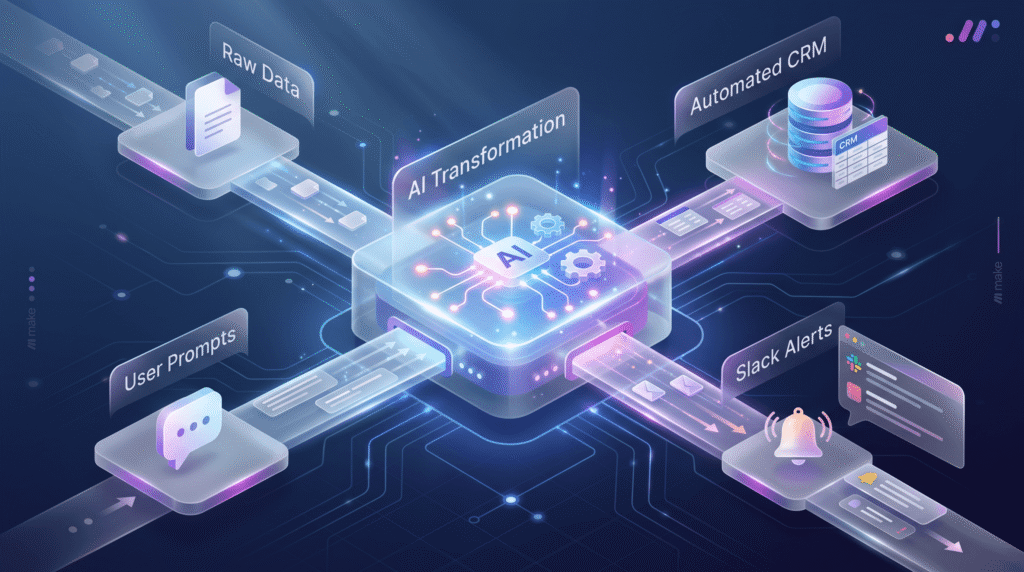
For businesses scaling their operations, deploying agentic AI systems provides a repeatable framework. Instead of asking staff to prompt an assistant manually each day, pre-built triggers handle data extraction, document classification, and task assignment automatically across existing software stacks.
FAQs
What is the most common use case of AI for small business?
Internal reporting and back-office administrative tasks are the most frequent applications. Companies regularly use AI models to summarize multi-system data, process PDF documents, and organize scheduling records.
How do small businesses prevent AI inaccuracies in financial tasks?
Operators implement human-in-the-loop workflows where outputs are checked before execution. Prompting systems to show their work and maintaining strict review checkpoints ensures calculations and assumptions are verified.
Can small business tools connect to AI securely?
Yes, business-tier accounts and dedicated API connectors preserve existing permission levels and typically do not use customer data to train general models. Organizations also sanitize sensitive client data prior to processing.
Connecting Systems for Real Business Operations
Wasif designs and implements structured automation architectures that connect CRM systems, databases, and language models without risking operational stability. By establishing clear human verification steps and reliable data pipelines, businesses can eliminate back-office bottlenecks while keeping full control over critical operations.
To discuss building dependable automated workflows for your business, contact Wasif through the contact page.