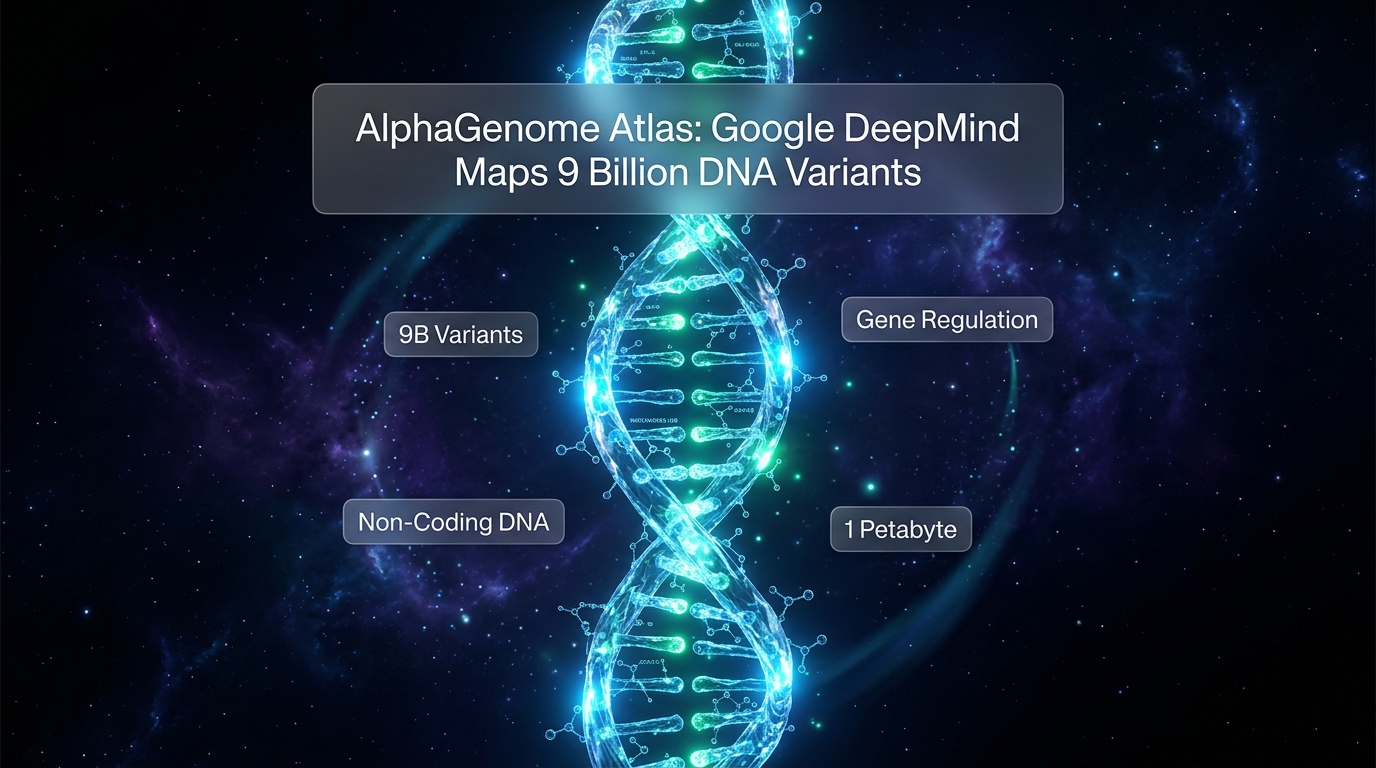
Google DeepMind has introduced AlphaGenome Atlas, a new genomic database that maps the predicted biological effects of all 9 billion single-letter genetic variations across the human genome. Built on the company’s AlphaGenome AI model, the database compiles pre-calculated predictions for both coding and non-coding DNA regions into a single resource for researchers.
The human genome contains roughly 3 billion base pairs of DNA. While the 2 percent of the genome that codes for proteins is relatively well documented, researchers have historically had limited tools to evaluate the remaining 98 percent of non-coding sequence data. The new database addresses this gap by cataloguing predicted regulatory disruptions across the entire genome.
Key Features of the AlphaGenome Atlas Database
To construct the database, Google DeepMind ran the AlphaGenome model across every single nucleotide variant possible in human DNA. The computation generated a 1-petabyte dataset detailing predicted alterations in gene regulation, transcription, and protein synthesis.
Navigating petabyte-scale data can present technical barriers for research teams. To simplify querying, the release includes several practical features:
- AlphaGenome Variant Impact (AVI) score: A single metric combining predictions across both coding and non-coding sequence regions to help researchers rank variant importance.
- Complete genome coverage: Pre-calculated predictions across all 9 billion potential single nucleotide changes, avoiding the need for researchers to run individual model computations.
- Web-based user portal: A browser interface that allows researchers and biologists to inspect variants directly without requiring custom code or local machine learning infrastructure.
- Non-coding regulatory mapping: Predictions on how variations outside protein-coding sequences alter splice sites and transcription rates.
Early Research Findings and Use Cases
Initial deployments of the database have shown practical utility in both rare disease analysis and population-scale genetics. Early access teams used the dataset to resolve specific biological questions where existing databases lacked sufficient non-coding data.
At the Broad Institute, a team led by Laura Covill applied the AVI score to investigate unsolved rare disease cases. The score flagged a specific mutation in the DNM1 gene, predicting that the variant created an abnormal splice site. This prediction supplied the primary evidence needed to resolve the case.
In population genetics, Dr. Gareth Hawkes analyzed records from more than 54,000 UK Biobank participants. By grouping individual variations according to their predicted molecular impacts in AlphaGenome Atlas, the analysis identified 22 percent more non-coding associations than traditional statistical scans. Concentrating on the top 1 percent of high-impact variants revealed 19 distinct genetic regions associated with body mass index.
Practical Implications for Research Teams
Evaluating non-coding DNA has historically required complex laboratory assays or bespoke computational pipelines. The release of a pre-calculated dataset shifts the workflow from running predictive compute to querying indexed results.
Because the database provides a unified AVI score through a web interface, clinical researchers can test hypotheses regarding genetic variations without configuring GPU clusters or writing bespoke analysis scripts. The dataset provides direct support for teams examining rare variants that do not appear frequently enough in population studies to achieve standard statistical significance.
Data Accessibility in Modern Workflows
Making complex biological predictions accessible via web portals mirrors broader shifts in computational infrastructure. When technical teams build AI automation and data pipelines, removing manual data processing steps allows domain specialists to focus directly on analysis rather than pipeline maintenance.
The availability of structured AI outputs also creates opportunities for downstream integration into larger research pipelines, similar to how modern Agentic AI Systems & AI Workforce tools query structured databases to execute analytical tasks autonomously. Google DeepMind has stated that the web portal is available immediately for scientific and clinical researchers worldwide.
Why the AlphaGenome Atlas Matters for Researchers
For labs without in-house machine learning infrastructure, the AlphaGenome Atlas removes a major barrier to entry. Instead of training custom models to interpret a single variant, researchers can now query the AlphaGenome Atlas directly and get a pre-computed prediction in seconds. This shift from bespoke modeling to a shared, queryable resource is likely to accelerate how quickly rare-disease and population-genetics teams move from a candidate variant to a testable hypothesis.
If you want to integrate advanced data systems or build custom automation workflows for your organization, reach out to discuss your project.