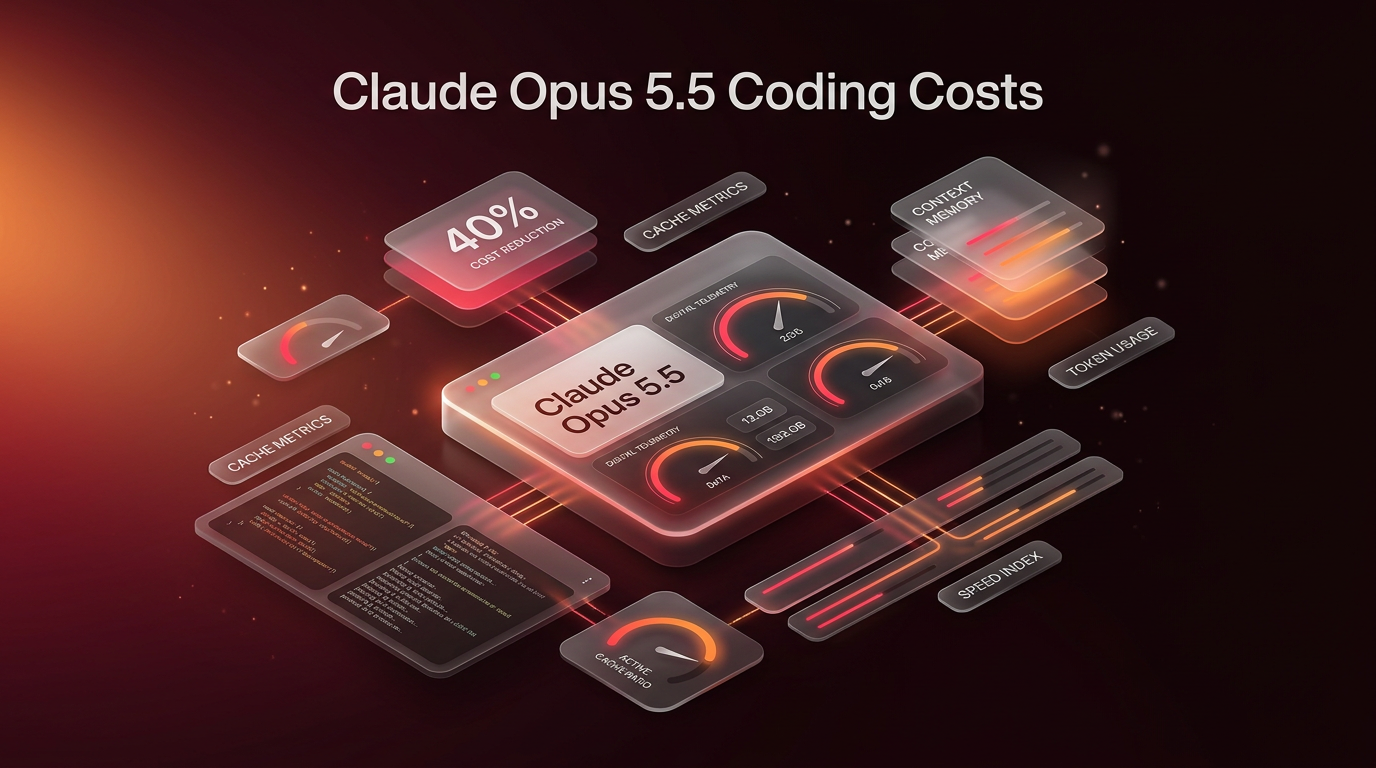
Claude Opus 5.5 has been released by Anthropic with targeted pricing adjustments and model refinements designed for context-heavy programming workloads. As announced on the Claude blog, the company estimates that Claude Opus 5.5 costs about 40 percent less to run than Opus 5 for typical workloads billed by token. The update focuses directly on how developers manage memory, long context windows, and multi-step autonomous tasks.
Over the six months leading up to September 2026, developer habits within Claude Code shifted substantially. Aggregate data published alongside the release reveals that average context per request expanded by 2.6 times, shifting the input-to-output token ratio from 189:1 up to 324:1. With automated agents handling broader scopes and longer codebases, repetitive context reading now accounts for the primary share of total operating expenses.
Key Pricing Changes in Claude Opus 5.5
The economic changes in Claude Opus 5.5 rest on structural adjustments across base token costs and cached token retrieval. For developers paying standard token rates, standard input and output prices dropped by 20 percent. More notably, the price to read a cached token dropped by 60 percent, lowering the financial penalty of maintaining large repositories in memory.
Anthropic stated that on the date of release, reading a cached token on Claude Opus 5.5 costs one-fifth of the price charged by competing models for comparable capabilities. Because context per request continues to multiply across complex tasks, these discounts compound as conversations progress. When systems repeatedly review documentation, dependencies, and test logs, high cache hit rates keep ongoing expenses predictable.
Speed represents the other major operational shift. The company reported that Claude Opus 5.5 outputs text more than 30 percent faster than Opus 5. While faster throughput does not directly alter token consumption, it substantially reduces latency during unattended runs where terminal sessions execute successive terminal operations.
Developer Workflow Shifts and Cache Resilience
Anthropic paired the model release with data examining developer patterns inside Claude Code between March and September 2026. The findings illustrate why managing context efficiency has overtaken basic prompt engineering in modern development stacks:
- Claude runs 3.3 times longer per prompt while generating over 40 percent more model calls per prompt without intervention.
- Developers experience 68 percent fewer interruptions during extended task execution.
- Engineers are twice as likely to connect tool servers or specialized skills, and one-third less likely to paste raw text blocks directly into prompts.
- Cache misses declined by more than 50 percent due to structural improvements in the Claude Code execution harness.
Cache stability has historically been vulnerable to minor interaction disruptions. The updated harness minimizes accidental invalidations caused by refreshing logins, inserting instructions midway through tasks, or mounting tools dynamically. For both Claude Opus 5.5 and Fable 5.1, engineers can adjust reasoning effort levels mid-session without wiping out cached states.
Infrastructure controls have also expanded for remote teams. Developers accessing Claude Opus 5.5 through cloud providers or direct API keys can now enable a one-hour cache duration, matching a capability previously reserved for direct subscribers. Additionally, when a primary agent spins off subagents to investigate parallel modules, each delegated worker inherits the parent cache rather than incurring duplicate billing for the shared project tree.
Task Efficiency and Turn Reductions with Claude Opus 5.5
Beyond pricing drops, model reasoning quality directly affects compute volume. In benchmark observations shared by Zeta Labs, Claude Opus 5.5 completed tasks with fewer turns and fewer tool invocations than Opus 5. Zeta Labs noted completing twice as many difficult objectives while cutting operational expenses nearly in half.
However, performance gains vary depending on the scope of work. As noted in developer documentation by Addy, tightly scoped code updates show similar turn counts across both model versions. In those straightforward scenarios, the 20 percent token discount and 60 percent cache read discount provide the only savings. The primary advantage of Claude Opus 5.5 appears during open-ended problem solving, where older models often wasted steps pursuing flawed architectures or misinterpreting library boundaries.
Reducing unnecessary conversational turns provides larger cost benefits than discounted cache queries. When an agent identifies a bug correctly on turn three instead of turn eight, it prevents hundreds of thousands of accumulated context tokens from cycling through the model harness.
Practical Steps to Manage Context Costs
To take full advantage of the Claude Opus 5.5 architecture, engineering teams must maintain disciplined context hygiene. Organizations have moved away from scaling automated pipelines blindly, prioritizing structured context budgets instead.
A practical first step is executing the /usage command inside Claude Code. This utility breaks down cumulative tokens into fresh inputs, generated outputs, and cached reads, exposing whether a project environment is wasting compute on repeated cold loads.
Teams should also establish model stability before running deep scripts. Selecting Claude Opus 5.5 at the beginning of a build session prevents unnecessary context resets caused by switching models halfway through an investigation. Similarly, running context compaction commands right before stepping away from the terminal ensures that stale error traces are cleared while relevant architectural outlines remain primed in memory.
For teams integrating long-horizon workflows into production through agentic AI systems or custom pipeline orchestrators, configuring the one-hour cache retention setting prevents periodic background queries from reloading extensive library documentation from scratch.
What This Changes for Client Builds
Wasif builds custom workflows and automations that often balance complex context across diverse tools. When implementing autonomous programming routines and enterprise logic via AI automation, unexpected token spikes often occur when workers inspect broad file hierarchies repeatedly.
The structural changes introduced with Claude Opus 5.5 make continuous testing and code maintenance substantially more sustainable for client deployments. Because forked subagents can reference parent memory caches without double billing, multi-stage debugging pipelines can verify database migrations, unit suites, and API routes simultaneously without causing exponential cost inflation.
By treating context caching as an architectural priority rather than an afterthought, development teams can build longer-running, more capable systems while keeping token bills under control. Claude Opus 5.5 establishes a pricing pattern that rewards stable system design over piecemeal prompt drafting.
If you are planning to deploy reliable agentic pipelines or scale automated business workflows, explore options to connect with Wasif Ahmed through the contact page.