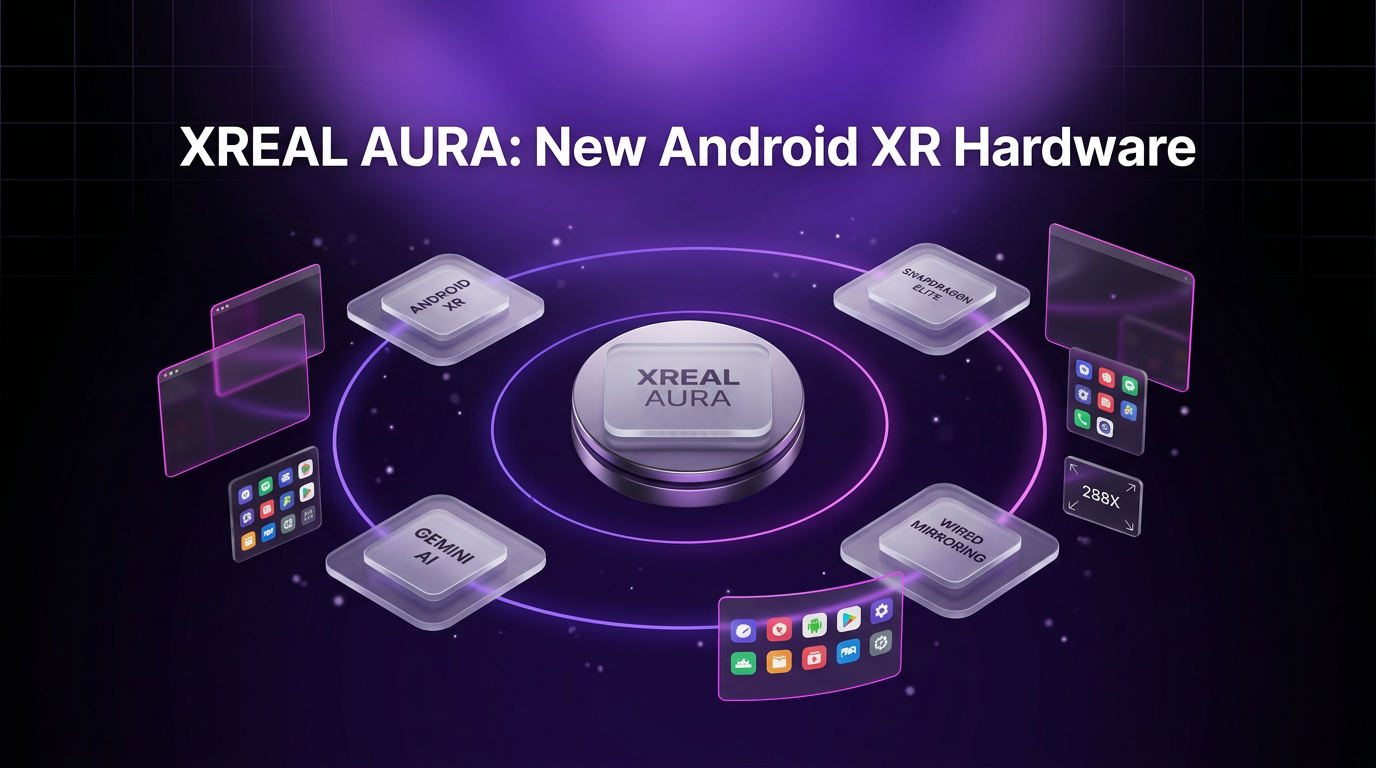
The new XREAL AURA glasses have arrived as the initial wired hardware built specifically for the Android XR operating system. Announced by Google and XREAL, the system combines transparent spatial lenses with a dedicated external processing puck designed to run productivity tools, streaming media, and Android apps on a virtual screen.
Hardware manufacturers have spent years balancing wearable comfort against processing power. Placing heavy processors, heat sinks, and batteries inside a headset often produces neck strain during extended work blocks. The XREAL AURA glasses separate the optics from the processor, placing the computing module in a pocket-sized unit connected by a single cable. This article covers the announced technical specifications, the integration of Google Gemini, practical workstation features, and launch availability details for builders and business operators.
What Are the Core Hardware Specs of the XREAL AURA Glasses?
The primary advantage of the physical design is its weight distribution. The headset unit weighs under 95 grams, which is significantly lighter than standalone mixed-reality headsets that carry their computing modules and batteries directly on the wearer’s face. High-performance spatial computing requires substantial cooling and battery cells, so shifting those components off the head helps enable longer daily use without physical fatigue.
Processing takes place within a companion compute puck that houses the battery and Qualcomm Technologies’ Snapdragon Reality Elite platform, which makes its commercial debut in this device. The puck connects to the headset via a single cable and also functions as an input device, doubling as a physical trackpad when navigating spatial interfaces without extra peripherals.
Visual display specifications announced for the headset include:
- A 70-degree field of view that accommodates multiple active application windows simultaneously.
- Transparent optical lenses that allow direct sight of physical surroundings without relying exclusively on video passthrough cameras.
- Electrochromic lens dimming that darkens the glass for theater-style media viewing and clears immediately when people approach.
- Support for high-resolution 3D stereoscopic spatial rendering across videos, still photos, and games.
- Window follow mode, keeping chosen active windows centered in front of the wearer or tucked into a compact edge view during transit.
How Android XR and Gemini Function Together
Operating system integration determines whether spatial hardware remains a novelty or becomes a functional daily workspace. The XREAL AURA glasses run Android XR, giving wearers native access to Google Play app libraries alongside more than 150 titles tailored directly for spatial environments. Wearers can run standard mobile or tablet Android utilities alongside dedicated immersive tools.
Google has embedded Gemini directly into the system software. Unlike traditional voice assistants that only answer audio prompts, Gemini on Android XR monitors spatial input from both the physical environment and the active virtual screens. Wearers can consult Gemini about documents in their digital workspace, ask for window management assistance, or request contextual information about physical surroundings. The assistant can highlight specific physical objects in the room or pinpoint data points on active virtual monitors to direct the wearer’s focus.
This assistant capability also extends into interactive media and gaming. When users run Android titles or stream games from external hardware, Gemini can provide contextual advice and walkthrough guidance verbally without forcing the player to set down their controller or exit the game session.
Workstation Capabilities and Wired Mirroring
For independent professionals and teams, spatial hardware must deliver tangible utility as a mobile office. The XREAL AURA glasses support multi-window layouts that let wearers arrange browser windows, text editors, and communication channels freely across their visual field. Users can pair standard Bluetooth keyboards and mice or navigate using the puck trackpad.
A notable feature for mobile professionals is Wired Mirroring. By connecting a laptop via a standard USB-C cable that supports display output, the laptop screen projects into the spatial environment as an adjustable window. The company reports that Wired Mirroring requires zero additional software installation on the host computer. Users can reposition their mirrored operating system next to independent Android XR applications.
Because the projected screens remain visible solely through the wearer’s transparent lenses, the configuration provides visual privacy in shared spaces such as cafes, co-working lounges, and airplanes. Teams managing confidential records or client pipelines in platforms like Go High Level can open sensitive dashboards in transit without exposing screens to bystanders.
Media Streaming and Spatial Entertainment
Beyond office workflows, the hardware serves as a private personal display for streaming video and gaming. The XREAL AURA glasses feature native compatibility with streaming services like YouTube and Google TV, with support for 180-degree, 360-degree, and stereoscopic 3D video formats. Wearers can manually darken the transparent lenses to create an isolated personal cinema viewing experience.
Launch content announced alongside the device includes spatial productions such as the San Francisco Ballet’s Nutcracker, Atlantic Studios’ Galapagos: The Last Eden (narrated by Margot Robbie), and Nevatars (co-directed by Andy Serkis and Josh Nelson Youssef). In addition, Google Photos is scheduled to receive a dedicated spatial gallery update later this year, letting wearers organize image archives by date and expand individual memories into 3D environments.
Gaming support spans standard Android titles, connected PC or console streaming, and XR games built by studios such as Owlchemy Labs and Resolution Games with direct hand interaction. Upcoming releases scheduled for the platform include Fallout Factions and Project Hail Mary: Journey Among the Stars.
Pricing, Enterprise Distribution, and Release Dates
Orders for the XREAL AURA glasses opened on October 28 for users aged 18 and older across the United States, Canada, and Korea, with orders opening in Japan on November 2. Google announced launch pricing starting at USD 1,099, valid through the end of the calendar year. Hardware shipments are scheduled to begin in mid-November through xreal.com and BestBuy.com.
For enterprise deployments, Google directed corporate buyers to the Android Enterprise platform to evaluate fleet management and security provisioning. The integration of standard Android enterprise controls suggests Google aims to position these glasses alongside traditional mobile hardware for remote field service, logistics, and executive travel.
Where This Fits in Real Client Builds
As wearable hardware gains direct access to multimodal models like Gemini, the surface area for automated workflows expands rapidly. Wasif Ahmed tracks these hardware shifts because client efficiency frequently depends on how quickly team members can ingest, verify, and route business information into core systems.
In practical workflows involving AI automation and CRM pipelines, multimodal assistants capable of reading screens and physical documents in real time reduce manual data entry. Whether field operators are verifying equipment or managers are reviewing automated summaries while away from their desks, wearable Android XR interfaces create a natural bridge between physical actions and cloud-hosted business logic.
FAQs
How heavy are the XREAL AURA glasses during daily use?
The headset portion weighs under 95 grams because the battery and Snapdragon Reality Elite processor reside inside a separate tethered compute puck. This keeps the glasses lightweight and comfortable for longer work sessions compared to all-in-one headsets.
Can I connect my existing laptop to the XREAL AURA glasses?
Yes, the hardware includes Wired Mirroring via a USB-C video connection. Your computer screen appears as a scalable, private virtual window alongside your Android XR apps without requiring extra driver installations.
What are the release dates and launch pricing for the XREAL AURA glasses?
Orders opened on October 28 in the United States, Canada, and Korea, followed by Japan on November 2. Launch pricing starts at USD 1,099 through the end of the year, with initial hardware shipments beginning in mid-November.
Conclusion
The arrival of the XREAL AURA glasses represents an important milestone in practical spatial computing. By pairing lightweight 95-gram optics with an external Snapdragon compute puck and native Android XR software, Google and XREAL have built a focused device tailored for mobile multi-screen productivity, confidential screen viewing, and hands-free Gemini assistance. If you are exploring how to modernize your operations or connect intelligent assistants into your daily operations, contact Wasif Ahmed to discuss building scalable automation systems for your business.