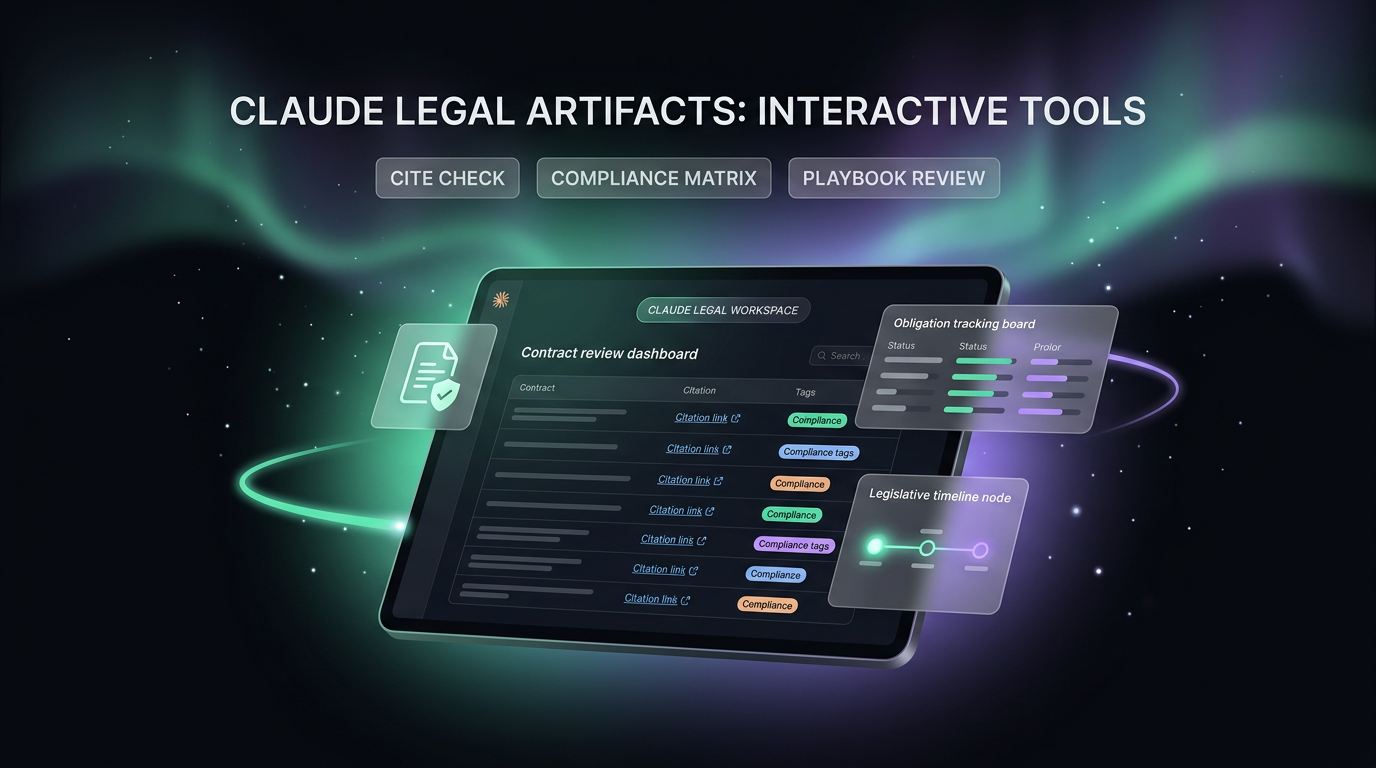
Anthropic has introduced pre-built legal workspaces designed to help attorneys, corporate counsel, and compliance teams collaborate directly on legal tasks. These new Claude legal artifacts provide interactive trackers, tabular reviews, and intake dashboards that teams can adapt to their internal operations and share with business stakeholders.
Since the rollout of Claude for Legal in May, corporate teams have requested simpler configurations and more straightforward ways to share working documents across departments. In response, this gallery release pairs pre-configured functional interfaces with external legal data connectors, allowing legal professionals to inspect contract obligations, track statutory deadlines, and verify source citations without manual data handling.
What Are Claude Legal Artifacts?
Claude legal artifacts operate as interactive modules inside the Claude interface. Rather than generating static text answers in a conversational thread, Claude creates living workspaces such as comparative matrices, status boards, and verification tables. Each artifact opens with a populated example so team members can examine how data points organize before importing their proprietary files or connecting outside repositories.
Every output produced within these tools links directly back to its original reference text. This ensures that when attorneys audit summaries or clause extracts, they can immediately inspect the underlying contract language or statutory code. Legal practitioners provide their files, Claude handles the initial data extraction or comparison, and lawyers apply their judgment to approve or edit the findings.
The Core Tools in the New Legal Gallery
The initial release includes several pre-built tools designed around the recurring tasks legal departments manage daily:
- Cite Check: Scans legal briefs and filings against source documents, flagging misattributed quotations, inaccurate page citations, and referenced authorities that fail to support specific propositions.
- Playbook Deviation Board: Evaluates incoming third-party contracts against internal negotiating guidelines, highlights non-standard clauses, and routes specific deviations to designated subject matter approvers.
- Regulatory Horizon Scan: Plots pending legislation and regulatory rules on a visual schedule mapped to where the enterprise operates, sorting changes by projected impact and linking each item to official legislative records.
- Jurisdiction Survey Matrix: Organizes multi-jurisdiction surveys, such as varying state data breach notification rules, into a single comparative grid with direct links to relevant statutory codes.
- Tabular Review: Parses large volumes of agreements into structured tables covering selected parameters, such as change-of-control clauses or non-solicitation provisions.
- Matter Board: Converts intake emails, engagement letters, and spreadsheets into a clear pipeline showing the matter lead, next required deliverable, and upcoming deadlines.
These Claude legal artifacts allow teams to complete extensive document passes in minutes while maintaining strict data lineage back to primary sources.
Third-Party Connectors and Ecosystem Collaborations
To reduce manual file uploads, Anthropic has integrated more than 60 specialized connectors into the platform. These connectors bridge Claude with existing legal software stacks, including Filevine, Bloomberg Law, Ivo, Legora, and Patlytics. Through these integrations, an artifact can query an internal repository or external legal research base automatically.
Alongside internal templates, Anthropic collaborated with legal tech companies and established law firms to build specialized artifacts for the directory. For example, law firm Goodwin created an AI Governance Benchmark artifact that allows organizations to evaluate internal AI policies against compliance benchmarks. Law firm Foley & Lardner introduced an Obligations Checker to review agreements for mutual duties both before and after closing.
Technology vendor Harvey contributed an intake module where business units submit requests inside Claude, allowing standard queries to receive immediate answers based on approved guidance while routing higher-risk questions to attorneys. In the compliance sector, PwC built a Subpoena Response Tool that converts standard objection precedents into audit-ready drafts.
Collaboration Controls and Public Interest Initiatives
Enterprise adoption of artificial intelligence in legal operations requires strict confidentiality controls. Anthropic designed these workspaces to support selective internal and external sharing. In-house counsel can collaborate with corporate finance teams, outside legal partners, or technical teams while applying role-based controls and maintaining ethical walls to protect privileged communications.
In addition to enterprise features, Anthropic announced funding for public interest organizations and academic programs. Initiatives include supporting groups like The Access Project, which uses Claude to assist self-represented individuals with record-clearance eligibility and local court filings. Anthropic is also introducing a Legal Ambassadors Program to foster peer-led learning among legal professionals exploring workflow automation.
Practical Considerations for Legal and Operational Workflows
Deploying Claude legal artifacts changes how business units request assistance from legal counsel. When business units submit questions through connected intake artifacts, routine inquiries receive uniform guidance without creating email backlogs. This structured intake lets attorneys focus on complex risk management.
For teams evaluating contract automation, these interactive workspaces complement broader operational systems. When paired with tools built on AI automation and custom CRM data pipelines, structured data from contract reviews can update client databases, track renewal dates, or feed billing schedules automatically.
FAQs
How do Claude legal artifacts protect client confidentiality?
Claude legal artifacts operate within enterprise privacy controls that enforce ethical walls and granular sharing permissions. Legal departments can share specific interactive views with business units or external counsel without exposing broader matters or confidential client repositories.
Do Claude legal artifacts replace legal review?
No, these artifacts perform the preliminary extraction, comparison, and cross-referencing steps. Every output includes direct citations to source text, ensuring that a qualified lawyer inspects the evidence and applies professional judgment before any filing, negotiation, or advice is finalized.
Can organizations build custom Claude legal artifacts?
Yes, legal teams can prompt Claude to tailor any gallery workspace to their specific operational playbooks. Furthermore, organizations can integrate internal data repositories using more than 60 supported legal connectors to automate document ingestion.
What This Changes for Client Builds
In client implementations, Wasif focuses on connecting analytical engines to operational business tools. The introduction of Claude legal artifacts bridges a long-standing gap between unstructured legal documents and structured operational pipelines. Rather than treating contract analysis as an isolated activity, teams can now extract verified obligations, compliance triggers, and key milestones directly into wider administrative databases.
When Wasif integrates systems using Make.com or agentic AI systems, structured data generated by these legal artifacts can trigger automated notifications, update customer accounts in Go High Level, or feed governance calendars. This creates a reliable bridge between legal compliance and day-to-day business actions.
Conclusion
The arrival of Claude legal artifacts marks an important step toward structured, verifiable AI workflows for corporate counsel and law firms. By grounding every observation in verified citations and providing pre-built dashboards for intake, compliance, and contract audits, these tools allow legal teams to operate with greater speed while keeping human oversight central. To assess how automated workflows can assist your legal and operational systems, explore practical implementation options and discuss your workflow architecture by reaching out through the contact page.