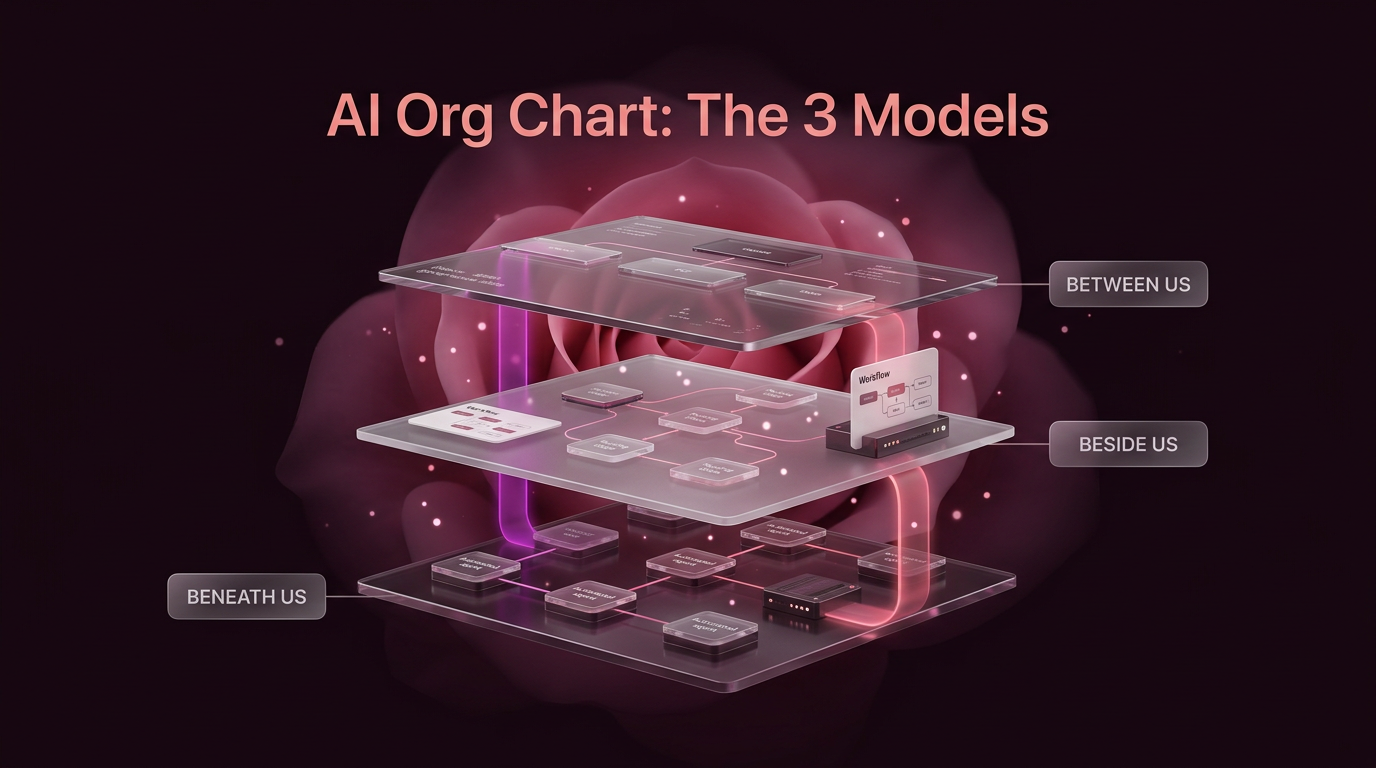
When artificial intelligence enters a company, the traditional corporate hierarchy begins to shift. An analysis published by OpenAI essayists Hemanth Asirvatham and Elliott Mokski in The future of the firm examines how the modern AI org chart will take shape. Rather than executing sudden company-wide layoffs, businesses are watching autonomous agents enter the workplace in three specific structural positions: beneath existing workers, beside them as functional peers, or between human layers to coordinate complex operations.
For operations leaders and business owners, understanding how these structural shifts happen is critical. Work does not transform overnight into pure automation. Instead, chimeric firms emerge, mixing human oversight with automated systems to handle increasing volumes of work without expanding headcounts at traditional rates.
How the AI Org Chart Evolves from the Bottom Up
Most corporate technology rollouts run top-down, planned by executives and handed down to department managers. The current adoption of intelligent agents inverted that flow. Ground-level workers and individual contributors are actively building an internal AI org chart from the bottom up by delegating repetitive tasks to software agents.
Asirvatham and Mokski point out that early career workers now find themselves managing digital deputies immediately upon entering an organization. Frontline staff understand the daily friction points, manual spreadsheet work, and operational bottlenecks far better than distant executives. Because of this proximity, team members on the ground are best positioned to instruct task-specific models on how to draft memos, reconcile data, or answer incoming customer inquiries.
This reality produces automation without immediate pink slips. When software performs ninety percent of an employee’s original tasks, the worker does not simply lose their role. Instead, the remit of that role expands tenfold. The human contributor steps into a supervisory position, spending their time defining objectives, reviewing system outputs, and directing automated pipelines.
Three Scenarios for an AI Org Chart Structure
To understand where software agents settle inside modern businesses, the authors present three distinct structural configurations. Each model creates different management responsibilities and requires unique infrastructure.
1. Beneath Us: The Promoted Contributor
In this initial scenario, the human reporting hierarchy looks entirely unchanged from the outside. The operational difference lies in the newly created basement beneath every desk. Each employee acts as a director of their own small squad of automated tools and digital assistants.
An entry-level accountant, for instance, stops manually entering invoice data and instead oversees automated parsers and reconciliation routines. The junior worker evaluates exceptions, audits irregular entries, and reports findings to their direct manager. Management responsibility moves down the ladder to the lowest rung, turning entry-level contributors into coordinators of digital staff.
2. Beside Us: Autonomous Functional Colleagues
As models gain end-to-end capabilities, they begin sitting beside human employees on the AI org chart. Rather than serving as personal assistants to one person, these autonomous workflows report directly to department directors or team leaders.
In this structure, a digital system might own a full business sub-function, such as initial client qualification, document generation, or routine inventory reporting. Human team members treat the system as a specialized peer. They feed it project inputs, receive structured deliverables, and collaborate across common communication channels like Slack or project management boards.
3. Between Us: Algorithmic Management Layers
The least intuitive pattern places automation directly between human executives and human frontline workers. Here, software acts as an operational coordination layer. The executive sets strategic objectives, guidelines, and quality standards inside a centralized system.
The platform evaluates project status, routes tickets to human specialists based on availability, verifies work quality against predetermined rules, and provides performance tracking. While this model optimizes resource allocation, it requires careful governance to preserve personal agency and avoid excessive procedural rigidity across teams.
Structural Changes Inside Emerging Autonomous Firms
The redesign of the corporate structure introduces several practical questions that company founders must evaluate carefully:
- Firm capacity and size: Rather than reducing headcount to cut operational costs, productive businesses are using autonomous systems to multiply output while keeping team sizes stable.
- The disappearing entry-level rung: When repetitive manual tasks are automated, traditional apprenticeship paths disappear. Businesses must design new ways to teach domain expertise when junior employees no longer perform mechanical groundwork.
- Operational overhead: Automated systems require clean data and reliable integration pipelines. Without disciplined system architecture, introducing agents can increase operational friction instead of reducing it.
- Compensation shifts: As individual contributors handle larger scopes of responsibility, performance value shifts from task execution speed to system governance, prompt design, and output verification.
Building a successful AI org chart means acknowledging that software tools are only as effective as the underlying systems connecting them. Companies that succeed do not simply buy standalone generative licenses; they architect predictable operational pipelines that let software agents execute tasks reliably.
FAQs
How does an AI org chart differ from a traditional hierarchy?
A traditional hierarchy organizes reporting lines exclusively between humans across fixed departmental tiers. An AI org chart incorporates autonomous workflows and digital agents directly into the structure, positioning them as task assistants underneath contributors, as independent functional units beside teams, or as coordination layers between management tiers.
Does integrating AI agents lead to immediate layoffs?
The reference analysis notes that early adoption often expands worker remit rather than eliminating roles. When automation absorbs routine grunt work, human staff shift toward quality control, strategic coordination, and larger project scopes that previous bandwidth limitations prevented teams from tackling.
Why does agent adoption start on the frontline instead of the C-suite?
Frontline staff manage the specific operational details and manual workflows that current software models can easily resolve. Because executives often lack visibility into daily granular tasks, ground-level employees are usually the first to identify practical use cases for automated deputies.
What This Changes for Client Builds
In practical implementation work, Wasif sees these organizational shifts taking shape across growing service firms and independent agencies. Businesses rarely need sweeping structural overhauls on day one. Instead, the fastest route to high efficiency is building dependable AI automation pipelines that remove routine friction from everyday client management and data entry.
When engineering agentic AI systems, Wasif focuses on structuring clear boundaries for each automated workflow. Rather than treating an agent as an uncontrolled experiment, successful setups treat software modules like junior specialists with defined inputs, verified checkpoints, and clear exception handling. This approach ensures business owners retain oversight while expanding their team’s execution capacity without runaway payroll overhead.
Conclusion
The evolution of the modern AI org chart demonstrates that workplace automation is an organizational design challenge, not just a technical upgrade. Whether your company adopts autonomous systems beneath individual staff members, beside specialized departments, or between coordination layers, the goal remains the same: scaling operational output while giving human teams higher-leverage work.
If you are ready to structure reliable automated systems and agentic workflows for your business operations, reach out to Wasif Ahmed to discuss your project.