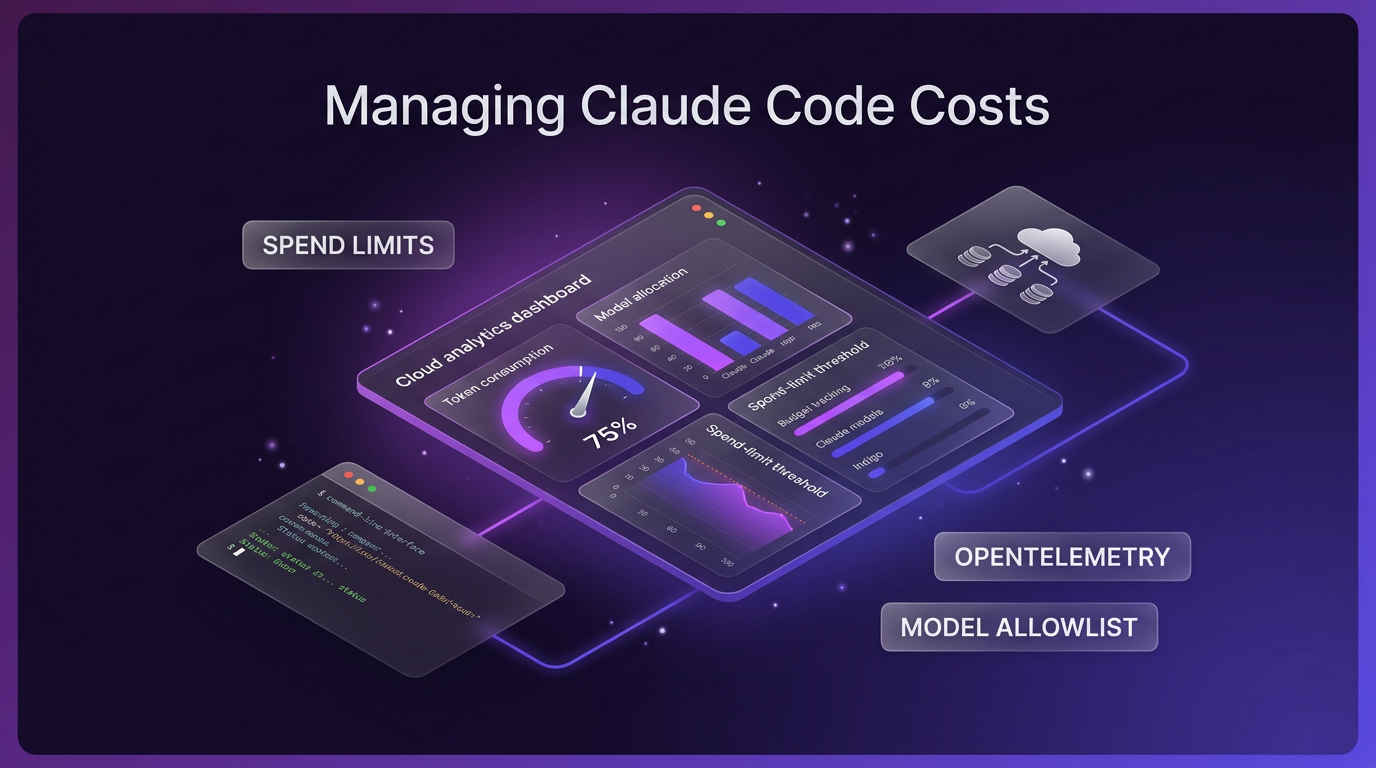
Managing Claude Code costs on Google Cloud requires a clear balance between enabling developer velocity and preventing unexpected token usage. Because Claude Code acts as an agentic assistant that inspects files, runs command-line tools, and iterates over multistep coding issues, it naturally consumes more tokens than conversational question-and-answer prompts. To address this spend pattern, Anthropic and Google Cloud presented a structured governance model built around three key levers: control, track, and prove.
As detailed in an article announced on the Anthropic resources hub, organizations can combine Google Cloud native capabilities with the self-hosted Claude apps gateway. By setting up identity-backed guardrails and telemetry feeds, engineering leads gain granular oversight before monthly invoices finalize. Here is how teams establish that control structure.
Understanding Why Agentic Coding Changes Spend
Standard chat interfaces evaluate prompt tokens and output tokens in straightforward, single-turn interactions. In contrast, Claude Code runs multiple sequential actions across repositories to resolve coding problems. Managing Claude Code costs therefore relies on understanding that higher token consumption correlates directly with task complexity and the specific Claude model selected for the job.
Waste rarely comes from top-tier power users solving intricate architectural problems. Instead, unwanted expenses usually gather across routine daily actions where an overpowered model is applied to simple maintenance, or where forgotten background schedules continue executing. Effectively managing Claude Code costs means guiding developers toward the right models without shutting down their momentum.
Lever 1: Establish Control Through Identity Guardrails
The control lever establishes active parameters for developer usage rather than arbitrary company-wide cutoffs. The Claude apps gateway ships directly inside the standard Claude command-line binary and runs within a dedicated Google Cloud project. Because team members authenticate via an identity provider (such as Google Workspace), every token call links directly to an authenticated profile.
- Spend caps per developer: Administrators can set custom spend limits per user, identity provider group, or entire organization across daily, weekly, or monthly periods.
- Early threshold warnings: Claude Code displays in-CLI warnings directly to developers when their usage crosses 75 percent and 95 percent of their allotted limit.
- Automatic gateway limits: When an individual hits their 100 percent threshold, the gateway returns HTTP 429 status codes until the window resets or a manager elevates their cap via the gateway Admin API.
- Model allowlists and defaults: Platform teams can lock specific models to specific groups. Setting an efficient model default handles the vast majority of developer prompts while reserving top models for heavy engineering tasks.
Lever 2: Track Claude Usage with OpenTelemetry
Setting limits is only the first layer; managing Claude Code costs also demands real-time observability into operational behavior. Google Cloud provides per-project billing breakdowns, Cloud Billing budget notifications, service-level spend caps in preview, and BigQuery billing exports for deep cost analysis.
To see detailed operational metrics before billing summaries process, teams can leverage Claude Code OpenTelemetry exports. The binary exports telemetry records to any OpenTelemetry Protocol (OTLP) receiver, such as Google Cloud Monitoring, Grafana, or an internal collector. This pipeline records active sessions, duration, pull requests, commits, and token usage, further categorized by custom skills, plugins, and Model Context Protocol (MCP) servers.
By passing the OTEL_RESOURCE_ATTRIBUTES environment variable (such as department=engineering,cost_center=dev-42), every metric inherits verifiable cost-center tags. Platform managers can monitor active developers, session volumes, and gateway-blocked requests directly on Google Cloud Monitoring dashboards without configuring telemetry manually on each remote laptop.
Lever 3: Prove Value and Tie Spend to Outputs
The final lever centers on business return. Managing Claude Code costs effectively means assessing cost per task rather than looking exclusively at aggregate raw token costs. A task that costs several dollars in token usage can still deliver substantial net savings if it safely automates complex pull requests or routine bug sweeps that previously occupied several engineering hours.
By pairing BigQuery billing exports with pull-request metrics collected via OpenTelemetry, organizations map operational expenditures to real engineering deliverables. This data demonstrates where automation creates measurable workflow leverage across specific departments.
Where This Fits in Real Projects
When engineering teams scale custom integrations, cost predictability is as vital as the automation itself. Wasif builds scalable systems across AI automation and custom software development, where setting strict API gateway boundaries, rate limits, and clear observability pipelines prevents runaway cloud usage while delivering practical productivity gains.
FAQs
How does Claude Code consume more tokens than typical chat models?
Claude Code functions as an autonomous tool runner rather than a single-response chat window. Because it must inspect directory structures, read source files, run terminal commands, and reason across consecutive execution steps, managing Claude Code costs requires budgeting for multi-turn task loops.
What happens when a developer hits their Claude apps gateway spend limit?
When an authenticated developer reaches their defined spend ceiling, the gateway serves an HTTP 429 status code that halts further requests for that period. Usage warnings alert developers directly in the CLI at 75 percent and 95 percent usage, allowing teams to request increases through an Admin API ticketing integration.
Can organizations route Claude Code telemetry into existing dashboards?
Yes. Claude Code natively outputs metrics using OpenTelemetry Protocol standards. Teams can route these feeds straight into Google Cloud Monitoring or third-party monitoring platforms to visualize token burn, model distribution, and active developer count in real time.
Conclusion
Effectively managing Claude Code costs comes down to implementing the right guardrails before scaling developer adoption across your team. By setting automated spend limits, configuring model defaults, and feeding OpenTelemetry data directly into Google Cloud Monitoring, organizations capture full engineering value while keeping token budgets entirely under control.
If you need assistance designing robust AI architectures, backend systems, or cloud guardrails, reach out directly at Wasif Ahmed’s contact page to discuss your upcoming project.