Lovable has officially announced the launch of the Lovable Partner Program, a structured framework designed to help independent builders and established agencies deliver custom software to clients. The Lovable Partner Program creates a formal path for software creators to monetize their skills while giving businesses a vetted directory of service providers who build applications using Lovable.
The announcement addresses a distinct shift in how software gets built. While early discussions around AI tools focused heavily on job displacement, practical demand has shifted toward professionals who know how to turn AI development platforms into working software for organizations. Lovable notes that over 800,000 people and agencies already use its platform for client deliverables, ranging from simple sites to enterprise operational tools.
The Structure of the Lovable Partner Program
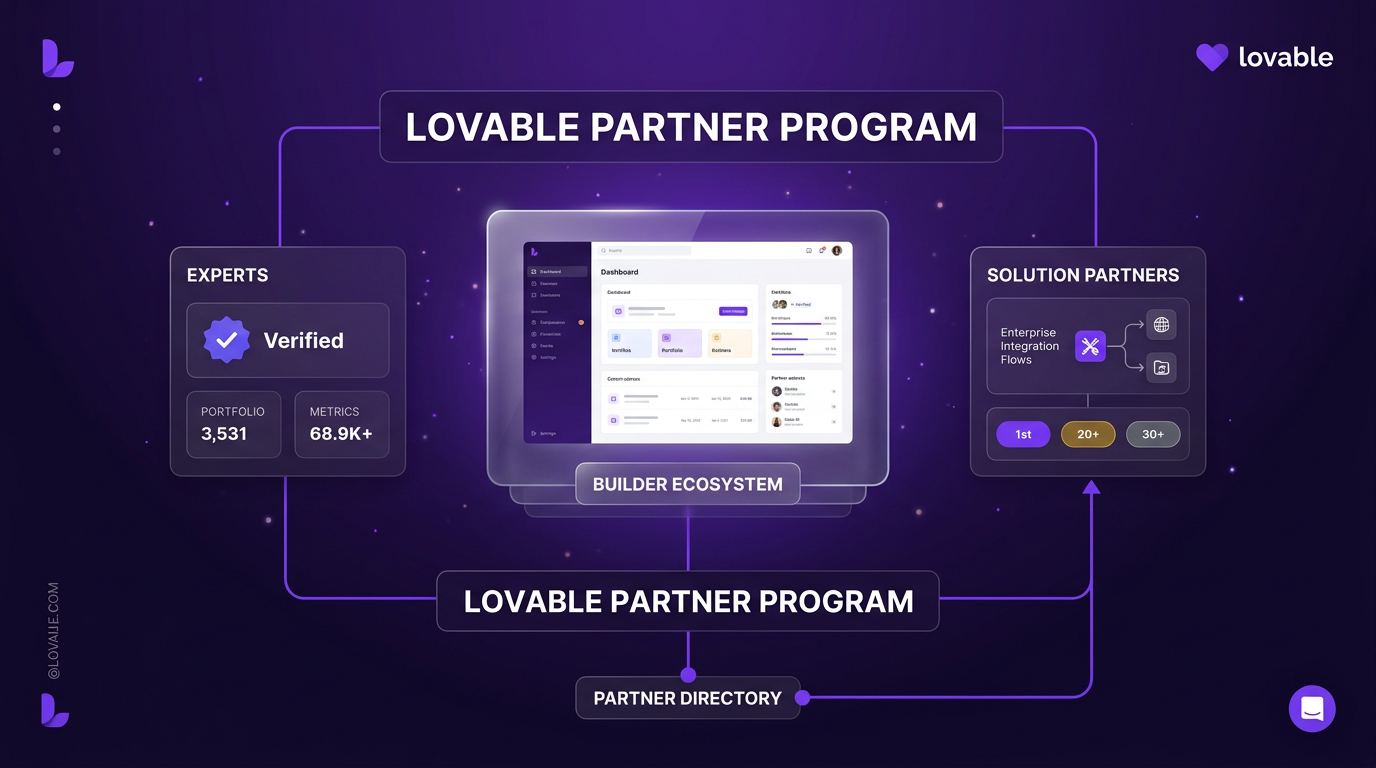
The program separates service providers into two distinct tracks based on their scale and the complexity of projects they handle. Both tiers provide certification and access to a centralized directory where prospective clients can discover verified partners.
- Expert Track: Tailored for freelancers and boutique agencies building websites, internal tools, client portals, and automations. Certification requires shipped project work rather than theoretical tests. Experts holding an active Pro plan gain listing eligibility in the partner directory and earn a 10% referral commission on referred Business tier accounts.
- Solution Partner Track: Designed for larger consultancies and systems integrators handling complex business transformations. Partners can earn up to 20% commission on referred enterprise contracts across three partnership tiers, alongside a 10% commission on Business subscriptions. This tier includes dedicated support from a Partner Development Manager, co-selling opportunities, and direct access to Lovable support channels.
- Partner Directory: A searchable public directory allowing businesses to filter providers by project type, such as intake workflows, custom booking tools, or SaaS prototypes, and evaluate past verified builds before hiring.
Why the Client Builder Economy Is Expanding
According to data cited by Lovable from McKinsey’s 2026 State of AI report, roughly nine in ten businesses currently use AI in some capacity, but fewer than half have deployed it across their entire organization, and only about a third report measurable bottom-line improvements. This gap has generated demand for external specialists who can implement custom systems quickly.
Lovable surveyed builders on its platform to understand who is delivering this work. The findings indicate that 25% of respondents who build for clients earn most or all of their income through Lovable projects, with half reporting meaningful secondary income. Notably, over a third of respondents had no prior software development background before using the platform, yet they achieve client revenue rates comparable to traditional agency freelancers.
Delivery speeds also alter project economics for small businesses. Lovable reports that 81% of surveyed builders operate outside the United States across 139 countries, with local businesses forming their largest client segment. Many of these clients previously lacked the budget or timeline required for traditional custom software development.
Early Agency Results Across the Ecosystem
Before the Lovable Partner Program’s public launch, more than 500 organizations, including enterprise consultancies like KPMG and Deutsche Telekom, signed agreements and initiated certification. Several case studies illustrate how agencies of different sizes use the platform for revenue:
At digital consultancy O3 World, a 50-person team built an internal resource-planning tool using Lovable that saved the agency an estimated $35,000 annually. The team subsequently transitioned to client builds, reporting 50% to 70% faster turnaround times on client experiences and a 30% to 50% reduction in design and development effort for specific deliverables.
Agency Imaginary Space grew from a solo design operation into an 18-person firm generating $1.2 million in annual recurring revenue across more than 300 projects. Similarly, UK-based agency J&T Promotions expanded from building entry-level websites to delivering operational platforms, custom CRMs, and analytics dashboards for over 450 clients.
Other agencies focus on specialized deployments. CoBuild Agency uses the platform to launch digital products for high-profile creators, while Fireline IT develops specialized incident response and disaster management systems for medical and emergency personnel.
Practical Implications for Businesses and Agencies
For agencies and independent creators offering web designing or full-stack software delivery, the program provides clear monetization channels through software commissions alongside standard service fees. It also establishes portfolio credibility through verified directory listings tied to real production code.
For hiring organizations, the directory mitigates the risk of hiring untested freelancers. Clients retain complete ownership of all shipped code, allowing them to continue retainers with their original partner, transition maintenance to in-house developers, or take over management independently.
How This Fits into Modern System Builds
In practice, AI generation platforms represent one layer of a complete business system. While platforms like Lovable generate front-end interfaces, portals, and SaaS dashboards rapidly, sustainable client systems typically require structured back-end integrations, database syncing, and event-driven workflows. Wasif Ahmed implements complete operational stacks by pairing custom front-ends with robust AI automation through Make.com and dedicated CRM architectures in Go High Level to ensure new applications communicate reliably with existing business operations.
The Lovable Partner Program reflects this same demand for structured delivery, connecting verified builders with businesses that need dependable, production-ready software outcomes.
If you want to build custom business software, client portals, or integrated automation workflows for your team, explore how to get started at Wasif Ahmed’s contact page.