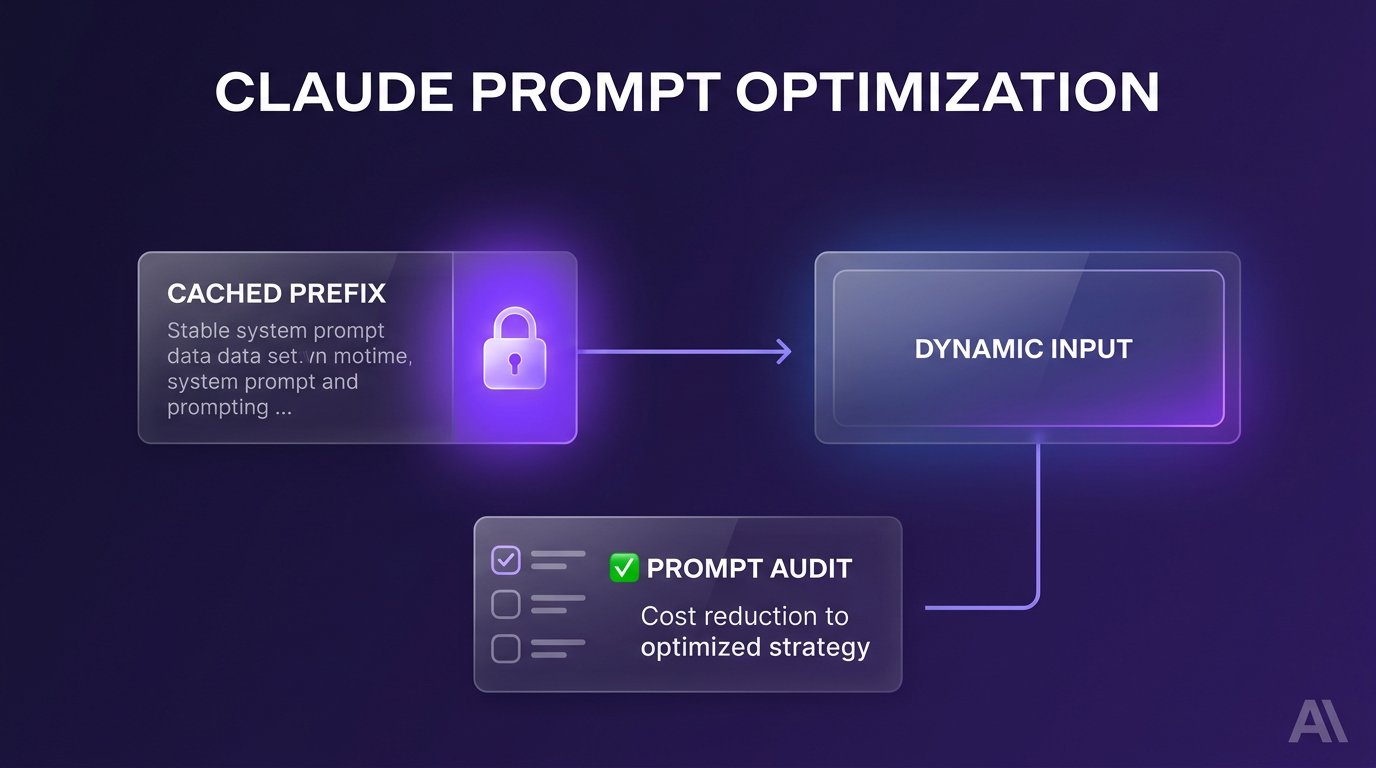
Claude prompt optimization is central to running production AI workflows that balance output quality with token expenses. In an engineering guide published on the Anthropic blog, the company shared techniques for Claude prompt optimization that reduce inference costs while improving reliability. Developers can achieve these gains through three primary levers: maximizing prompt cache hit rates, pruning legacy prompt anti-patterns, and calibrating effort settings to specific tasks.
How Prompt Caching Cuts Input Costs
When Claude handles an incoming request, it converts the prompt into an internal working state during the prefill phase. This prefill computation represents the bulk of input processing expense. Prompt caching stores this key-value (KV) cache state so subsequent requests sharing an identical prefix can read the processed state directly instead of recomputing it from scratch.
Cached reads are billed at a substantial discount compared to full input pricing. However, prompt caching requires byte-exact matches across the prompt prefix and remains pinned to a specific model. Cache entries also operate under a default time-to-live (TTL) of 5 minutes, though 1-hour TTL configurations can be specified for longer tasks.
Strategies to Protect the Prompt Cache
Small variations in API payloads can inadvertently break cache prefixes and force expensive cache writes. Applying disciplined payload construction keeps the prompt cache warm across automated workflows.
- Keep dynamic data out of the system prefix: Timestamps, dynamic session IDs, or changing user metadata placed inside the system prompt force cache misses. Append volatile parameters as conversational user messages at the end instead.
- Maintain static tool ordering: When using the Claude Messages API, tool definitions are assembled at the top of the prompt. Dynamic reordering or altering tool schemas between calls invalidates the entire cached block.
- Defer rarely used tool definitions: Developers can declare tools upfront but mark seldom-used functions with defer_loading. Claude references them via tool search only when needed, preventing tool lists from bloating the cached prefix.
- Pre-warm the cache before execution: Sending an initial request with max_tokens set to 0 and an explicit cache breakpoint creates the cache entry without generating completion tokens. This ensures live requests hit an active cache immediately.
- Watch subagent execution times: If a subagent or tool call blocks execution for more than 5 minutes, the parent process cache expires. Rewriting an expired cache incurs a 1.25x penalty on standard input pricing, or 2x for 1-hour caches.
Removing Prompt Anti-Patterns on Frontier Models
Prompts created for earlier model generations often include defensive prompting rituals that hinder newer models like Opus 5. This is where Claude prompt optimization matters most: as model capabilities expand, legacy instructions create token bloat and degrade execution accuracy.
Verification Rituals and Emphasis Boosters
Directives like “verify twice before responding” or “be maximally thorough” were common workarounds for earlier models. Frontier models interpret these instructions literally, triggering redundant database queries, duplicate API calls, and inflated reasoning tokens. In benchmark tests from Opus 4.8 to Opus 5 on customer support tasks, removing these phrases eliminated duplicated lookups and unneeded knowledge retrieval.
Manual Scaffolding and Contradictory Rules
Explicit instructions telling the model to write thoughts in a manual scratchpad can conflict directly with native reasoning layers. During migration testing, manual scratchpads caused Opus 5 to write tool calls inside its internal reasoning block rather than executing them. Similarly, conflicting guidelines cause frontier models to stall or withhold appropriate actions while seeking unnecessary clarification.
Auditing Prompts with Claude Code
Anthropic updated the claude-api skill in Claude Code with the /claude-api prompt-audit command. Running this command scans working directories, tool configurations, and system prompts for outdated rules and deprecated thinking configurations. In Anthropic tests, automated prompt audits reduced migration costs by 14.6 percent while improving benchmark accuracy by 5.3 percent.
FAQs
How does prompt caching lower Claude API costs?
Prompt caching saves the prefill computation of stable prompt sections. Subsequent requests sharing the same byte-exact prefix read from the cache at a fraction of standard input token rates, avoiding redundant prefill computation.
What causes a prompt cache miss in Claude?
Cache misses happen when prompt prefixes diverge by even a single character. Common culprits include changing timestamps in the system prompt, reordered tool definitions, altering model IDs, or waiting longer than the 5-minute TTL between turns.
Why do legacy prompt templates reduce performance on newer Claude models?
Newer frontier models follow instructions with high fidelity. Scaffolding like manual scratchpads or commands to double-check work lead to redundant tool executions and conflict with native reasoning capabilities.
Putting Claude Prompt Optimization to Work in Workflows
In production automations and Agentic AI Systems, managing token latency and compute budgets determines long-term viability. Wasif designs AI automation architectures that isolate static business logic from dynamic payloads, ensuring multi-turn CRM agents and data pipelines maintain high cache hit rates without stalling on external API calls.
Claude prompt optimization is an ongoing discipline, not a one-time fix, as new models and features shift the cost calculus. If you are building custom AI workflows and want to optimize response speeds and API operating costs, reach out to discuss your project.