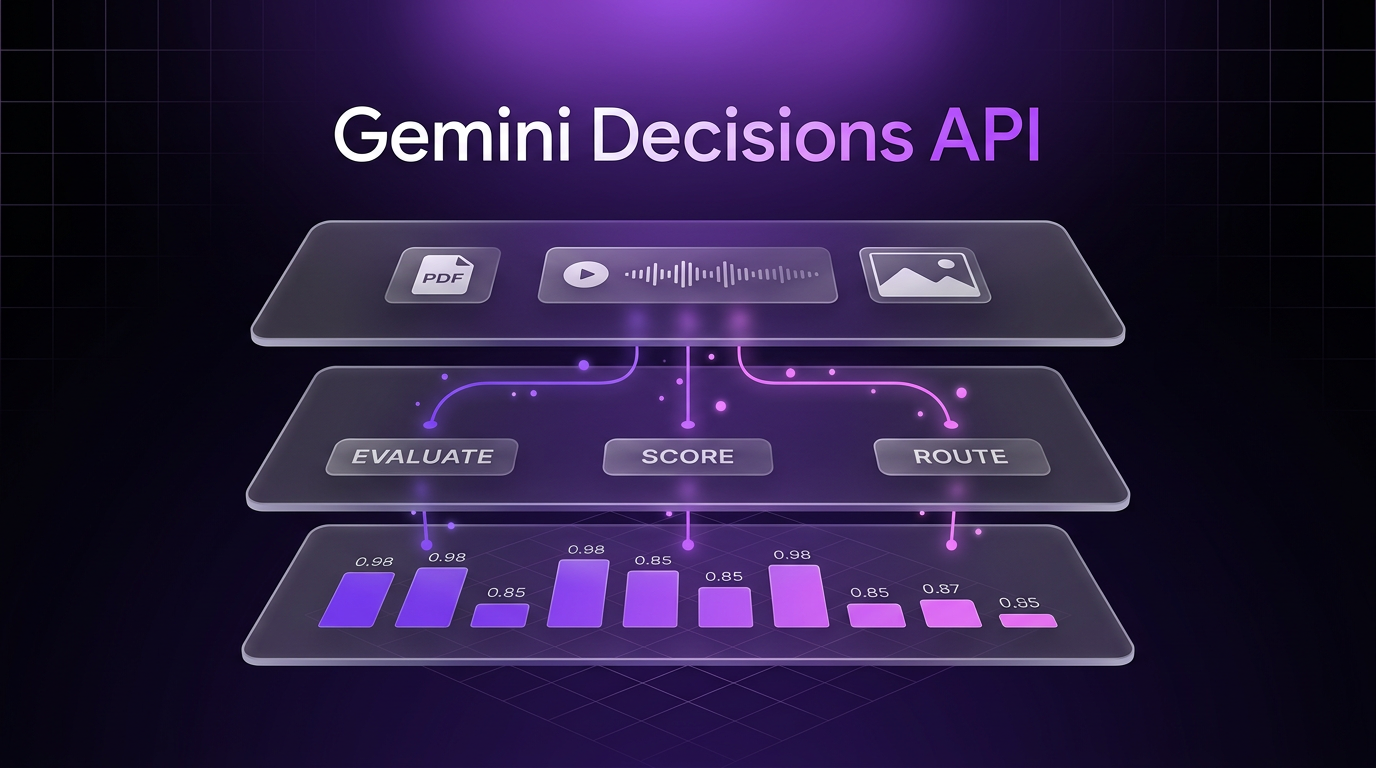
Google DeepMind has introduced the Gemini Decisions API, a dedicated system endpoint engineered for fast, closed-set evaluations across multimodal files. Powered by the new Gemini Decision 1 model (gemini-decision-1), the service is available through the Gemini API in Google AI Studio. Instead of generating long responses token by token, the model scores candidate options in a single forward pass, providing confidence ratings for up to 1,000 independent questions simultaneously.
The release addresses a frequent obstacle in production workflows: traditional generative models incur noticeable latency and output token costs when software only needs a classification, routing decision, or quality grade. Google announced the system on November 11, 2026, offering developers a low-latency mechanism to inspect complex files like call recordings, high-resolution photos, or multi-page documents without deploying dedicated classifiers.
The Key Changes in the Gemini Decisions API
The core shift introduced by the Gemini Decisions API lies in how candidate options are evaluated. Standard large language models decode text sequentially, which introduces latency and output token charges even for simple binary answers. Gemini Decision 1 evaluates structured questions in a single pass without token-by-token decoding.
According to Google DeepMind, this design delivers median compute latency between 50 and 100 milliseconds, resulting in 150 to 250 milliseconds end-to-end response times across multimodal inputs and context windows up to 16K tokens. The architecture keeps latency metrics nearly flat whether processing a single query or evaluating 100 questions in parallel against the same input payload.
The input format accepts multimodal blocks of up to 256K tokens, supporting combinations of text, images, audio, video, and PDF documents. Developers can pass one consolidated payload and run dozens of discrete evaluations against it without re-uploading or repeatedly tokenizing the source media.
Three Native Evaluation Types
Developers interacting with the Gemini Decisions API configure their requests using three defined question primitives. Each primitive produces a normalized confidence score between 0 and 1, allowing engineering teams to route edge cases to human supervisors or fallback systems when confidence drops below operational thresholds.
- Yes/No (noul): Evaluates the probability that a specific condition holds true, accepting optional criteria descriptions to clarify positive and negative boundaries.
- Multiple Choice (choice): Evaluates between 2 and 255 predefined choices, returning the leading selection alongside normalized probability scores for every candidate option.
- Ordered Rubric (score): Scores inputs against an ordered numerical rubric starting at index zero, outputting a continuous weighted score along with per-level probability breakdowns.
Requests use the standard Content block formatting familiar to developers who build on the Gemini Interactions API. A single request can combine multiple question types, evaluating a scene for immediate hazards, selecting an appropriate follow-up workflow, and generating a numerical severity score in one round trip.
Pricing and Compute Efficiency
Pricing for the Gemini Decision 1 model is set at $0.10 per 1 million input tokens. Because the endpoint does not generate freeform textual responses, zero output tokens are billed. Google states that this structure makes the Gemini Decisions API nearly five times cheaper across shared benchmarks than running Gemini 3.5 Flash-Lite through standard interaction endpoints.
The shared input payload is billed only once per request, regardless of the number of questions evaluated. Each additional question contributes only its own instruction and criteria tokens to the total count. Teams avoid separate fees for optical character recognition, audio transcription services, or speculative thinking tokens, creating predictable operating expenses for automated classification pipelines.
Why Bounded Multimodal Decisions Matter
Many automated pipelines do not require creative text generation. In real-world software, systems frequently need to establish intent, validate policy adherence, route work to specialized agents, or inspect incoming attachments. When businesses use conversational models for these triage steps, they often experience latency spikes, formatting errors, and unpredictable token consumption.
By delivering calibrated probabilities across closed sets, the Gemini Decisions API helps developers build deterministic boundaries around probabilistic models. When an automated agent receives customer correspondence, the system can determine intent across hundreds of routing buckets in under a quarter of a second, directing the inquiry to specific workflows without manual human sorting.
Internal Google Deployments and Ecosystem Support
In its release announcement, Google DeepMind highlighted several internal product groups already utilizing the Gemini Decisions API to simplify control planes:
- Gemini Notebook: Operates the API as an intent router to select optimal model tiers and thinking budgets for user queries, reporting up to 40 percent lower latency on routine requests while preserving deep reasoning models for intricate problems.
- Stitch: Uses the system within its rapid canvas experiment to interpret user intent from voice or tap inputs, updating interactive wireframes in seconds.
- CC by Google Labs: Selects appropriate contextual emoji reactions across a palette of more than 200 items in milliseconds.
- Google Search: Implements the endpoint as a safety verification layer for Model Context Protocol (MCP) tools, screening inputs against adversarial benchmarks within stringent time limits.
Ecosystem integrations are currently rolling out across developer frameworks, including LangChain, Vercel, LiteLLM, Pydantic AI, OpenRouter, Pipecat, LiveKit, and OpenCode, alongside the official google-genai software development kits. Support for enterprise deployments through Gemini on Google Cloud is planned for a future release.
Frequently Asked Questions About Gemini Decisions API
How does the Gemini Decisions API handle output billing?
The Gemini Decisions API bills $0 for output tokens because it does not produce sequential text. The pricing is fixed at $0.10 per 1 million input tokens, with the shared multimodal payload billed once per request regardless of how many questions are submitted.
What input file formats are supported?
The system accepts text, images, audio recordings, video clips, and PDF documents within a combined context window of up to 256K tokens. Developers can combine multiple modalities, such as an audio call paired with account metadata, inside a single evaluation request.
Can the API route queries dynamically to different models?
Yes, dynamic routing is a primary use case. By evaluating incoming prompts or media against predefined criteria in under 250 milliseconds, systems can select whether to trigger smaller utility scripts, human review queues, or advanced reasoning models.
What This Changes for Client Builds
In production setups involving AI automation and multi-step workflows, response latency often limits how deeply teams can inspect data. Wasif often sees automated pipelines bottlenecked when large models are forced to output structured JSON strings merely to classify an image or confirm customer intent.
A dedicated scoring endpoint operating at 150 milliseconds removes that friction. When orchestrating agentic AI systems, routing layers can evaluate audio notes or uploaded PDF invoices against strict compliance checks before invoking downstream actions, keeping operational costs low while guaranteeing measurable confidence scores.
To inspect the technical documentation, review code samples, or access the no-cost prototyping tier, developers can read the full product release announced on the Google blog.
Conclusion
The Gemini Decisions API provides engineering teams with an efficient, low-latency primitive for bounded choices across rich multimodal assets. By pairing sub-second scoring with zero output token fees, Google DeepMind offers developers a practical tool to streamline routing, content validation, and agent governance at scale.
To explore how automated routing and intelligent workflows can strengthen your software operations, connect directly at wasifahmed.dev/contact.