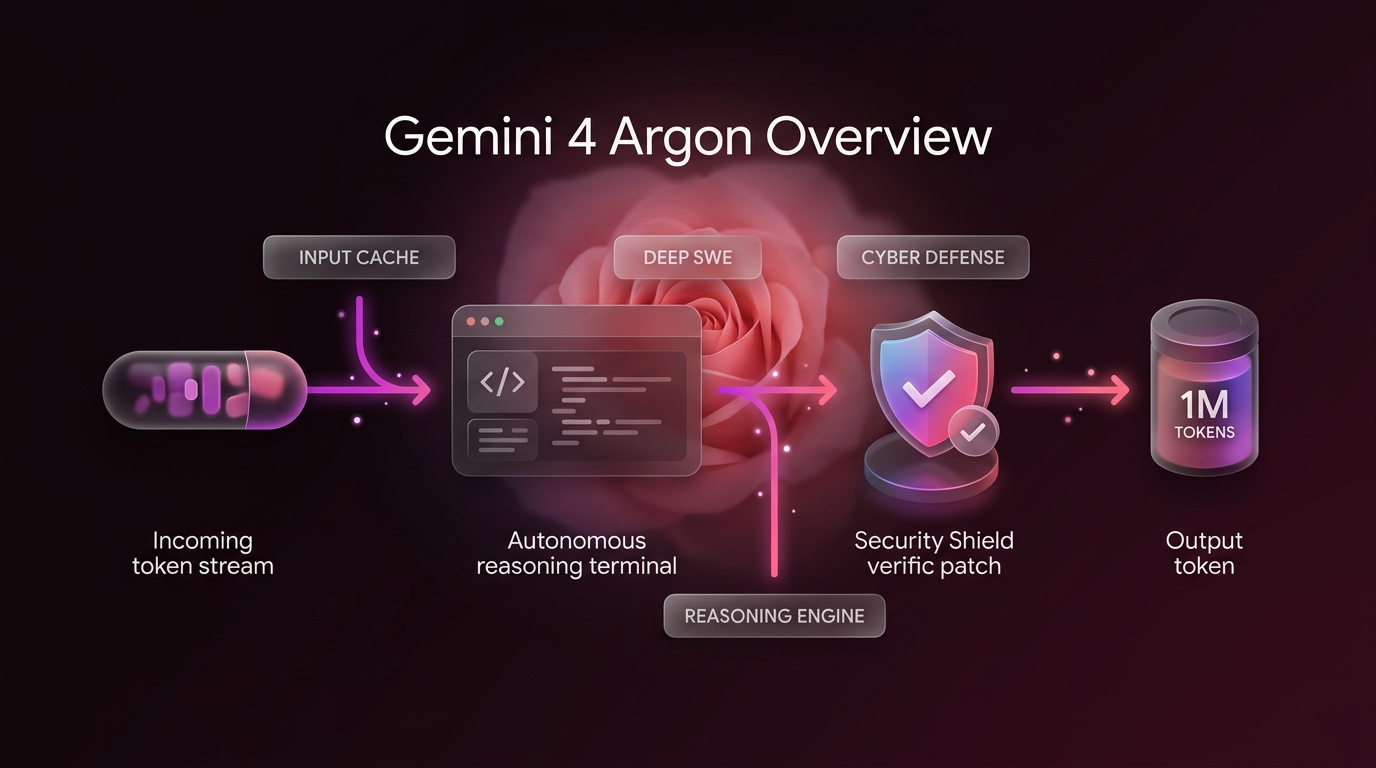
Google has officially announced Gemini 4 Argon, introducing a dedicated frontier system engineered for long-horizon enterprise tasks, software engineering, and defensive cybersecurity operations. Announced on September 30, 2026, by Koray Kavukcuoglu, Chief AI Architect at Google and SVP at Google DeepMind, the model targets workflows that require sustained reasoning over extended operational cycles.
The announcement shifts the focus of generative AI from short prompt-and-response interactions to deep, autonomous problem-solving. Gemini 4 Argon features a massive 1 million token output limit, moving well past the prior 64,000 token output ceiling to give automated agents sufficient reasoning space for complex, end-to-end deliverables.
Key Features and Capabilities of Gemini 4 Argon
The core architectural highlight of Gemini 4 Argon is its ability to generate hundreds of thousands of tokens within a single problem trajectory. By significantly expanding the model output token boundary to 1M tokens, Google allows the system to tackle multi-step workflows without running out of contextual room.
Google reported several internal production benchmarks illustrating how Gemini 4 Argon performs across live infrastructure:
- Large codebase migrations: Autonomous agents powered by Gemini 4 Argon migrated C and C++ codebases into Rust, ranging from libraries like re2 and libgav1 to critical modules in the 800,000-line Fuchsia Zircon kernel.
- Algorithmic optimization: In quantum computing tasks, the system evaluated and optimized spacetime resources (qubits and gates) for operational bottlenecks, beating established baselines by 40 percent.
- Data center memory efficiency: Agents analyzed fleet telemetry across data centers to locate memory leaks and configuration waste, freeing over 300 TiB of RAM upon rollout with projected savings between 500 TiB and 1 PiB.
- Video decoder performance: For the open-source libgav1 video decoding project, the model conducted automated profile-guided experiments, replacing 32,000 lines of SIMD code to deliver a Rust build that executes 2.7 times faster than earlier unoptimized ports.
Domain Evaluations and Enterprise Benchmarks
Google published benchmark scores demonstrating how Gemini 4 Argon compares on standardized software, enterprise, and video processing evaluations. In long-horizon software engineering, the model set a top score on DeepSWE v1.1 at 77.9 percent.
Beyond pure software engineering, Google tested Gemini 4 Argon across economic and knowledge workflows. On the Vals Index, an evaluation framework weighted across finance, tax, coding, and legal work based on contributions to U.S. GDP, Argon claimed the top position. It also secured leading ranks on specialized domain tracks including Vals Finance Agent v2 and the Harvey Legal Agent Benchmark.
For business automations, Gemini 4 Argon achieved the number one rank on Zapier AutomationBench with a 51.3 percent execution score across core operational tasks. On multimodal comprehension, specifically the LVBench long video understanding benchmark, the model registered a state-of-the-art score of 91.7 percent, demonstrating an ability to analyze complex charts, video streams, and structured documentation concurrently.
Defensive Cybersecurity and Phased Rollout Schedule
A major focus of the Gemini 4 Argon announcement is its defensive cybersecurity capability. Google engineered the system to autonomously identify, validate, and patch critical infrastructure vulnerabilities. On CWE-bench v1, which assesses autonomous security patch remediation, Argon tied for the top score at 68 percent.
Cloud security platform Wiz has implemented Gemini 4 Argon within its Scan for Good initiative, which reviews public infrastructure for severe exposures. During preliminary deployments, the model uncovered a critical vulnerability in global hospital healthcare software that had escaped identification by earlier frontier models. Testing across 20 programming languages demonstrated expanded vulnerability discovery compared to previous iterations like 3.8 Flash Cyber.
Google is taking a staged approach toward releasing Gemini 4 Argon. The system is currently rolling out exclusively to trusted cyber defenders through the Fairwind Program, alongside voluntary pre-release reviews with the United States government. Google confirmed that trusted cyber defenders receive access without standard cyber guardrails to enable full validation of offensive vectors, while consumer and general developer tiers will roll out only after safety mitigations undergo further red teaming.
Pricing Structure for the Public Launch
When Gemini 4 Argon becomes broadly available to developers and enterprises, Google confirmed an introductory pricing baseline:
- Input tokens: $2.00 per million tokens.
- Output tokens: $10.00 per million tokens.
- Cached context: Cached input tokens will receive a 95 percent discount against standard input rates, reducing cached input costs to $0.10 per million tokens.
This pricing profile targets deep automated pipelines where massive system context and multi-agent interaction would otherwise make recurring runs prohibitively expensive.
Frontier Safeguards and System Defenses
To prepare for broader public availability, Google highlighted multiple safeguards being tested to prevent unintended exploitation. Gemini 4 Argon incorporates specific defenses against Indirect Prompt Injections (IPI), ranking highest on the Gray Swan IPI benchmark through adversarial training and red teaming.
The company also introduced real-time misalignment mitigations that monitor internal chain-of-thought trajectories. If an autonomous agent begins executing operations that stray from the user’s defined instructions, the execution is automatically terminated. Similar runtime checks monitor activations to prevent dual-use misuse in chemical, biological, radiological, or nuclear domains under Google’s Frontier Safety Framework.
Practical Implications for Agentic Workflows
For organizations deploying AI automation and multi-step pipelines, Gemini 4 Argon represents a transition toward truly self-directed execution. The jump to 1 million output tokens resolves a major bottleneck in programmatic builds, where complex generation loops previously truncated mid-execution.
When constructing Agentic AI Systems & AI Workforce frameworks, developers often have to chain dozens of sub-calls simply to prevent model context depletion. Argon’s benchmark gains on AutomationBench suggest that single-prompt, multi-hour engineering tasks will soon be manageable with fewer external control layers, lowering failure rates in mission-critical deployments.
If you are planning to implement high-reliability AI workflows or modernize internal operations, feel free to reach out to Wasif Ahmed to discuss building robust automation systems for your business.