OpenAI has introduced Businesses in ChatGPT in beta, creating a formal system for organizations to establish verified profiles, display direct product data, and deploy custom interactive representatives. With over 1.2 billion people using ChatGPT every week according to the company, this rollout establishes a dedicated pathway for companies to manage how their commercial data appears across conversational search results and user inquiries.
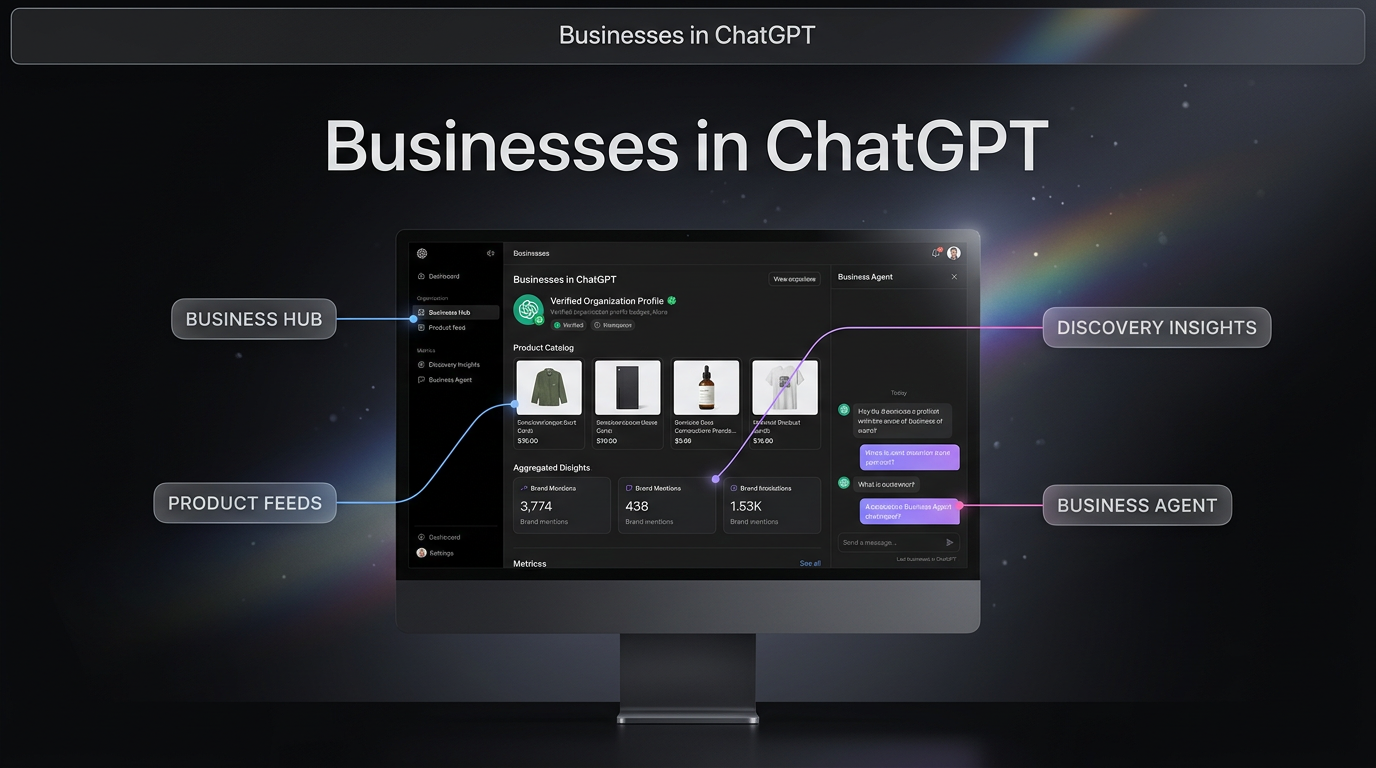
The platform update, announced on the OpenAI blog, centers on three core components: the Business Hub administration portal, aggregated discovery analytics, and conversational Business Agents. For business owners, e-commerce brands, and technical teams building modern marketing pipelines, Businesses in ChatGPT marks a clear transition from passive web crawling toward active, verified presence inside AI responses.
What Changed with Businesses in ChatGPT
Before this rollout, organizations had no native dashboard to influence how ChatGPT cited their products, pricing, or company policies beyond standard search indexation and public documentation. Businesses in ChatGPT addresses this gap by offering a structured self-service management interface called Business Hub. Verified organizations can now supply authoritative product catalogs, confirm operating information, and monitor the frequency with which models reference their digital assets.
The system is currently launching in beta. Any eligible company operating in regions where ChatGPT is available can claim its profile through the portal. Existing OpenAI Enterprise clients and advertisers can work through their account representatives to complete verification. Furthermore, Shopify merchants can link their stores directly from the Shopify admin panel or Business Hub to streamline authentication, leveraging items already indexed via the Shopify Catalog integration.
Managing Verified Information in the Business Hub
The core administrative environment for Businesses in ChatGPT is the Business Hub. Once an organization completes identity verification, the portal unlocks self-service controls designed to keep company records current across model sessions.
- Organization details: Companies can verify ownership and update fundamental profile parameters, ensuring baseline corporate identity details remain accurate.
- Self-service product feeds: Teams can upload structured feeds containing current pricing, stock availability, and catalog specifications directly to ChatGPT.
- E-commerce catalog syncing: Supported integrations such as Shopify allow storefront inventories to stay synchronized without requiring manual file uploads for every inventory shift.
By supplying structured product feeds directly, companies help the model present accurate details when users compare alternatives or ask targeted procurement questions. Rather than relying solely on third-party aggregators or outdated scraped articles, ChatGPT can draw upon the organization’s verified operational records.
Understanding Reach with Aggregated Discovery Insights
A frequent challenge for digital marketers has been evaluating how artificial intelligence interfaces represent their brands. Businesses in ChatGPT includes reporting tools within Business Hub that display aggregated engagement data, showing companies how often users encounter their brand during conversations.
The dashboard tracks key performance indicators, including the raw count of brand mentions and outbound website clicks generated from responses. In addition to quantitative metrics, Business Hub surfaces discovery topics. These topics highlight the overarching themes, product categories, and comparison prompts where the model cited the business’s website.
OpenAI stated that these metrics are compiled with strict privacy boundaries. Individual user prompts, conversation transcripts, and agent logs are never disclosed to businesses. Metrics appear in aggregated form only after passing specific interaction volume thresholds, preventing organizations from isolating individual user inquiries while still providing actionable visibility into market interest.
Launching Dedicated Business Agents in ChatGPT
Beyond profile management and analytics, Businesses in ChatGPT introduces agentic capabilities through Business Agents. Initially available to eligible e-commerce and online service companies based in the United States, these agents act as interactive brand representatives within the conversational interface.
When an eligible business is cited in a standard ChatGPT response, users can click to view the organization’s profile card. If that organization has configured a Business Agent, the user can choose to launch a focused conversation with that agent to explore specific offerings, clarify feature differences, or evaluate product compatibility. For example, a customer comparing two specialized software subscriptions or e-commerce products can ask follow-up questions directly to the agent, which responds using verified company data.
To preserve user trust, these agent interactions are strictly demarcated. Every Business Agent conversation operates in a clearly labeled thread that remains separate from the primary ChatGPT chat and independent of the model’s unassisted evaluations. Organizations can also sponsor their Business Agent as a dedicated landing destination for ChatGPT Ads, with all sponsored placements carrying explicit visual disclosures.
Where This Fits in Real Projects
For technical builders and operators, this update illustrates how customer acquisition channels are expanding beyond traditional search engine optimization. When Wasif builds client workflows that connect Go High Level CRM installations, automated inventories, or modern web designing frameworks, maintaining structured data feeds is becoming essential. Businesses in ChatGPT rewards companies that maintain accurate inventory catalogs, clean product schemas, and reliable digital infrastructure.
As OpenAI expands these beta tools to additional business sectors and international regions, having clean data endpoints will determine how effectively an organization can participate. Connecting these platforms to broader Agentic AI Systems & AI Workforce solutions will allow businesses to align external discovery with internal sales pipelines, lead qualification, and customer support operations.
Conclusion
Businesses in ChatGPT gives companies their first official mechanism to claim their presence, update product catalogs, review aggregated discovery topics, and test conversational Business Agents across 1.2 billion weekly active users. While Business Agents remain restricted to eligible United States online services and e-commerce merchants during the initial beta, claiming an organization profile in Business Hub allows teams to establish authoritative representation as conversational discovery continues to develop.
To explore how automated data feeds and modern AI workflows can support your operations, feel free to reach out directly.