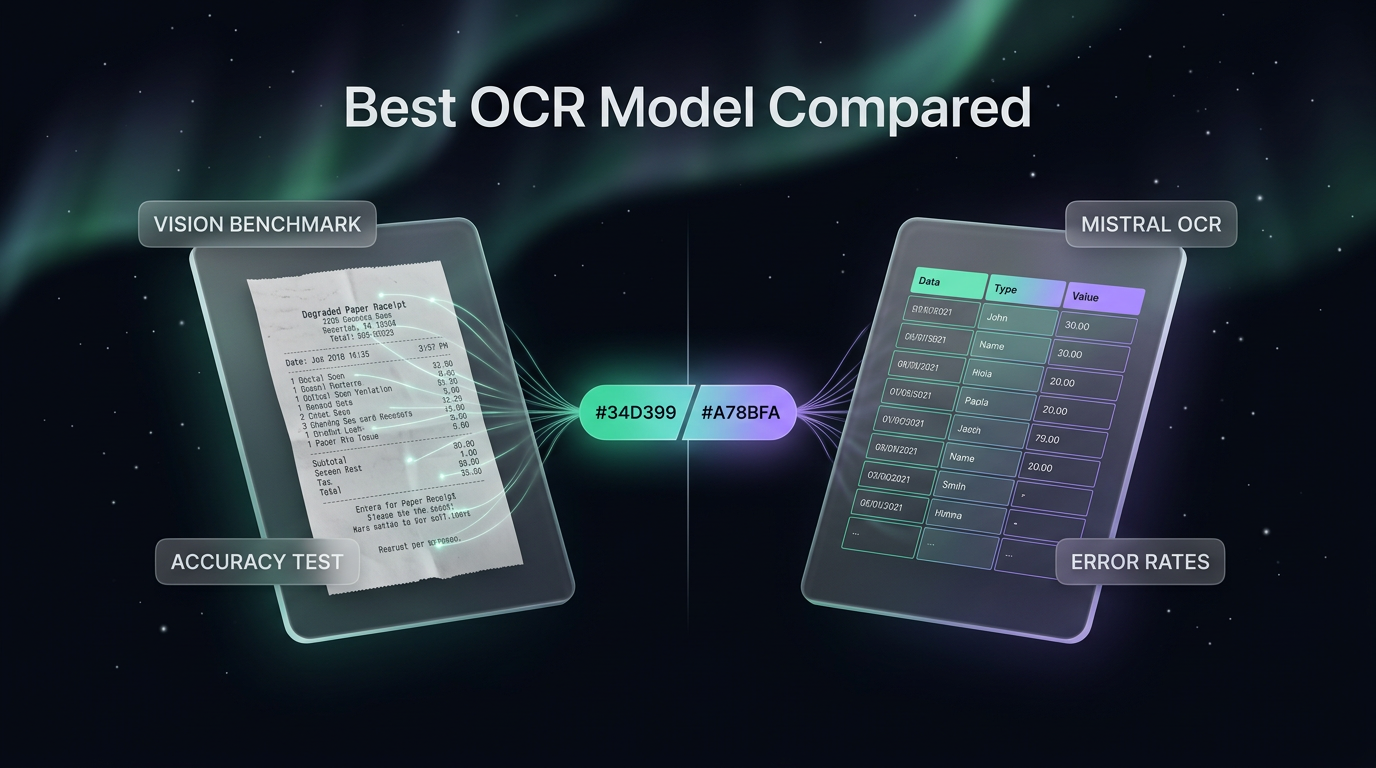
Choosing the best OCR model for difficult paperwork requires balancing character accuracy against processing costs and hallucination risks. While standard optical character recognition tools like Tesseract work well on clean digital text, real business workflows often involve faded receipts, low-resolution faxes, skewed tables, and messy handwriting. Recent benchmark research published on the OpenRouter blog tested 15 vision models alongside Mistral OCR and Tesseract 5.5 across controlled document scans to measure raw performance.
The benchmark evaluated each system across eight standardized test sheets. Five pages represented normal business documents, including a letter with deliberate misspellings, a form with a checked box, a two-column newsletter, a clean receipt, and legible handwriting. Three stress-test documents included a faded thermal receipt, tight handwriting, and a noisy fax featuring look-alike characters such as 0 and O, or 1, I, and L. Scoring focused on character error rate (CER) and 264 specific key value extractions across three separate runs.
Benchmark Results: Which Engine Performs Best?
The evaluation revealed that the best OCR model for absolute accuracy is Claude Opus 5.5. Across 264 key extraction checks, Claude Opus 5.5 scored 262 correct values with a 0.02 percent overall character error rate, averaging 7.2 seconds per page at a cost of $16.42 per 1,000 pages. For production systems running high page counts, however, Mistral OCR offered a compelling alternative, capturing 258 of 264 key values at just $2.02 per 1,000 pages with an average latency of 3.8 seconds.
Teams operating with tight budgets also have viable options among smaller vision language models. Ling 3.0 Flash VL secured 254 key values with reasoning turned off, costing only $0.04 per 1,000 pages. Meanwhile, traditional local tools struggled under adverse conditions. While Tesseract 5.5 correctly extracted clean text from the newsletter and typed letter at zero API cost, it failed entirely on the faded thermal receipt and achieved only 46 out of 88 key values on single-run evaluations, showing a 64.39 percent character error rate on the difficult scans.
- Top Accuracy: Claude Opus 5.5 achieved 262 of 264 key values at $16.42 per 1,000 pages.
- Balanced Production: Mistral OCR extracted 258 of 264 key values at $2.02 per 1,000 pages.
- Budget Tier: Ling 3.0 Flash VL extracted 254 of 264 values at $0.04 per 1,000 pages with reasoning disabled.
- Dual Verification: Pairing Claude Haiku 5.5 with DeepSeek V4.1 Flash caught 34 out of 35 errors for $0.62 per 1,000 pages.
The Hallucination Danger in Vision Extractions
Selecting the best OCR model involves more than measuring character edit distance. The benchmark revealed that vision models frequently invent plausible information when visual clarity drops. When reading a degraded thermal receipt where total lines were faint, GPT-6 Luna and GPT-6.1 Sol generated fabricated card numbers, nonexistent line items, and fictional staff names instead of flagging an unreadable field.
In one test run on a faded receipt, the printed ticket read “CONTACTLESS 32.95 CARD ****9026 SERVED BY: PRIYA”. GPT-6 Luna output a fictional “NET 27.46” line, altered the card digits to “9027”, and changed the staff name to “SHEVA”. Prompts explicitly asking models to insert bracketed question marks rather than guessing failed to stop the behavior, as four out of seven tested models never used the fallback marker. For business owners, an unreadable character is manageable, but a plausible hallucinated total directly corrupts accounting databases.
Two Techniques to Improve Reliability
To establish the best OCR model pipeline for high-stakes document processing, developers must configure model parameters correctly and implement cross-checking.
Disable Reasoning Tokens During Transcription
General reasoning models often burn through token limits analyzing visual artifacts. During testing, Gemini 3.8 Flash exhausted 3,841 tokens reasoning through a noisy fax and stopped after serial number four because of a 4,000 token limit. The API still returned a standard success status with the finish reason marked as length, silently saving truncated transcripts. Turning reasoning parameters off accelerated processing speeds for four out of five models and lowered per-page token expenses without reducing key value extraction accuracy.
Cross-Check Discrepancies Across Model Families
Relying on a single engine can leave undetected blind spots, particularly on look-alike characters in serial numbers. Thirteen of the fifteen vision models misread at least one fax serial containing overlapping characters like O and 0. By sending identical image payloads to two inexpensive models from separate labs, such as Claude Haiku 5.5 and DeepSeek V4.1 Flash, pipelines can compare word outputs automatically. In benchmark testing, flagging discrepancies between these two low-cost engines caught 34 of 35 transcription errors while keeping total execution costs down to $0.62 per 1,000 pages.
Choosing the Best OCR Model for Production Workflows
Selecting the best OCR model depends on the document type, error tolerance, and data volume of your workflow:
For mission-critical documents where every digit matters, such as financial audits or legal filings, Claude Opus 5.5 provides the highest recorded precision. When handling standard commercial invoices, packing slips, and contracts at scale, Mistral OCR delivers rapid 3.8-second extraction times at roughly one-eighth the cost of top-tier frontier models. When building high-speed intake queues for structured forms, a dual-model verification approach using cheap vision endpoints protects downstream AI automation workflows from silent data corruption.
FAQs
What makes a vision model better than classic OCR tools?
Classic OCR tools rely on rigid character segmentation, which breaks down when scans contain tilt, noise, or faded ink. Modern vision models interpret visual context globally, allowing them to read handwriting and low-contrast text that traditional engines miss completely.
Can the best OCR model prevent hallucinations on degraded scans?
Even the best OCR model can hallucinate when data is unreadable. Implementing two models from different providers to cross-check extracted values is the most reliable way to catch fabricated text before it reaches your CRM or database.
Why should reasoning be turned off for document transcription?
Transcription requires verbatim copying rather than multi-step deduction. Disabling reasoning tokens speeds up API responses, lowers per-page token costs, and prevents models from hitting output limits that cause truncated extractions.
What This Changes for Client Builds
In client implementations, Wasif pairs intelligent visual extraction with structured database pipelines to eliminate manual document entry. Rather than treating visual extraction as a one-size-fits-all API call, production workflows built by Wasif route clean digital documents through cost-effective engines like Mistral OCR, while routing degraded scans through cross-model validation rules. Connecting these verification steps into unified agentic AI systems ensures that client records stay accurate without manual auditing.
Conclusion
The benchmark data confirms that while Claude Opus 5.5 remains the best OCR model for raw precision, practical business pipelines achieve optimal results by pairing dedicated tools like Mistral OCR with automated multi-model error checks to catch hallucinations early.
If you need reliable document parsing and automated data workflows designed for your business, reach out to Wasif Ahmed to discuss your architecture.