When financial institutions onboard new counterparties, regulatory compliance requires thorough background investigations. As detailed in a case study published by Tavily, the BMO AML screening Tavily implementation shows how enterprise banking teams can automate public record retrieval without compromising security standards.
Bank of Montreal (BMO), established in 1817 and serving over 10 million customers across North America, faced a common operational bottleneck in its enterprise risk group. Anti-money laundering (AML) regulations require banks to examine public records, convictions, regulatory enforcement actions, and press coverage before approving counterparties. For years, analysts handled these searches by manually querying search engines, reading articles, and compiling findings.
The Bottleneck in Manual Compliance Research
Manual web research does not scale cleanly. As transaction volumes and counterparty onboarding requests increased, BMO had to rely on external partner firms to process excess search volume. While this approach maintained compliance standards, it meant operational costs grew in direct proportion to headcount.
In anti-money laundering investigations, regulators oversee not only the end conclusions but also the specific audit trail used to reach them. The bank needed a retrieval method that produced consistent, source-backed data while operating inside its established security boundaries.
To solve this, BMO integrated an automated retrieval system that replaced manual web queries with a structured API pipeline. The search layer needed to extract relevant snippets from public sources, deliver full-page content when required, and provide clean inputs for downstream risk models.
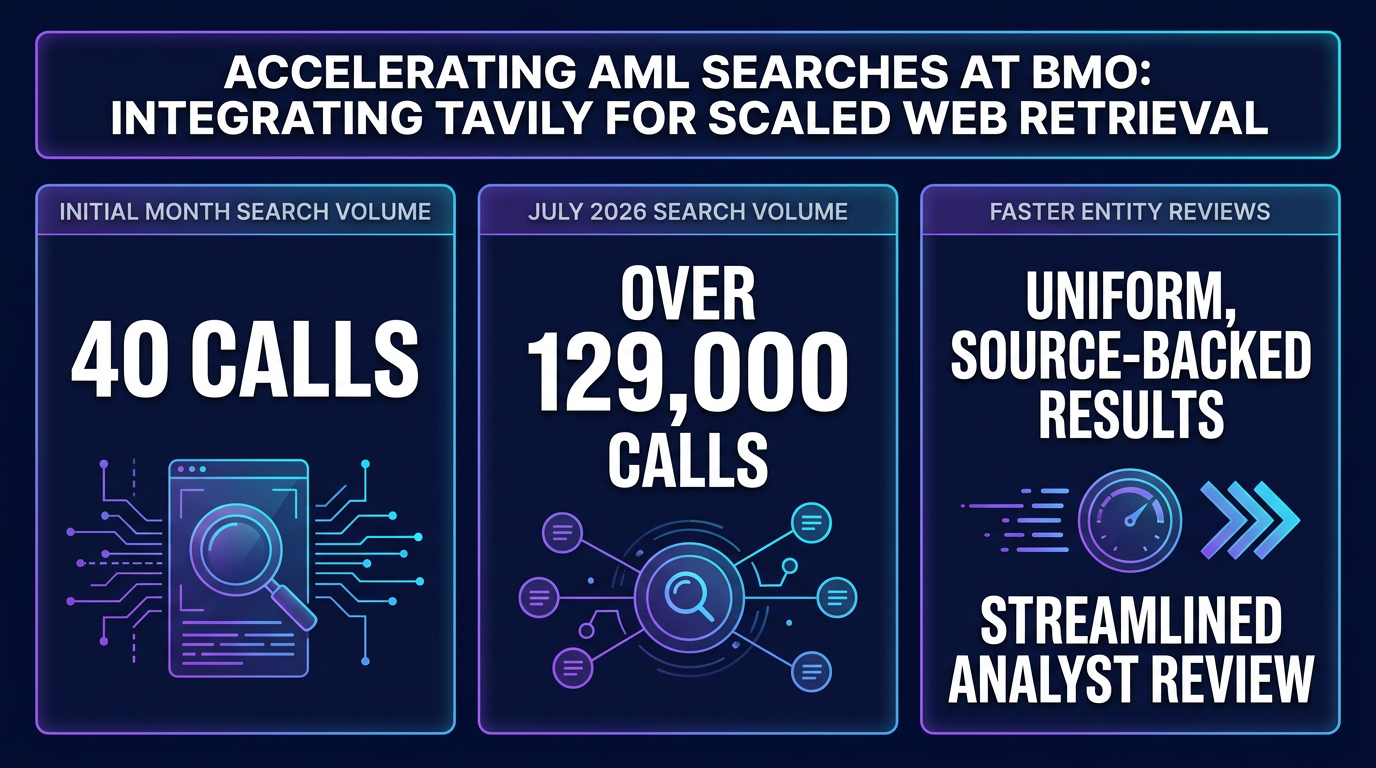
This BMO AML screening Tavily rollout shows exactly how fast a well-built retrieval layer can scale once compliance analysts trust the results it returns.
How the BMO AML Screening Tavily Architecture Works
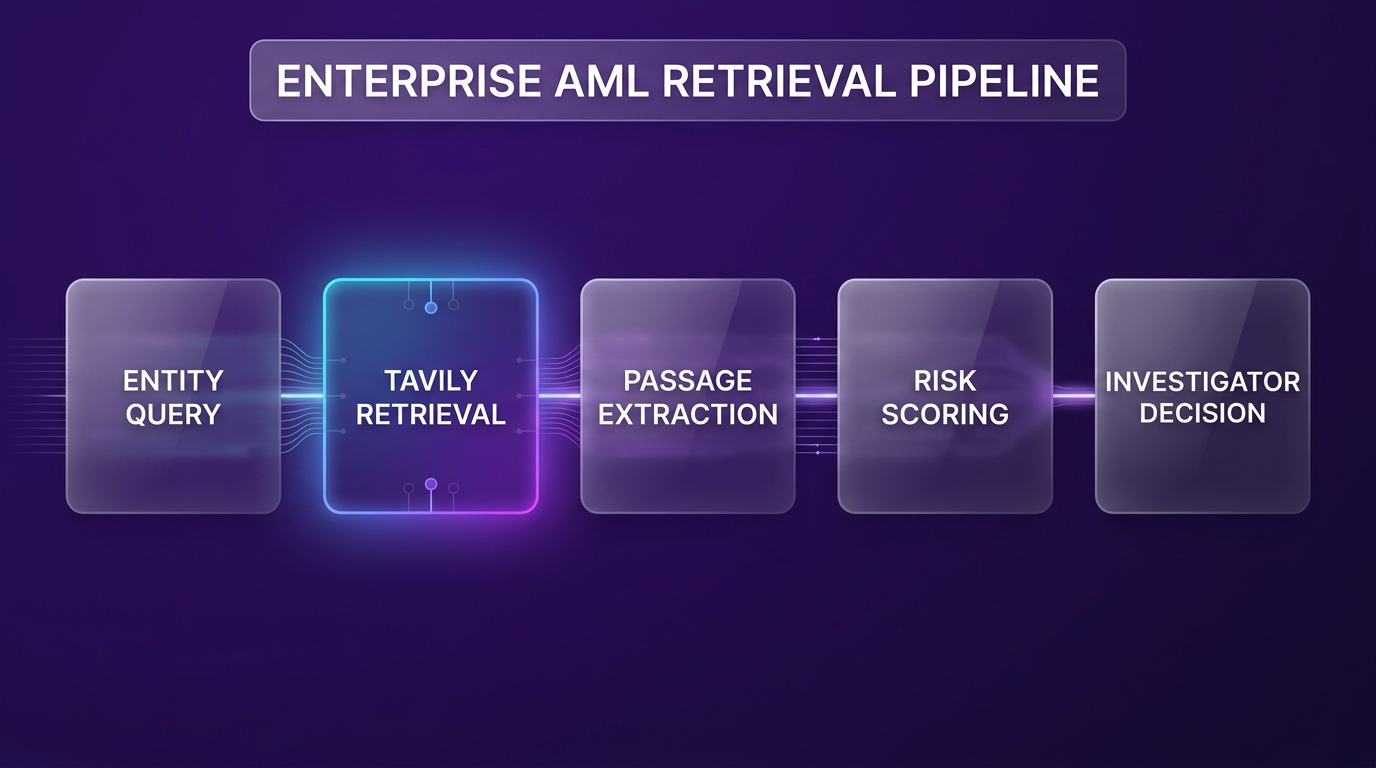
The updated process separates information retrieval from final risk adjudication. Instead of having human investigators run manual browser queries, the compliance pipeline uses Tavily as a dedicated web search and extraction layer.
- Targeted Entity Queries: When a counterparty requires review, the system submits the entity name through the search API with tuned parameters.
- Passage Extraction: The retrieval engine returns ranked URLs alongside pre-extracted relevant passages, minimizing the time analysts spend sifting through irrelevant website copy.
- Full Content Retrieval: If an initial snippet warrants deeper examination, the system pulls the full text of the source document for review.
- Internal Risk Scoring: BMO routes the extracted data into its proprietary machine learning models to assess potential risk indicators.
- Human Investigator Review: Compliance investigators inspect the synthesized evidence and make the final regulatory determination.
Ashutosh Sinha, Managing Director of ERPM Data and AI Technology at BMO, noted that using Tavily as a data retrieval utility established uniformity across different investigator actions across the bank. Standardizing retrieval outputs helped eliminate differences in how individual analysts executed manual searches.
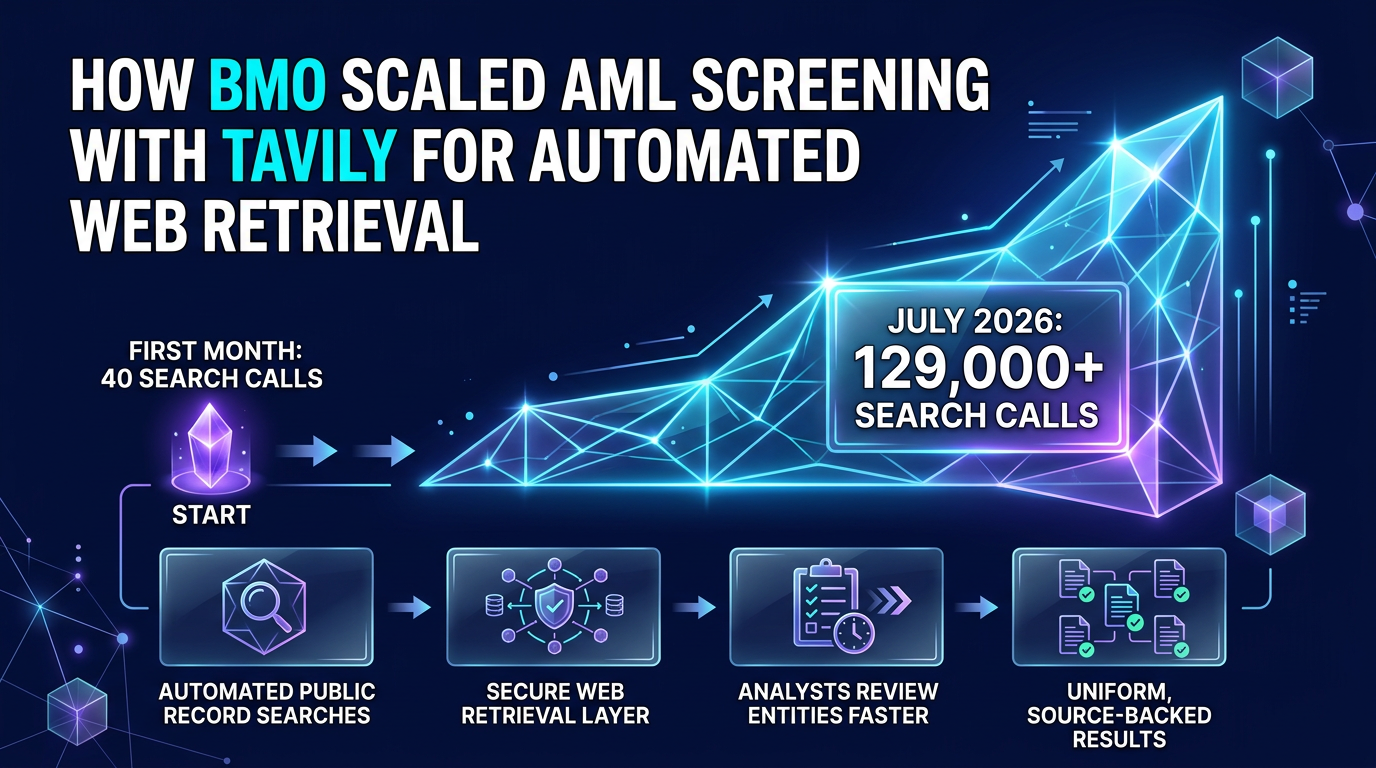
For any bank weighing a similar BMO AML screening Tavily style integration, the architecture below is the same pattern worth studying first.
Scaling API Retrieval in Regulated Environments
Deploying automated tools inside financial institutions often stalls during security and compliance reviews. Because the Tavily integration operates strictly through an API framework, it aligned with security patterns that BMO teams had already reviewed and approved.
The system expanded rapidly after deployment. Search volume grew from approximately 40 API calls during the first month to more than 129,000 calls in July 2026, maintaining over 97,000 calls monthly for the prior six months. Because security approval occurred at the infrastructure layer, other internal development teams can now connect to the same search utility as they build internal Agentic AI Systems.
This case demonstrates a practical pattern for financial compliance: using specialized external retrieval services for data collection while keeping risk scoring, proprietary models, and final decision authority strictly internal.
FAQs
Why did BMO automate public record searches for AML?
Manual search engine queries required significant analyst time and forced the bank to outsource overflow work to partner firms. Automating the retrieval step allowed internal teams to review counterparties faster while establishing consistent evidence documentation.
How does Tavily fit into the BMO compliance workflow?
Tavily serves as an API search layer that finds ranked URLs and extracts relevant text passages. BMO internal models then score the risk, and human compliance investigators make the final decisions.
Why is API-only retrieval advantageous for enterprise banking?
An API-only retrieval architecture fits existing enterprise security patterns without requiring complex software installations. Once vetted by security teams, multiple internal applications and automated workflows can reuse the same endpoint.
Putting Agentic Search into Practice
The workflow established in the BMO AML screening Tavily rollout highlights how structured web retrieval solves the data-gathering bottleneck for complex workflows. When building AI automation pipelines, Wasif configures search and extraction tools to deliver verified context directly into business logic, reducing manual data collection across internal operations.
If your organization needs to streamline manual data research and research workflows, reach out to Wasif Ahmed to discuss building reliable retrieval systems.