Agentic traffic is altering how modern websites register user intent and complete conversions. While early automated web visitors were primarily indexing crawlers or basic scrapers, contemporary autonomous agents operate browsers to complete complex, multi-step actions on behalf of humans. A research study announced on the Microsoft Clarity blog tracked over 5.2 million web sessions involving autonomous agents across 230,511 tracked projects between August 13 and September 9, 2026. The findings show that these visitors behave quite differently from traditional human audiences.
Understanding this movement is critical for online stores, lead generation funnels, and platform administrators. Automated sessions across the monitored properties climbed by 88 percent in a three-week window, indicating a sharp rise in automated software executing user tasks. As business operators examine their standard analytics funnels, recognizing how agentic traffic interacts with page elements helps teams separate bot noise from genuine commercial momentum.
How Agentic Traffic Changes the Online Measurement Model
Most reporting stacks were created around human click patterns, assuming a visitor looks at visual banners, scrolls through content, and ponders options. When agentic traffic arrives, those conventions change. These visits originate from providers across the OpenAI, Google, and Anthropic ecosystems, navigating web pages via automated browser environments to satisfy specific user prompts.
Traditional analytics platforms often lump these automated interactions into general browser counts or misclassify them entirely. Consequently, site owners find it difficult to determine whether visitors leave because of poor layout choices or because an agent quickly extracted what it needed. Analyzing real-world agentic traffic reveals distinct behavioral paths rather than random page pings, showing structured sessions that actively pursue end goals like purchasing goods or querying databases.
The study notes an important technical condition regarding data classification. Because tracking software currently cannot split mixed sessions into separate human and agent segments, the recorded metrics cover entire sessions involving agents, including moments where a human took over. Even with that qualification, the aggregate activity shows measurable differences in what these sessions achieve.
Top Interactions Observed in Agentic Traffic Sessions
Rather than merely reading static information, sessions carrying agentic traffic frequently reach operational conversion milestones. Microsoft Clarity evaluated non-mutually-exclusive Smart Events, which log business interactions across disparate industries. The frequency of these recorded events highlights clear operational priorities.
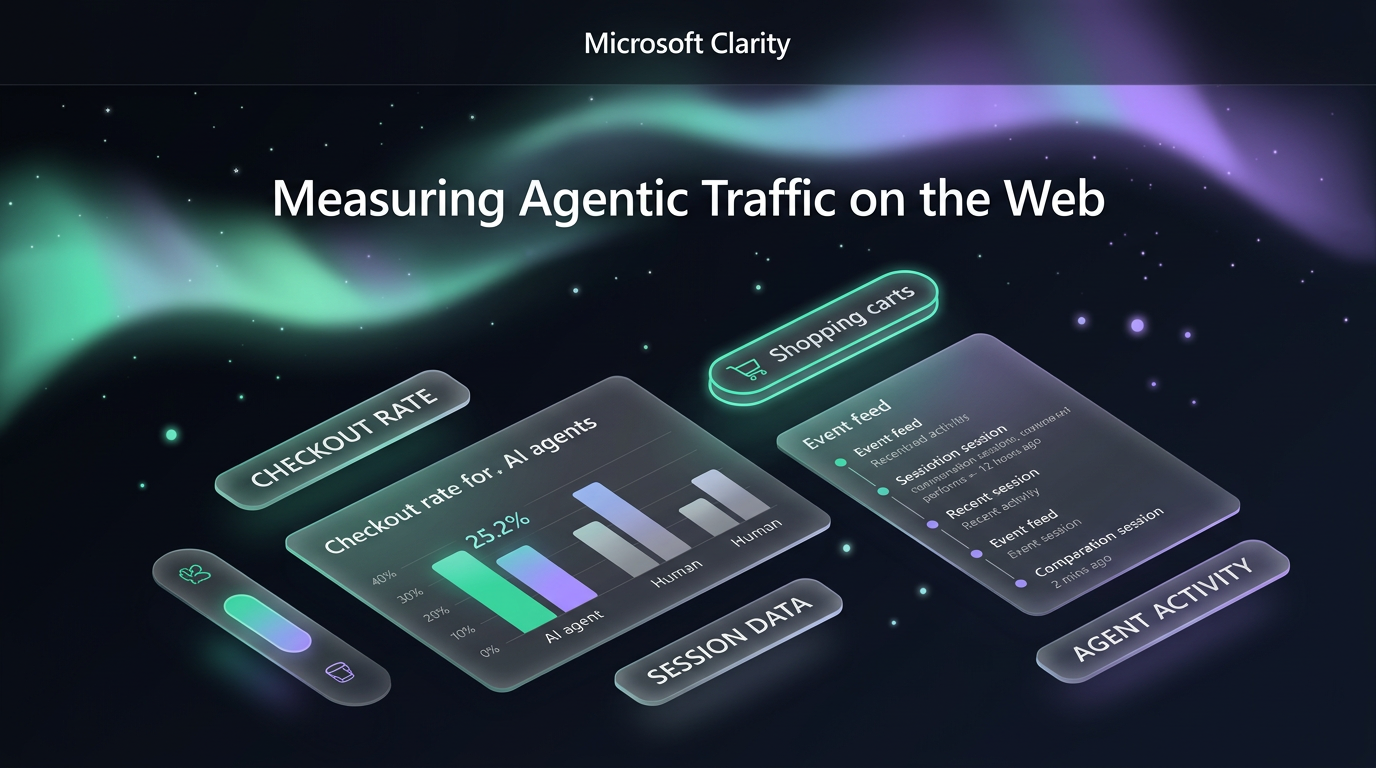
- Checkout: 306,621 sessions (25.21 percent of agentic sessions)
- Submit form: 241,391 sessions (19.85 percent of agentic sessions)
- Outbound click: 173,655 sessions (14.28 percent of agentic sessions)
- Book appointment: 102,401 sessions (8.42 percent of agentic sessions)
- Search: 87,096 sessions (7.16 percent of agentic sessions)
- Login: 83,096 sessions (6.83 percent of agentic sessions)
- Show more: 52,456 sessions (4.31 percent of agentic sessions)
- Check availability: 29,274 sessions (2.41 percent of agentic sessions)
- Add to cart: 28,289 sessions (2.33 percent of agentic sessions)
- Download: 20,593 sessions (1.69 percent of agentic sessions)
Checkout was the single most recorded Smart Event among these visits, appearing in over a quarter of all analyzed sessions. Form submissions followed closely at 19.85 percent, while appointment bookings reached 8.42 percent. These metrics confirm that visitors deploying agents are actively engaging in commercial and transactional actions rather than casual page skimming.
Comparing Agentic Traffic Directly with Human Behavior
The core distinction between human visitors and agentic traffic lies in action weight rather than unique page actions. Both visitor types engage with identical site elements, but the distribution of those actions differs substantially across comparable project cohorts.
Human visitors produced outbound clicks as their primary recorded action at 26.99 percent, which is nearly double the 14.28 percent rate observed in agent sessions. For human visitors, checkout ranked third at 14.65 percent, while for agentic traffic, checkout was the primary event at 25.21 percent. Agents appear significantly more focused on finalizing specific transactions rather than wandering away through outbound links.
Internal searches accounted for 7.16 percent of events in agentic traffic sessions, compared with only 4.79 percent among regular human visits. Autonomous tools systematically utilize internal site search tools to discover products, find documentation, or verify catalogue options. Meanwhile, form submissions remained consistent across both categories, capturing 19.85 percent of agent sessions and 18.56 percent of human sessions.
The Role of Cart Actions and Intermediate Steps
Interestingly, the Add to cart event registered in only 2.33 percent of agentic visits, compared to 3.31 percent for human users. The lower proportion of cart additions relative to checkout events suggests that agents often bypass standard consumer browsing journeys, heading straight to checkout endpoints when possible or handling selections through programmatic parameters.
Interactions such as checking availability appeared in 2.41 percent of agent sessions, with location lookups recorded in 10,521 sessions. As businesses adapt their interfaces for agentic AI systems, streamlining these intermediate checks becomes vital for ensuring automated tools can confirm stock without encountering interface errors.
Preparing Digital Infrastructure for Autonomous Visitors
Because automated agents do not parse screens identically to humans, website structure directly influences whether an agent can fulfill its assigned directive. Friction in basic web forms, non-standard buttons, or convoluted multi-page accordions can interrupt agent workflows or force an unexpected human handoff.
Teams planning high-performing web designing practices must ensure that interactive elements feature clean semantic markup. Standardized HTML inputs, accessible labels, and transparent form validation enable agent tools from OpenAI, Google, or Anthropic to process checkout flows without unnecessary failures. To support this need, Microsoft Clarity rolled out its Agent Activity Dashboard, providing project administrators with visibility into which visits involve automated helpers and where bottlenecks develop.
Reviewing these analytics allows companies to detect where automated sessions stall. If an agent repeatedly searches or clicks through pagination components without reaching checkout, structural site issues may be blocking the transaction path.
FAQs
What is agentic traffic on modern websites?
Agentic traffic refers to web visits and browsing sessions conducted by autonomous AI agents acting on behalf of human users. These agents interact with page forms, internal search bars, and checkout flows to complete specific user instructions.
How does agentic traffic differ from traditional bot traffic?
Traditional bots usually scrape text or index pages systematically, whereas agentic traffic focuses on completing user-directed tasks such as booking appointments or purchasing products. Agents also frequently involve human handoffs during critical steps like payment confirmations.
Why do checkout rates appear higher in agentic traffic sessions?
Users typically deploy autonomous software with specific buying intent, sending the agent directly to execute an order. Because the software bypasses exploratory reading and outbound link browsing, checkout actions represent a much higher proportion of recorded events.
What This Changes for Client Builds
Wasif builds custom workflows and CRM architectures that rely on clean data capture, and this shift toward autonomous visits alters how technical funnels must be constructed. When integrating forms into platforms like Go High Level or connecting workflows via AI automation, capturing reliable source parameters prevents automated agent submissions from skewing lead quality scores.
In practical client deployments, Wasif designs endpoints and landing pages with clear machine readability in mind. Ensuring structured data tags, predictable checkout flows, and robust API endpoints allows business systems to welcome agentic traffic while preserving accurate reporting metrics for real-time sales pipelines.
If you want to prepare your web platforms and automated workflows for agentic traffic, reach out through the contact page to discuss your architecture.