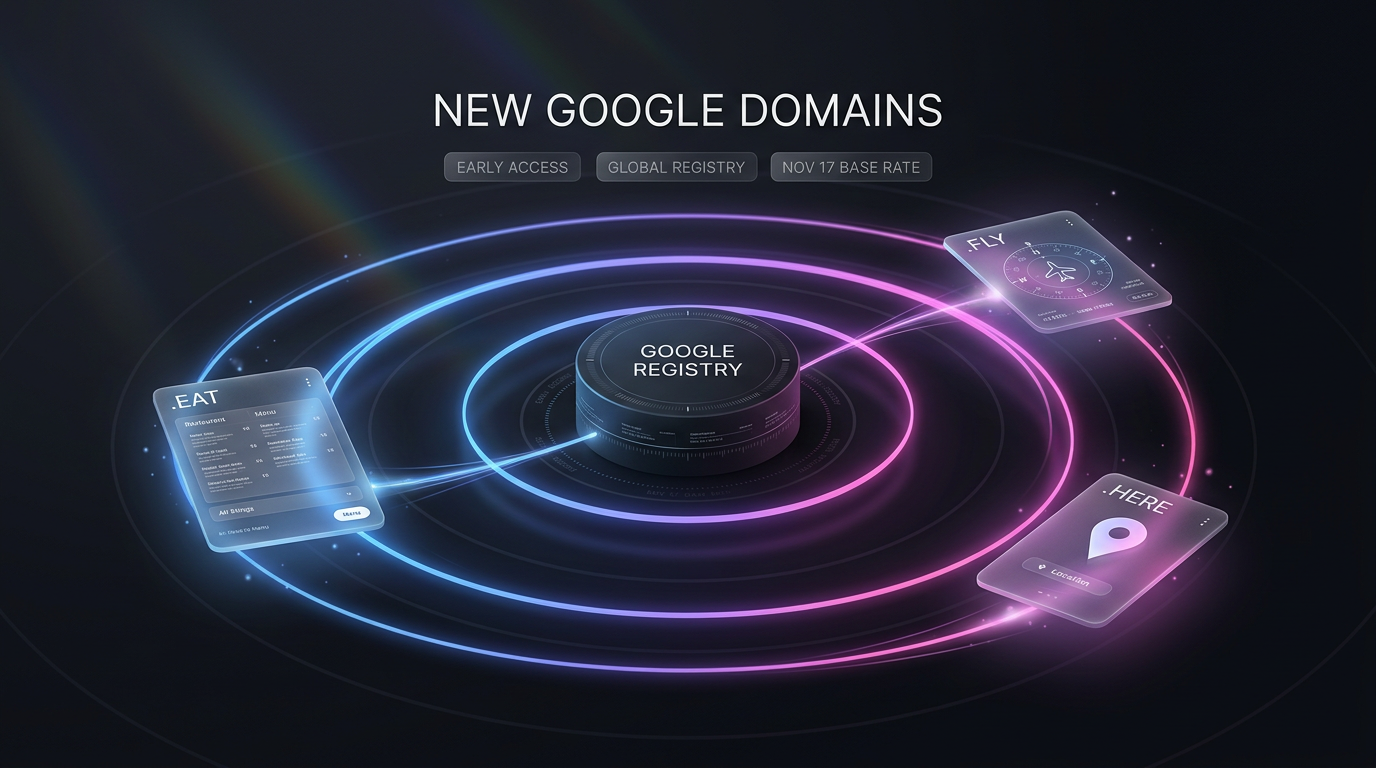
Google Registry has officially rolled out three new Google domains: .eat, .fly, and .here. Announced on November 10, 2026, by Bruno Panara of the Google Registry team, these top-level domains give companies and independent builders clean website endings that explain their primary offer before a visitor clicks a link. The release introduces options for hospitality teams, aviation and automated travel systems, and localized digital services.
As announced on the Google Registry blog, the three namespace additions are currently accessible under an Early Access Program. This phase uses an additional one-time registration tier fee that drops daily until regular public registration opens at standard base pricing. For builders planning online architecture, securing clear domain names remains a foundational step in clear digital positioning.
The Rollout Schedule for New Google Domains
The release follows a phased rollout model common to domain registry expansions. Starting on November 10, 2026, interested businesses can register names across all three extensions through their preferred domain registrars. During this initial Early Access Program, buyers pay an added fee above the standard annual renewal fee. This initial fee drops each day according to a predetermined schedule managed by Google Registry.
The early access window runs for exactly seven days. At 16:00 UTC on November 17, 2026, the three extensions transition into general public availability. Once that threshold passes, businesses can secure available addresses at standard base annual pricing without any one-time early access charge. This setup allows trademark holders and brands to secure high-priority terms early if they wish to pay the premium, while standard projects can wait for base-rate open registration.
Breaking Down .eat for Dining and Food Services
The .eat extension targets food brands, restaurants, consumer packaged goods, and specialized hospitality software. Google Registry positioned this domain to help food businesses replace long or awkward URLs with short terms directly tied to their menus or products.
Several organizations registered names during the initial testing period:
- Wingstop selected wingstop.eat to direct visitors toward its flavored chicken wings and brand menu.
- Clayton Farms, an operator of quick-serve restaurants that grow microgreens and produce directly on-site, secured america.eat to map regional fresh food distribution.
- Ghips registered ghips.eat to present its specialty potato chips cooked in grass-fed ghee.
- Xook secured xook.eat for its robotic automated food kiosks serving fresh salads and rice bowls.
- Kinro launched insurance.eat to provide restaurant owners with commercial insurance quotes through licensed brokers.
For culinary brands and software tools serving kitchens, these examples show how a dedicated ending eliminates extra filler words like “order” or “get” from a primary web address.
How .fly Serves Travel, Aviation, and Logistics
The second extension in the release, .fly, serves commercial travel providers, logistics infrastructure, and autonomous drone operators. Several early adopters are pairing this ending with automated assistance and verification tools:
Caddy operates caddy.fly, offering a conversational assistant inside WhatsApp and iMessage that books commercial flights, schedules hotel stays, and handles itinerary changes. Onfly also secured on.fly, developing business travel tools where employees book or cancel trips through automated messaging interfaces. In industrial flight, Voltair registered voltair.fly to showcase long-range utility drones that inspect electrical power lines across remote terrain.
The extension also houses developer platforms that borrow the term metaphorically. Canary uses canary.fly to host tools that test and verify code generated by automated models before production deployment. In subscription billing, Flycode operates flycode.fly, running recovery workflows that automatically retry failed customer credit card payments.
Practical Actions on .here for Local and Instant Services
The third addition, .here, acts as an action-oriented destination for digital platforms, hiring boards, legal support, and health tracking. It functions as a direct call to action, pointing users toward immediate completion of a task.
Real estate platform Zillow secured two distinct action paths: rent.here for apartment hunters and sell.here for property owners seeking valuations. Rocket Lawyer uses lawyer.here to connect clients with licensed legal representatives and digital contracts. Candidate placement engine Apply runs apply.here to pair job seekers with verified employer rosters.
Other operational uses include bloodtest.here from SiPhox Health, where patients order home test kits and track mail-in laboratory markers, and worlds.here from Pocket Worlds, a hub connecting users into social virtual environments. For founders planning client interaction portals, .here provides clear directional routing without unnecessary subdomains.
Evaluating Brand Positioning and Technical Routing
Selecting one of these new Google domains requires weighing clean branding against established naming conventions. While standard extensions like .com maintain broad recognition, shorter names on descriptive extensions help prevent typos on mobile devices and physical signage. Short addresses are easier to read on printed menus, vehicle wraps, and short-form marketing materials.
Companies building modern online infrastructure frequently pair dedicated extensions with custom redirects. A business can maintain its legacy domain for corporate email and administrative records while using an address like order.eat or apply.here for specific public campaigns. This split configuration preserves established search standing while improving click clarity on targeted conversion pages.
Practical Setup with Modern Systems
When incorporating these domain options into custom digital projects, connecting DNS records cleanly to hosting providers and CRM funnels is the primary technical requirement. Wasif frequently sets up focused destination landing pages during web designing builds, configuring custom apex records and CNAME paths to route incoming domain traffic directly into high-converting interfaces.
For businesses deploying automated backends, integrating a concise domain with custom software development ensures that incoming webhook endpoints, intake questionnaires, and booking flows remain distinct from internal dashboards. Clean addresses reduce confusion when clients receive automatic confirmations via SMS or transactional emails.
FAQs About New Google Domains
When will the new Google domains become available at standard prices?
The Early Access Program concludes on November 17, 2026, at 16:00 UTC. At that point, .eat, .fly, and .here become available at standard base annual registration prices through public domain registrars without extra access fees.
Can any business or person register these domain extensions?
Yes. Google Registry has opened .eat, .fly, and .here as generic top-level domains without restrictive industry licensing requirements. Any organization or individual can register available names through supported registrar partners.
Do new domain endings hurt search rankings?
Search engines treat top-level domain extensions equally when evaluating content quality and relevance. Using one of the new Google domains will not inherently hurt search rankings, provided the site follows proper indexing practices, structured data rules, and standard technical optimization.
Conclusion
The arrival of .eat, .fly, and .here adds three functional branding choices for hospitality, travel, and digital service businesses. By understanding the rollout dates and early access fee structure, business owners can evaluate whether securing high-value keywords now or waiting for general availability on November 17 fits their branding strategy.
If you are planning your next online build or want to streamline your digital platform architecture, reach out to Wasif Ahmed to discuss your project.