Cloudflare has announced Bot Preference Sync, a feature designed to keep a website’s robots.txt file aligned with edge-level AI crawler policies. The tool is available across all plan tiers, from Free to Enterprise accounts. As crawler traffic diversifies across search indexing, AI agent actions, and model training, Cloudflare announced on its official blog that site owners can now manage both edge firewalls and crawler directives from a single dashboard location.
Key Changes Introduced with Bot Preference Sync
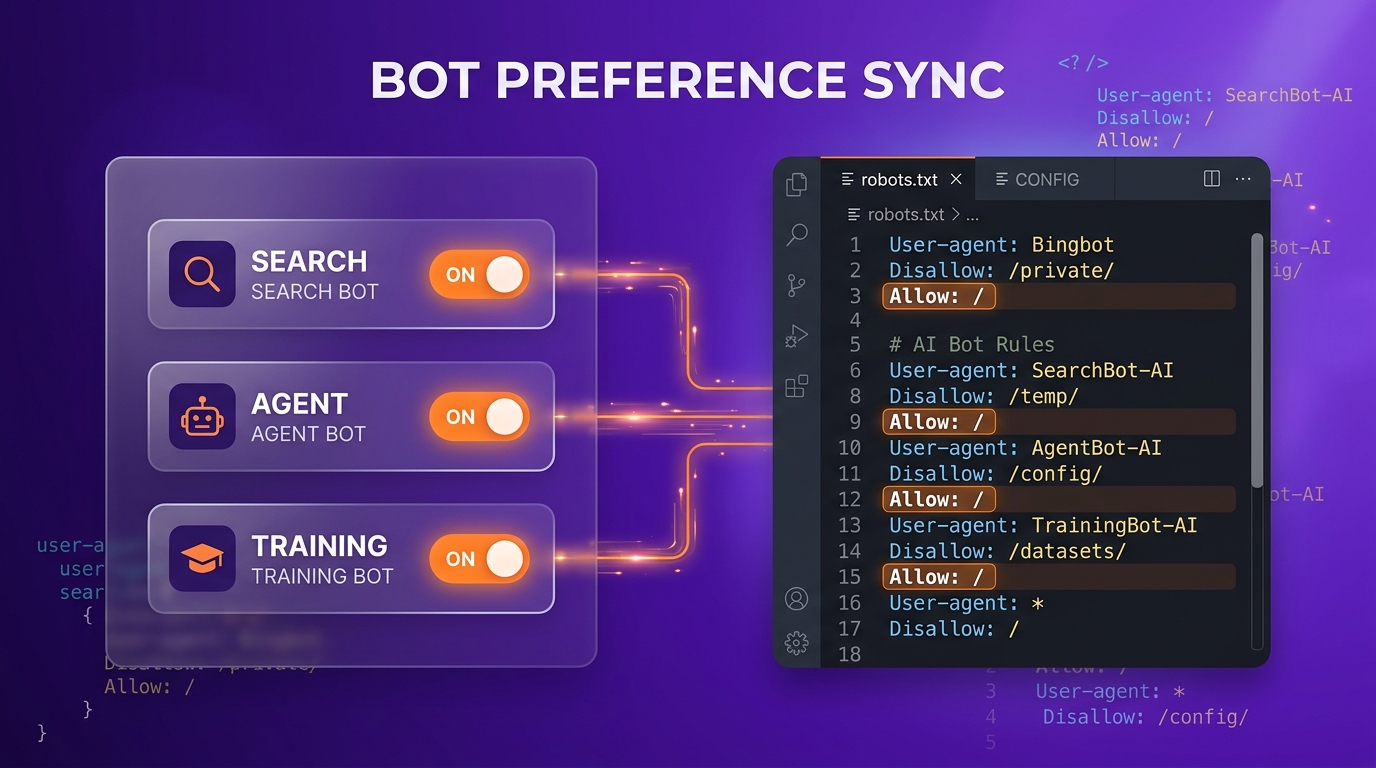
Managing crawler access traditionally required administrators to handle two separate layers: the public robots.txt file and edge security rules. When these configurations conflict, crawlers may ignore stated directives or attempt to bypass enforcement mechanisms. Cloudflare Bot Preference Sync resolves this gap by automatically updating the robots.txt file whenever an administrator adjusts AI bot rules in the zone dashboard.
The system categorizes AI bot traffic into three distinct groups:
- Search crawlers that index content for standard discovery and web search results.
- AI agent crawlers that retrieve information on behalf of users interacting with assistants.
- Training crawlers that scrape text, imagery, and code to train machine learning models.
For Search and Agent traffic, site operators can choose to allow access, block access on pages that serve advertisements, or block access entirely. For Training traffic, a Disallow option writes specific directives into robots.txt while maintaining search visibility for verified crawlers that provide transparency data.
How the Robots.txt Integration Operates
Instead of overwriting existing website configurations, Bot Preference Sync prepends generated directives to the top of the existing robots.txt file. Any pre-existing custom disallow rules remain untouched below the managed block. Cloudflare maintains the list of specific user-agents through its internal BotBase registry, periodically updating the crawler strings as new AI bots emerge.
For all newly created accounts, Bot Preference Sync is active by default. Existing accounts that utilized legacy managed robots.txt settings receive a prompt to review their current settings and transition to the updated system. Site operators running customized or highly granular rule sets retain the option to turn the automated synchronization off at any time.
Cloudflare also introduced a specific default workflow for ad-supported websites. During domain setup, administrators can indicate that their site relies on ad monetization, which sets model training to Disallow automatically. This default aims to preserve human ad traffic and search indexation without permitting unmonetized model scraping.
Transparency Standards for Mixed-Use Crawlers
A persistent technical challenge for site owners involves mixed-use crawlers, where a single bot user-agent handles both search indexing and model training. To prevent search penalties when blocking training, Cloudflare requires crawler operators to satisfy specific transparency criteria to maintain verified status under a Disallow Training rule.
To avoid blanket edge blocks under disallow rules, bot operators must respect robots.txt preferences, provide options to opt out of AI summaries, grant URL-level visibility into scraped pages, and demonstrate publicly that disallowing training does not diminish traditional search ranking. Cloudflare tracks compliant and non-compliant crawlers publicly within its Radar platform.
What This Changes for Client Builds
In custom web designing and development projects, maintaining crawler hygiene often requires manual static file deployments whenever new AI scrapers launch. Automated synchronization reduces maintenance overhead by letting administrators govern AI data ingestion directly at the DNS and edge layer.
For businesses integrating AI automation workflows, having granular control over which content agents can index helps protect proprietary data while maintaining inbound search discovery. Wasif implements these edge configurations to ensure client websites maintain clear boundaries between commercial search traffic and automated model scraping without breaking technical SEO standards.
To evaluate your website architecture or configure your edge bot management rules, reach out through the contact page.