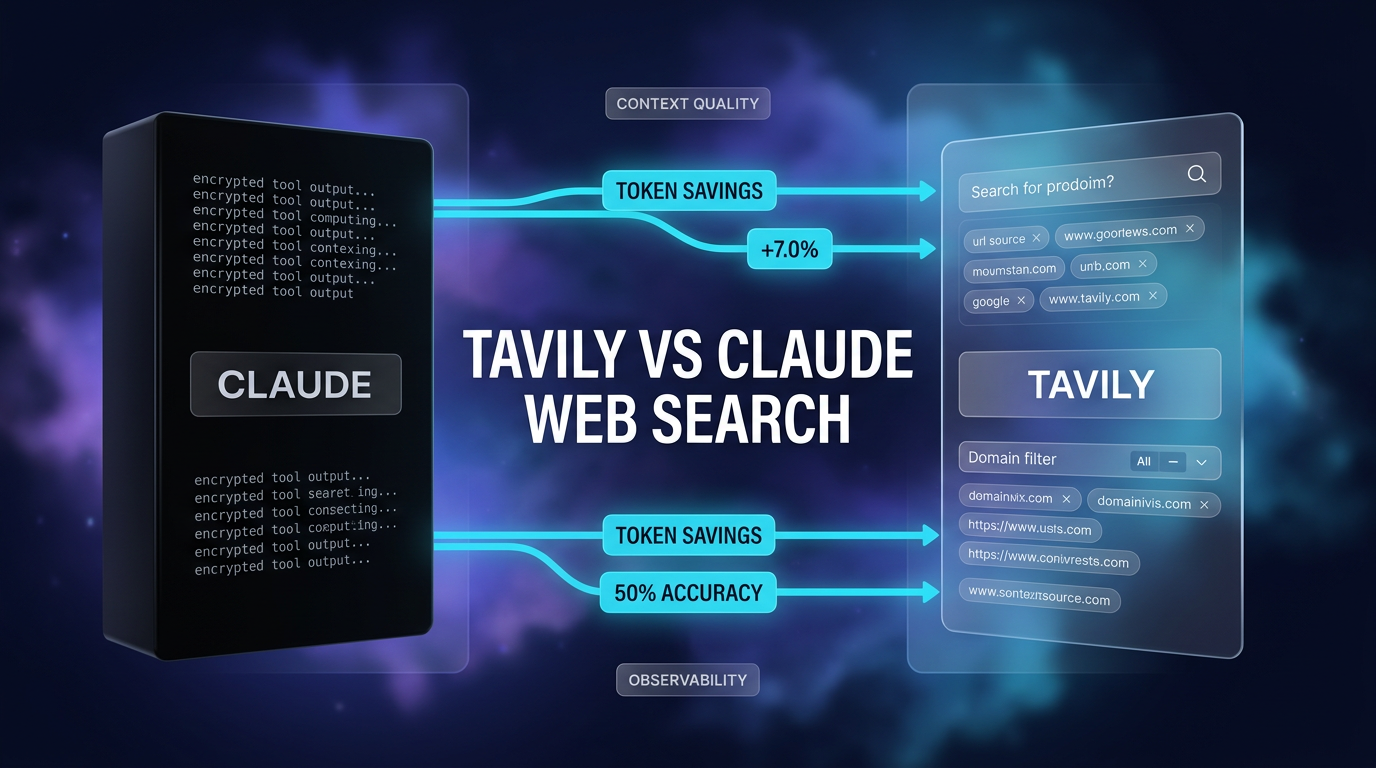
Evaluating Tavily vs Claude web search has become a practical decision for developers moving conversational prototypes into real-world automated agents. Native web access inside Anthropic’s Claude provides an immediate way to retrieve recent online data without configuring extra infrastructure. When agents transition into continuous business workflows, search accuracy, context bloat, observability, and token expenses quickly redefine project requirements.
A benchmark published by Tavily evaluated Tavily vs Claude web search across SealQA-Hard, a standard test set of 254 multi-hop web queries. By holding the prompt, model, search budget, and evaluation framework constant, the test isolated how retrieval APIs influence end results. The findings highlight clear distinctions between managed provider tools and dedicated search infrastructure designed specifically for autonomous models.
Accuracy and Context Density in Tavily vs Claude Web Search
The primary duty of an external search layer is delivering relevant context so the underlying large language model can synthesize accurate responses. In the SealQA-Hard benchmark, Tavily Advanced achieved 15.3 percentage points higher accuracy than Claude native search while maintaining comparable response latency. This performance gap stems largely from how retrieved web content gets filtered before reaching the model prompt.
Large language models do not automatically benefit from voluminous text dumps. Raw HTML scrapes or weakly filtered web pages consume large portions of the context window with navigation menus, boilerplate language, and irrelevant side content. Tavily structures search outputs specifically for LLM ingestion, prioritizing information density over raw document volume. Giving Claude cleaner snippets enables clearer reasoning without forcing the model to sift through excess noise.
Token Consumption and Inference Cost Comparison
Inference expenses scale directly with input token volume, making retrieval efficiency a central budget factor. In the benchmark tests, Tavily Basic consumed 40 percent fewer tokens than Claude native web search across the 254 test questions. Tavily Advanced consumed 15 percent fewer tokens while producing the highest overall accuracy marks.
When calculating the cumulative spend per verified correct answer, the financial divergence between Tavily vs Claude web search expands:
- Tavily Basic required roughly half as many tokens per correct answer as Claude native search, cutting inference spend by approximately 50 percent.
- Tavily Advanced reduced costs per correct answer by roughly 40 percent compared to native Claude retrieval while delivering the highest task accuracy.
- Claude native search passed encrypted tool responses to the client, preventing developers from pruning input payloads before generation.
- Dedicated search APIs permit strict search depth toggles, limiting unnecessary document parsing during routine queries.
For applications executing tens of thousands of automated research runs monthly, reducing prompt token bloat produces measurable cost savings across production schedules.
Query Control and Developer Observability
Production reliability requires complete visibility into how an agent gathers facts. Claude native search packages web retrieval as an internal model tool, which hides the exact search query strings and returns encrypted tool call outputs. When an automated agent returns an incorrect conclusion or hallucinates, engineers cannot inspect the underlying search parameters to locate the failure point.
In contrast, Tavily operates as an explicit, observable API layer. Developers can log the exact queries formulated by the agent, review returned source URLs, and inspect the retrieved text fragments. This transparency simplifies debugging, regression testing, and quality assurance across continuous workflows.
Configurability also allows teams to adapt search behavior to specific business domains. Tavily allows engineers to restrict searches to whitelisted industry domains, set strict publish date ranges, adjust result depth from lightweight checks to deep crawls, and exclude irrelevant websites. Native model search generally forces a single, opaque retrieval behavior across all operational tasks.
Model Independence in Agentic Architectures
Tying search infrastructure directly to a single foundation model creates architectural lock-in. Rapid development across the AI ecosystem means engineering teams frequently rotate between Claude, OpenAI models, Gemini, or specialized open-source models hosted on independent infrastructure. When web retrieval is coupled to Claude’s proprietary tooling, switching models requires refactoring the agent’s web browsing implementation entirely.
Decoupling search from the reasoning engine keeps the retrieval pipeline stable regardless of which language model runs inference. Tavily connects directly into orchestration libraries like LangChain and LlamaIndex, as well as the Model Context Protocol (MCP). Teams can evaluate new reasoning models without rebuilding data connectors, domain whitelists, or citation parsers.
This architectural separation is especially valuable when building multi-agent teams. A research planner might operate on Claude 3.5 Sonnet, a data extractor might run on a cost-effective open-source model, and a report writer might utilize another system entirely. A shared, external search tier maintains uniform document retrieval standards across every worker node.
Where This Fits in Real Client Implementations
In client solutions designed around AI automation and custom Agentic AI Systems, Wasif Ahmed evaluates retrieval tooling based on system predictability rather than short-term setup convenience. While Claude native search works well for quick internal proofs of concept, multi-step business pipelines demand audit trails and deterministic budget controls.
When building agents that monitor market trends, enrich sales data, or cross-reference regulatory guidelines, Wasif Ahmed connects dedicated search layers via APIs. This structure keeps data gathering observable, protects context budgets from irrelevant token bloat, and preserves the flexibility to route tasks across different models as platform pricing shifts.
FAQs
When is Claude native web search the better option?
Claude native search is suitable for quick prototypes, single-turn prompts, and internal desktop exploration where setting up an external search API key is unnecessary. It allows teams to test whether an idea needs web retrieval without managing third-party infrastructure.
How does Tavily reduce LLM token usage?
Tavily cleans and summarizes web results before passing them into the model context window, eliminating boilerplate HTML, duplicate paragraphs, and irrelevant text. In published tests, this reduced token usage by up to 40 percent compared to raw native search passes.
Can Tavily be used with models other than Claude?
Yes, Tavily functions as an independent REST API and integration module. It works across OpenAI, Anthropic, Google Gemini, and open-source models through tools like LangChain, LlamaIndex, and the Model Context Protocol.
Understanding the operational differences in Tavily vs Claude web search helps businesses design stable automated workflows that remain cost-effective at scale. If you are planning an autonomous agent deployment or want to refine your workflow architecture, reach out through the contact page to discuss your project.
Bottom line: Tavily vs Claude web search comes down to prototype convenience versus a dedicated retrieval layer for production agents. When you compare Tavily vs Claude web search for real workloads, the deciding factors are configurable search, full observability, portable model infrastructure and inference cost per correct answer. For production teams, Tavily vs Claude web search is a question of control, not just convenience.