Building production-ready AI agents requires moving past the controlled conditions of internal prototypes. In a recent technical session hosted by search API provider Tavily, Forward Deployed Engineer Harsh Kataria, along with team members Christie Green and Yuval Perry, addressed the core problem teams face when moving autonomous workflows into production. The session, detailed in an article announced on the Tavily blog, outlined an architecture designed to deliver verifiable web research for high-stakes business environments.
In industries such as banking, compliance, and lending, automated assistants often fail because they lack traceable evidence. Prototype agents tend to rely on unstructured browsing, gathering noisy web pages filled with cookie consent banners and irrelevant display ads. To deploy production-ready AI agents that human reviewers can trust, developers must separate how information is retrieved from how text is generated.
Step 1: Start with the Decision and Work Backward
Most automation projects begin by drafting open-ended prompts that instruct an LLM to research a topic broadly. In production environments, this broad approach creates unpredictable answers and high token expenses. Reliable agent engineering begins with the terminal decision required by the operational team.
Consider a Know Your Customer (KYC) onboarding check. An operational reviewer does not need an essay summarizing a business. The reviewer needs answers to three specific questions: Does the entity have adverse media coverage? Are there active sanctions matches? Is there an unresolved ownership discrepancy?
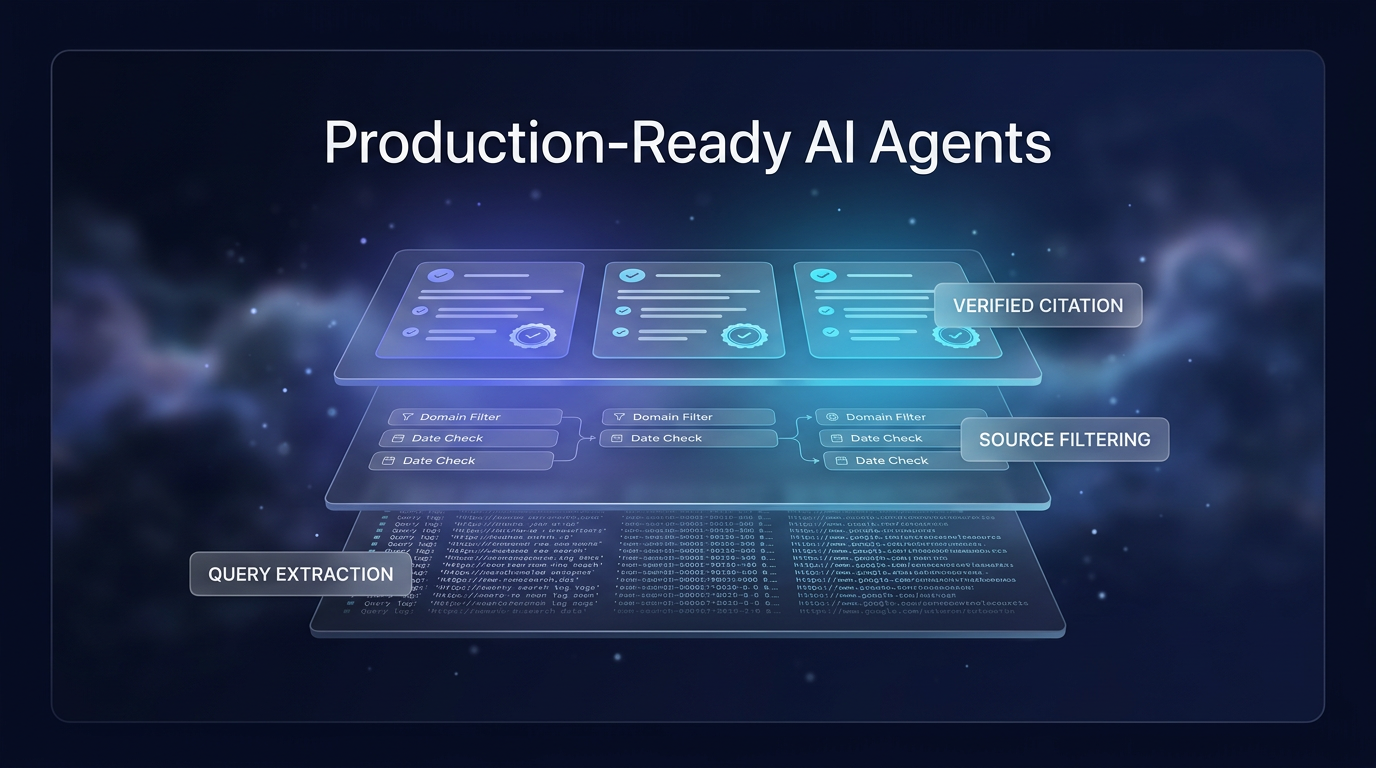
When teams define these discrete decisions in advance, the agent scope changes. Instead of browsing indiscriminately, production-ready AI agents generate targeted search queries for each specific risk parameter. The system retrieves source documents, extracts verifying citations, and flags conflicting data.
If the retrieved evidence contains conflicting records or insufficient corroboration, the system does not force the language model to guess. It routes the case directly to a human specialist, preserving operational safety and regulatory auditability.
Step 2: Evaluate Retrieval Separately from Generation
When an agent produces an inaccurate answer, engineering teams frequently rush to change system prompts or swap foundational models. This reaction misdiagnoses the failure point. In automated web workflows, bad answers usually stem from low-quality source data rather than model reasoning flaws.
To build production-ready AI agents, engineers must isolate the retrieval pipeline from the generation layer. If the agent receives low-grade source material, no prompt engineering will produce an accurate report. Inspecting the raw payload prior to model inference helps teams track several operational metrics:
- The exact query strings generated by the routing model.
- The volume of clean, readable text versus extraneous layout noise.
- The publication dates and recency of retrieved URLs.
- The verified domains that supply the supporting evidence.
Teams can enforce retrieval controls programmatically before passing context to an LLM. For instance, developers can restrict queries to authoritative regulatory domains, enforce published date ranges to exclude outdated press releases, and extract complete article text instead of brief search snippets. Clean context dramatically lowers token consumption while keeping human review cycles fast.
Step 3: Reuse One Search Foundation Across Multiple Workflows
Once a team solves the retrieval pipeline for one operational workflow, the architecture should serve other business functions. Teams do not need to rebuild web navigation connectors, rate limits, or verification filters for every new project.
A standardized agent architecture uses a consistent four-part sequence: specify the operational question, search for verified evidence, filter and normalize the content, and deliver a structured payload to the reviewer. This structure transfers across compliance, risk underwriting, and corporate intelligence.
During their technical session, Tavily highlighted real-world operational gains reported by enterprise users. Tavily noted that a global payments provider reduced KYC research durations from hours to minutes using focused web retrieval. Tavily also reported that a Fortune 500 financial institution lowered market research times across hundreds of thousands of corporate entities from roughly seven days to 15 minutes. In underwriting, consolidating fragmented browser tabs into structured, cited dossiers reduced manual search friction.
Reusing a single retrieval engine allows technical teams to focus on domain-specific schema design rather than low-level web scraping infrastructure. When building production-ready AI agents across multiple departments, architectural consistency reduces long-term maintenance costs.
Common Pitfalls in Web-Connected Agent Builds
Moving autonomous workflows into daily operations reveals recurring structural bottlenecks. Avoiding these technical missteps saves engineering cycles:
Relying on raw search engine snippets often breaks generation quality. Search snippets frequently cut off relevant factual context, leading models to hallucinate surrounding details. Systems need full-page text parsing with HTML boilerplate stripped away.
Ignoring domain reputation filters creates compliance vulnerabilities. If an agent treats an unverified forum post with the same weight as a corporate registry filing, the resulting report will mislead analysts. Filtering queries to verified top-level domains removes ungrounded noise.
Failing to store retrieved source URLs prevents human verification. A production system must link every factual assertion to a persistent citation. Without direct citation links, human reviewers are forced to re-run manual searches, defeating the purpose of automation.
FAQs
What are production-ready AI agents?
Production-ready AI agents are autonomous software systems designed to complete defined tasks using real-world data while meeting strict operational standards for reliability, cost, and verification. Unlike early prototypes, these agents feature isolated retrieval layers, strict domain filtering, and explicit source citation so human operators can verify their work.
Why should retrieval be evaluated separately from text generation?
Separating retrieval evaluation allows developers to see whether errors result from bad source data or model hallucination. If search results contain broken pages, ads, or outdated articles, fixing prompts will not solve the issue. Inspecting retrieved data directly keeps context clean and lowers API token expenses.
How do automated agents reduce risk in compliance workflows?
Automated agents enforce consistency by running pre-configured queries across trusted databases and corporate registries. They present human analysts with documented citations, relevant excerpts, and date stamps. When source data is incomplete or contradictory, the agent escalates the task to an analyst rather than fabricating a conclusion.
Putting Real-Time Search to Work
When Wasif Ahmed designs and deploys Agentic AI Systems & AI Workforce solutions, the primary technical goal is operational predictability. In real client environments, an agent cannot be left to browse the web without guardrails. It must operate on explicit rules, strict retrieval parameters, and structured outputs.
Wasif connects external retrieval APIs and language models directly into production backends through platforms like Make.com and custom application code. Combining high-density search retrieval with workflow tools like AI automation ensures that data moves reliably from raw search requests into core databases and CRM platforms. For teams handling complex research tasks, these structured pipelines convert unreliable chat experiments into dependable operational tools.
If you are planning to deploy production-ready AI agents that deliver verified data into your company workflows, contact Wasif at https://wasifahmed.dev/contact/ to discuss your architecture.