The Claude Duet proactive agent has officially launched as a research preview, introducing a standalone application designed to handle workplace tasks independently across connected software tools. Anthropic unveiled the preview on their platform, detailing how the software coordinates calendar management, administrative chores, and complex cross-platform operations on behalf of users. The preview release was announced on the Claude official resource site and marks a shift toward asynchronous, goal-oriented AI interactions.
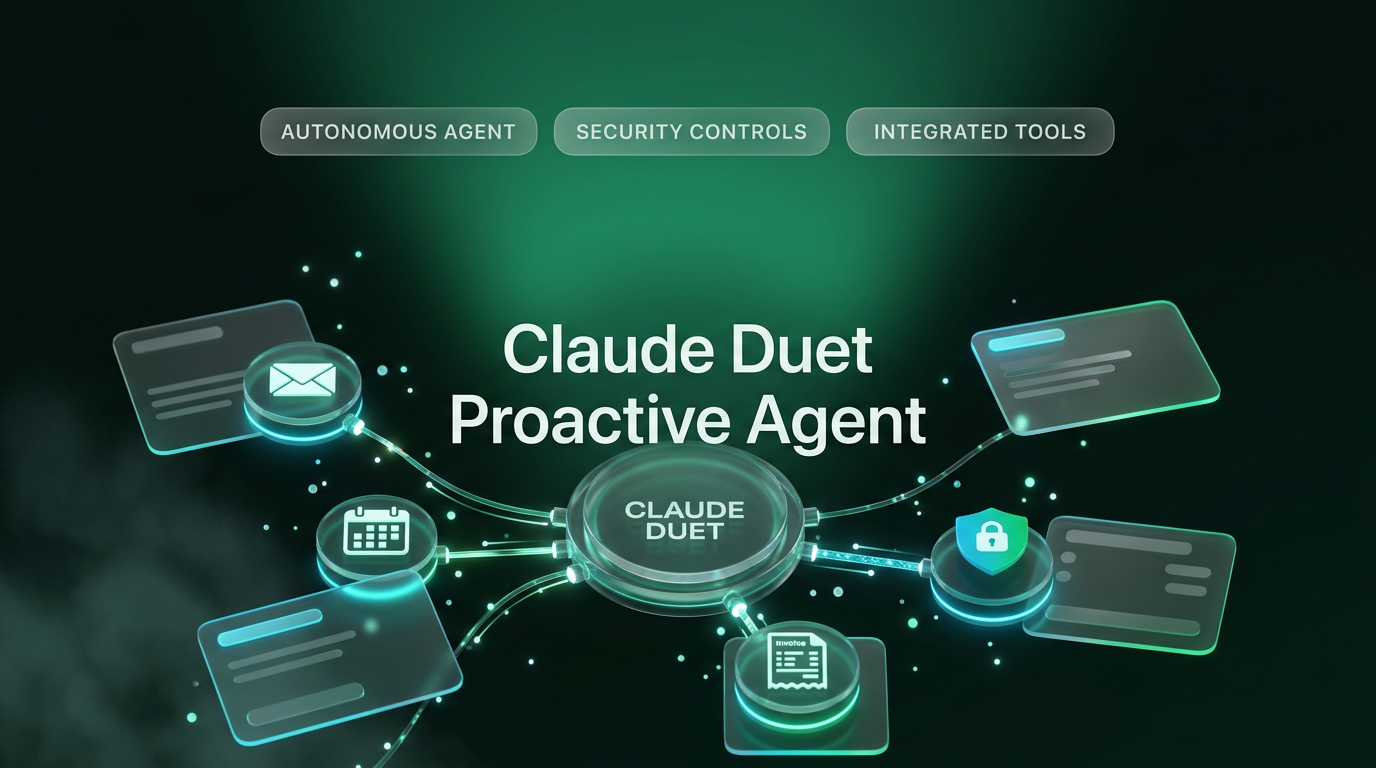
Rather than waiting for manual prompts at a desk, the Claude Duet proactive agent monitors connected services, generates morning priorities, and executes multistep workflows in the background. It is currently available as a standalone app on iOS, Android, and web via claude.ai for Pro and Max tier subscribers located in the United States via a waitlist.
Core Features of the Claude Duet Proactive Agent
The foundation of the Claude Duet proactive agent relies on the Claude Opus 5.5 model architecture. Anthropic built the interface to run as a single ongoing thread accessible by voice or text, carrying forward existing context, memory, and custom skills already established on a user account.
A critical architectural difference is background execution. The application provisions a dedicated virtual machine running its own headless browser. This design allows the Claude Duet proactive agent to execute tasks without requiring an active browser tab, an open laptop, or an unlocked phone. The system checks connected services periodically rather than continuously, an intentional operational choice designed to preserve account usage allowances during the preview phase.
Users can assign routine administrative jobs or broader technical tasks. These capabilities include:
- Scanning incoming messages on Gmail and Slack to draft context-aware replies for review.
- Checking Intuit QuickBooks or Stripe records to locate unpaid invoices and prepare reminder notes.
- Compiling payroll numbers inside Gusto with recorded hours, reimbursements, and bonuses.
- Assembling job postings and publishing them to LinkedIn after manual verification.
- Drafting agreements and circulating them for formal signature through DocuSign.
- Pulling contact deal records from HubSpot to create targeted follow-up communication.
- Building social media assets directly in Canva based on product launch details.
- Configuring and operating Shopify storefronts, with an interactive visual editor planned for a later release.
Safety Classifiers and Approval Boundaries
Granting an external program autonomous access to business tools requires strict technical boundaries. The Claude Duet proactive agent draws upon Anthropic’s established agent safety frameworks, incorporating the auto mode classifier used in Claude Code to restrict actions that stray beyond explicit user intent.
To handle authentication safely, the architecture uses the credential management standards built for Claude Managed Agents. This mechanism prevents the agent from directly reading or storing raw passwords and authentication tokens. In addition, the software incorporates dedicated defense layers developed from browser-use research to mitigate hidden prompt injections and malicious instruction overrides. Independent penetration testing and public bug bounty programs monitor the underlying infrastructure.
Data discretion operates through a dedicated safety classifier and custom system prompt. The system automatically refuses requests that involve transmitting high-tier sensitive records, specifically government identifiers and credit card credentials. Secondary private information, such as health files or sensitive financial records, is strictly blocked from leaving the workspace unless the user issues explicit authorization.
Financial transactions require multi-tiered confirmations. The Claude Duet proactive agent can initiate purchases via Stripe Link using virtual payment cards or Shopify Shop Pay. However, each transaction demands direct confirmation before execution, while sensitive financial maneuvers like trading securities or moving funds between bank accounts remain entirely prohibited.
How the Claude Duet Proactive Agent Changes Workflow Management
Traditional software automation requires rigidly mapped triggers, webhooks, and explicit logical branches. When an unexpected variable occurs, a standard workflow script halts or throws an exception. In contrast, this agent model relies on reasoning capabilities to make discretionary assessments about priority and scheduling.
For example, early testing shared by Anthropic demonstrated the agent reviewing calendar events and flagging scheduling conflicts caused by flight departures without requiring a dedicated automation rule. In another scenario, business operators processed multiple vendor invoices across individual store locations without manually switching between software accounts.
The system distinguishes between silent background processing and mandatory checkpoints. While the agent prepares drafts, structures dashboards, and gathers data independently, it pauses and prompts for manual confirmation before deleting records, dispatching formal client emails, or submitting payments. This dynamic oversight model allows business teams to maintain human supervision over critical touchpoints while offloading routine preparation work.
Current Limitations in the Research Preview
Because the release remains an early research preview, Anthropic noted several operational constraints. The software is primarily tuned for professional business workflows rather than personal consumer errands such as purchasing transit tickets. The virtual browser instance running in the cloud cannot currently be viewed in real time by the end user.
Usage consumption also requires consideration. Tasks delegated to the Claude Duet proactive agent consume the standard rate limits assigned to Claude Pro and Max plans. Running extensive modeling projects, generating presentation decks, or maintaining background syncs counts toward plan allotments faster than short conversational queries. Users can configure how frequently the agent checks connected accounts and what alert categories trigger direct notifications.
Integrating Autonomous Agents with Core Systems
For builders developing modern AI automation pipelines, tools like this preview highlight the growing transition from reactive assistants toward persistent workplace operators. While standalone chat interfaces serve quick inquiries well, durable operational gains occur when reasoning models connect directly to underlying business records.
Wasif designs structured systems that unite large language models with production platforms such as Go High Level and Make.com. Implementing proactive systems requires clean data hygiene, precise API boundaries, and clear human-in-the-loop triggers to ensure automated tasks execute safely. Exploring enterprise solutions like Agentic AI Systems & AI Workforce configurations allows businesses to connect automated workflows without exposing critical customer records or payment systems.
The rollout of the Claude Duet proactive agent signals that persistent, background autonomous helpers are becoming standard workspace components. Business teams that establish clean system architectures today will be best positioned to deploy these agents reliably.
If you are planning to implement autonomous agents and automated workflows in your business, reach out to Wasif Ahmed to discuss your architecture.