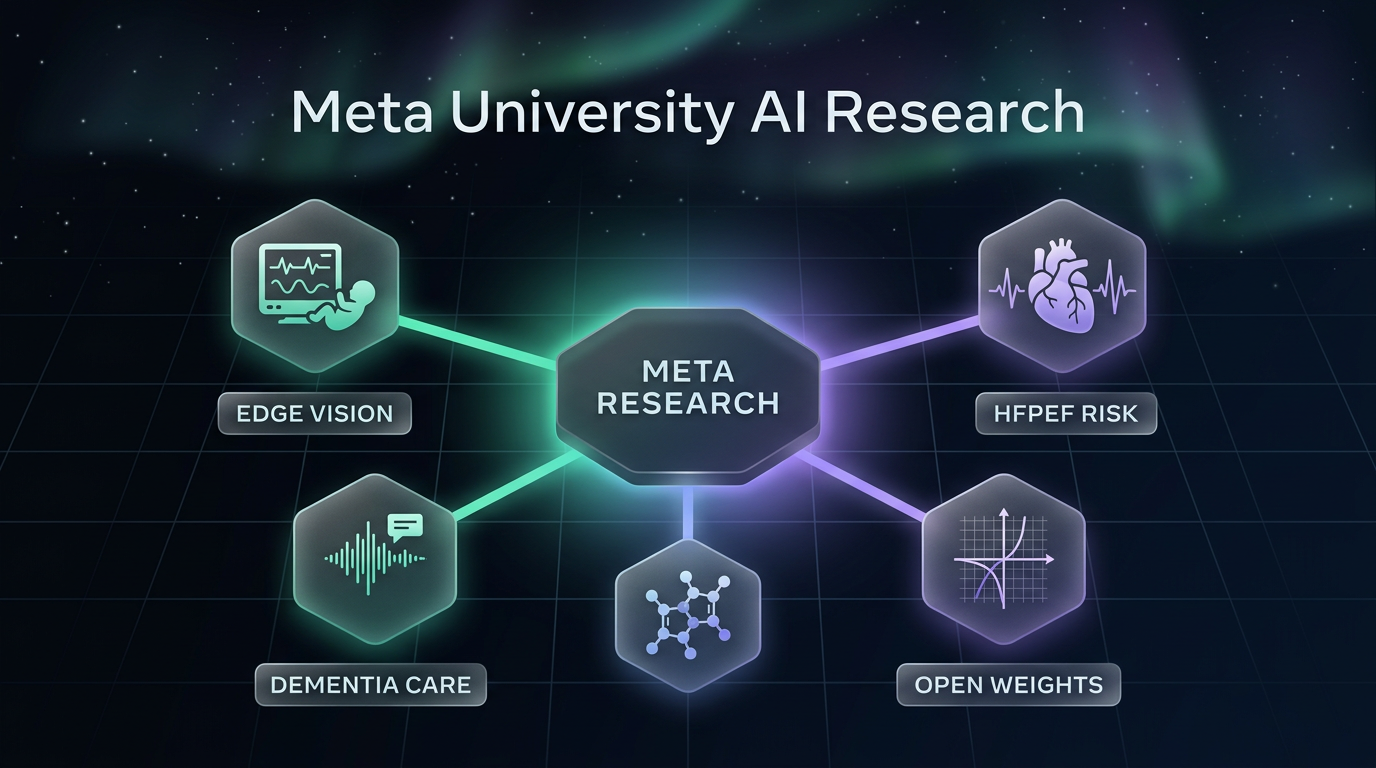
Meta university AI research is expanding through a direct collaboration initiative with five prominent United States institutions. As announced by Meta, the company is committing two million dollars across five schools to support academic investigations in medicine, biology, chemistry, physics, mathematics, and computer science. The partner institutions include California Institute of Technology, The Ohio State University College of Medicine, Louisiana State University, Indiana University, and UTHealth Houston.
Rather than focusing purely on abstract theory, these academic partnerships target practical clinical problems where commercial software often stalls. The initiative grants university teams access to Meta superintelligence models, open-weight foundational assets, smart glasses, and mixed reality hardware to address critical gaps in bedside monitoring, clinical decision support, and patient communication.
The Core Focus of Meta University AI Research
The allocation of two million dollars across five institutions provides structured funding alongside model weights and physical devices. Meta states that the program pairs financial grants with direct researcher collaboration, enabling university investigators to examine how open-weight architectures perform under clinical conditions.
Academic teams work across several disciplines, but the initial spotlight centers heavily on healthcare. In clinical settings, off-the-shelf software frequently fails because medical data is messy, patients cannot always communicate conventionally, and bedside safety demands real-time monitoring without sending raw video feeds to external commercial cloud servers. The newly funded research tracks explore whether lightweight, open-weight vision and language systems can solve these exact logistical bottlenecks.
Beyond medicine, the program extends into basic scientific disciplines. Researchers across mathematics, physics, biology, chemistry, and computer science will evaluate how foundational models assist with complex calculations, molecular modeling, and algorithmic problem-solving. This dual focus on natural sciences and patient care ensures that the theoretical capabilities of large models are grounded against rigorous experimental testing.
Bedside Computer Vision: Infant Tracheostomy Monitoring at LSU
One of the central projects supported by Meta university AI research is taking place at Louisiana State University under the direction of Dr. Michael Dunham. Known as the Eyes-On project, this effort addresses the severe clinical hazard of tracheostomy tube displacement in infant patients.
When an infant tracheostomy tube dislodges, clinical intervention must happen immediately to prevent asphyxiation. Infants with tracheostomies cannot cry out or vocalize distress, making bedside alarms or staff observation the sole line of defense. However, continuous one-to-one human observation by medical staff is not always feasible across full shifts. The Eyes-On project is developing a computer vision system to detect accidental tube displacement and physical signs of infant distress automatically.
Dr. Dunham's team explores Meta's open-weight Segment Anything Model (SAM) families for persistent image segmentation and anatomical tracking. Designed to operate alongside bedside cameras running on edge computing hardware, the system is structured to process frames locally rather than relying on high-latency cloud streaming. A proof-of-concept study has already been published, with further testing planned under this grant.
Local processing is fundamental to the system architecture. By keeping image inference within the patient room, the setup maintains continuous monitoring without requiring external network connectivity or creating patient privacy compliance risks. The project tests whether open vision models can sustain spatial tracking when an infant shifts position, turns, or exhibits subtle physical indicators of respiratory difficulty.
Adaptive Conversational Systems: Dementia Care at Indiana University
At Indiana University, Meta university AI research takes a distinct conversational direction. Led by Dr. David Crandall, researchers are tackling the communication hurdles faced by older adults living with dementia.
Standard commercial voice agents, whether deployed on smart displays or customer service phone trees, operate on predictable sentence syntax and standard vocal cadences. When an individual with cognitive impairment pauses unpredictably, repeats phrases, or uses atypical phrasing, conventional conversational interfaces regularly fail. This breakdown creates confusion and emotional frustration instead of utility.
Dr. Crandall's initiative aims to develop multimodal AI methods that study live conversational patterns involving people with dementia. The objective is to enable conversational agents, including assistive social robots, to recognize non-standard interaction cues and adjust pacing, phrasing, and contextual memory dynamically. The project assesses whether language models can be conditioned to exhibit genuine sensitivity to individual cognitive differences without requiring users to conform to rigid software inputs.
The integration of multimodal cues allows the system to analyze facial expressions, speech rhythm, and verbal content simultaneously. By examining these signals together, the interface can detect moments of confusion early. Rather than repeating an unhelpful prompt, the conversational agent can rephrase questions, simplify choices, or introduce supportive pauses to keep the interaction calm and productive.
Cardiovascular Diagnostics: Early HFpEF Detection at Ohio State
The third detailed healthcare track in Meta university AI research involves The Ohio State University College of Medicine. Artificial intelligence researchers Dr. Yuan Xue and Dr. Xia Ning are collaborating with cardiologist Dr. Yuchi Han to detect heart failure with preserved ejection fraction, commonly known as HFpEF.
Heart failure with preserved ejection fraction represents approximately fifty percent of all heart failure cases diagnosed today. Despite its high prevalence, early clinical identification is notoriously difficult. Early signs often mimic benign conditions or obesity, which means formal cardiological testing is frequently initiated only after advanced physical deterioration occurs.
The Ohio State research team is evaluating how Meta's open-weight models can assist in assessing future HFpEF vulnerability before severe episodes happen. Their approach leverages non-invasive, routinely collected diagnostic assets:
- Standard routine abdominal CT scans that patients receive for unrelated abdominal complaints.
- Longitudinal electronic medical records tracking vital signs, past medications, and lab panels over time.
- Resting electrocardiogram (ECG) readouts when available within patient files.
A notable feature of this project is its deliberate handling of missing data. Standard deep learning models often require complete diagnostic sets to run, whereas real-world hospital databases rarely feature complete inputs. The team is engineering the analytical framework specifically to make valid risk assessments even when historical scans or specific lab metrics are absent from the record.
By combining retrospective imaging with temporal patient records, the algorithm extracts subtle indicators of cardiovascular strain that individual clinical evaluations might overlook. The objective is not to replace cardiologist assessment, but to provide a passive screening mechanism that flags high-risk patients during routine care visits.
Why Open-Weight Models Matter for Clinical AI Applications
The technical structure of Meta university AI research emphasizes open-weight models over closed proprietary APIs. In clinical environments, this architectural choice brings measurable functional advantages that proprietary, hosted models struggle to match:
First, medical institutions face strict data governance policies. Pushing protected health information through external closed APIs introduces significant compliance friction. Open-weight models can be hosted entirely on internal hospital infrastructure or local edge hardware, ensuring patient data never leaves secure physical perimeters.
Second, medical researchers require inspectability. To diagnose why a diagnostic predictor flagged a high risk of HFpEF, physicians need to trace weights, model activations, and decision boundaries. Closed-source systems do not permit that depth of auditability.
Third, low latency is critical at the point of care. As demonstrated in the LSU tracheostomy project, detecting acute respiratory emergencies requires immediate inference. Running models locally on edge devices avoids network latency and connection dropouts that could compromise bedside safety.
Finally, open-weight architectures allow fine-tuning on specialized medical cohorts. Institutional researchers can adapt base vision and language weights to specific hospital camera hardware, unique sensor calibrations, and localized population demographics without sharing their proprietary clinical datasets with an external model vendor.
What This Signals for Practical AI Deployments
While Meta university AI research funds university laboratories, the mechanical takeaways matter for commercial engineering as well. When Wasif Ahmed evaluates system architecture for AI automation and Agentic AI Systems & AI Workforce builds, data fragmentation and strict privacy requirements mirror the exact challenges seen in clinical environments.
Many business workflows attempt to send fragmented customer records into rigid commercial models, resulting in hallucinated outputs or complete processing failures. The engineering choices being tested at Ohio State, LSU, and Indiana highlight the necessity of designing systems that accommodate missing variables, run resiliently on localized compute, and tailor responses to individual user traits.
In enterprise settings, system reliability relies heavily on predictability. Workflows that depend on third-party cloud endpoints often face unexpected API changes, variable response times, and ongoing data transmission liabilities. Implementing open-weight models gives engineering teams complete control over inference hardware, versioning, and internal security auditing.
As these academic teams release their findings, the broader development community will gain validated approaches for deploying open-weight vision and language models directly where edge reliability is mandatory. For organizations planning specialized automation architectures that require strict data privacy, exploring how open-weight models handle non-standard inputs provides a clear path forward.
Frequently Asked Questions About Meta University AI Research
Which institutions are participating in the program?
The five partner universities receiving grant funding and direct collaboration are California Institute of Technology, The Ohio State University College of Medicine, Louisiana State University, Indiana University, and UTHealth Houston.
What hardware and models are supplied through the initiative?
Meta university AI research equips participating teams with superintelligence models, open-weight foundational assets such as the Segment Anything Model family, smart glasses, and mixed reality headsets to investigate real-world clinical and scientific applications.
What disciplines are covered under the grants?
While early project announcements highlight clinical care, the funding program also supports academic investigations across physics, chemistry, biology, mathematics, and computer science.
To discuss how open-weight architectures and lessons from Meta university AI research apply to your operational workflows, contact Wasif Ahmed directly.