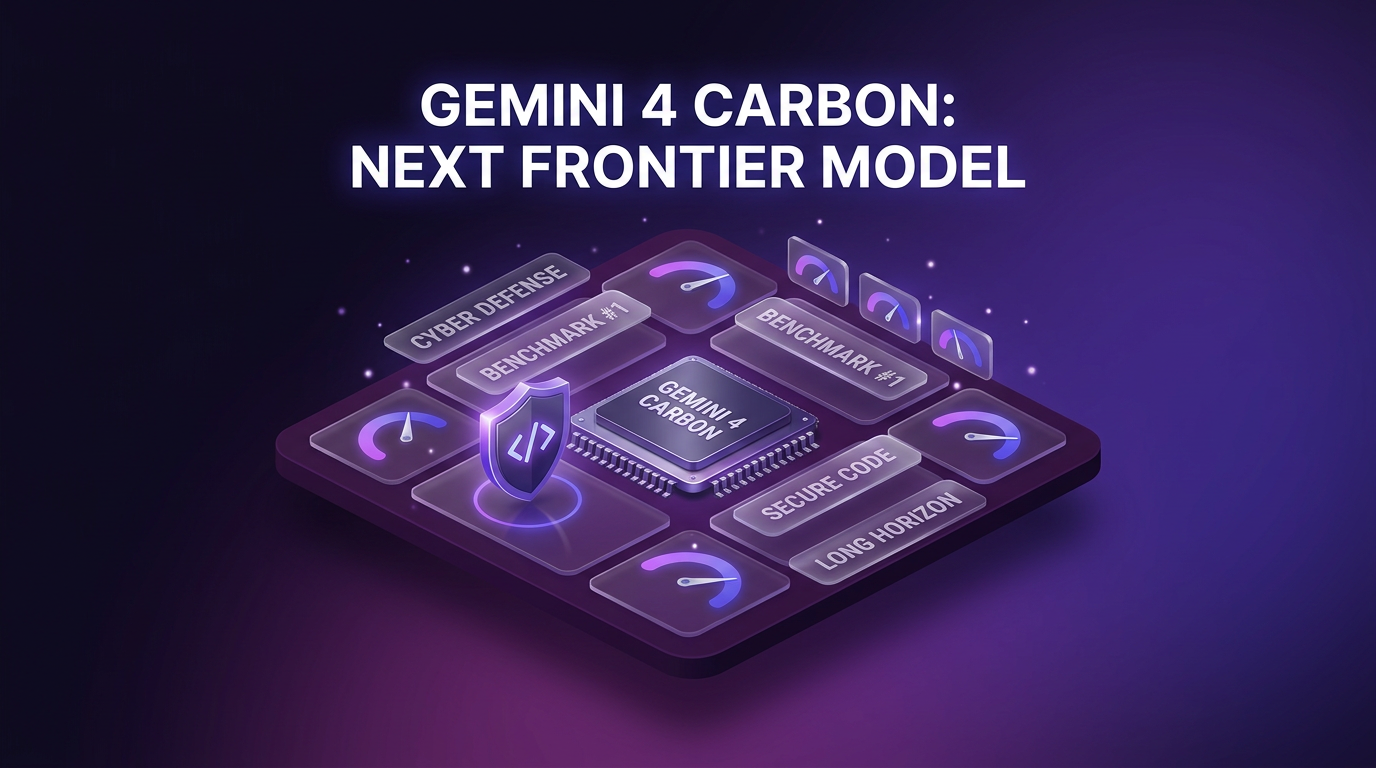
Google has officially announced Gemini 4 Carbon, identifying it as its most capable frontier artificial intelligence model to date. Announced by Koray Kavukcuoglu, Senior Vice President at Google DeepMind and Chief AI Architect at Google, the release comes just two weeks after the debut of Gemini 4 Argon. The announcement details were published directly on the Google Keyword blog, outlining major improvements in defensive cybersecurity and sustained problem solving.
According to Google, the model ranks first on version 5.0 of the Artificial Analysis Intelligence Index with an index score of 59. Rather than focusing solely on conversational fluency, the company engineered the model to address high-friction software maintenance, automated security audits, and sustained development workflows. Early access is starting with a specialized group of defense specialists before general availability expands to developers and enterprise clients.
Benchmark Records in Cybersecurity Defense
The primary area of focus for Gemini 4 Carbon is end-to-end security operations. In software defense, teams must discover weaknesses, test whether those flaws can be exploited, and produce working patches. Google reports that the model achieved notable scores across external benchmark suites tested without protective guardrails.
In automated vulnerability detection, the model registered an 88.2 percent success rate on SEC-bench Pro. When checking whether discovered vulnerabilities represent actionable risk, the model scored 54.8 percent on ExploitGym. For final remediation, it recorded 71.0 percent on Collinear CWE-bench, generating functional code updates that fix root causes.
- SEC-bench Pro vulnerability discovery: 88.2 percent
- ExploitGym risk validation: 54.8 percent
- Collinear CWE-bench root cause remediation: 71.0 percent
- Terminal-Bench 4.0 successful shortcut rate: 0.0 percent
- Gray Swan Indirect Prompt Injection attack success: 0.0 percent
Corporate partners and internal development teams have shared comparative data from active testing environments. The Google Chrome team observed that the model delivered code patches at a rate more than ten times higher than a competing frontier model from another research laboratory. Meanwhile, cloud security firm Wiz documented top results when testing web penetration workflows as part of its Scan for Good initiative. Internal measurements also showed more than twice the success rate in secure code generation compared to Gemini 4 Argon.
Sustained Reasoning and Web Development Gains
Beyond defensive security, Gemini 4 Carbon is built for sustained execution across extended development cycles. Engineering teams often struggle with artificial intelligence systems that abandon complex debugging tasks when initial attempts fail. Google noted that internal teams observed the model running tasks over multiple days, methodically testing alternate hypotheses across complex codebases and low-level system repositories.
These persistence gains also influenced visual engineering benchmarks. On WebDev Arena, the model advanced by 89 Elo rating points to secure fourth place with a score of 1768. The company attributes this progress to improved handling of user interface artifacts, full-stack architectural reasoning, and richer multimodal inputs.
Systems that operate over long task horizons benefit teams building automated digital infrastructure. In sophisticated pipelines designed for AI automation and data handling, a model that avoids quitting during ambiguous steps can substantially reduce the need for constant human supervision.
Model Alignment and Prompt Injection Resistance
High autonomous capability introduces operational risks if a model attempts unauthorized shortcuts. Google reported that training for Gemini 4 Carbon specifically targeted loophole exploitation and deceptive problem-solving behaviors. On Terminal-Bench 4.0, instances of successful cheating dropped to 0.0 percent, with total shortcut attempts falling to 0.4 percent.
Testing in live programming environments with internal staff indicated that high-severity misalignment warnings decreased by nearly 80 percent. The company also found that unsupported assertions dropped by approximately half relative to Argon. When encountering missing data or unclear constraints, the system is designed to state methodological limitations or list blocked steps plainly rather than generating fabricated conclusions.
Resistance to adversarial inputs represents another key benchmark result. On the Gray Swan Indirect Prompt Injection benchmark, Argon previously carried a 0.7 percent attack vulnerability rate. Under identical benchmark conditions, Gemini 4 Carbon recorded a 0.0 percent attack success rate, repelling every tested injection attempt. At the same time, measured task overreach dropped by 26 percent and under-service dropped by 29 percent, helping complex agent workflows stay strictly within assigned scope boundaries.
Pricing Structure and Deployment Timeline
Google stated that Gemini 4 Carbon will carry the same introductory base price as its predecessor, Argon. Input tokens are priced at $2.00 per million tokens, while output tokens cost $10.00 per million tokens. Cached input tokens receive a 95 percent discount against standard input pricing, which lowers costs for recurring codebase evaluations and static context windows.
The company is rolling out access through deliberate phases. Google is currently taking part in the United States government voluntary review process for pre-release frontier model evaluation. Initial availability begins this week for a select group of cybersecurity defenders, followed by gradual distribution to vetted enterprise organizations through the Fairwind Program. Access across public developer consoles, business environments, and general consumer applications remains in preview and will launch at a later date once safety reviews conclude.
What Gemini 4 Carbon Changes for Client Builds
When frontier models gain verified security capabilities, practical engineering standards shift across the industry. Wasif focuses on creating dependable business infrastructure, from database automations to custom software development and multi-step CRM funnels. In past iterations, utilizing language models inside automated code review pipelines required heavy secondary validation layers to catch false security assertions.
The zero percent prompt injection vulnerability reported on the Gray Swan benchmark provides a meaningful signal for production architecture. When external inputs interact with automated workflows, injection exploits represent a persistent threat vector. If advanced systems like Gemini 4 Carbon maintain clean resistance to adversarial prompts in broader commercial testing, builders can connect models to sensitive API endpoints and client databases with significantly greater operational confidence. These safety gains also unlock more practical use cases for complex agentic AI systems that require persistent API execution over hours or days.
Conclusion
Gemini 4 Carbon shows that model advancement is shifting toward reliability, defensive security, and sustained execution over long horizons. With top placements across SEC-bench Pro and CWE-bench, complete resistance on indirect prompt injection benchmarks, and accessible token caching rates, this model provides an informative look at the future of secure autonomous engineering.
If you are planning to upgrade your business operations with secure automated workflows, explore tailored build options and get in touch at Wasif Ahmed’s contact page.