The Kitesurf browser engine is now officially open source under the Apache 2.0 license. Cloudflare announced the release on its engineering blog, fulfilling a commitment made when the project first appeared in August and gained WebMCP support in September. Developers can now inspect the codebase on GitHub, test the engine on local machines, make modifications, and deploy their own instances directly to Cloudflare Workers.
Building autonomous tooling often requires programmatic web access, but traditional headless browsers like Chromium consume substantial memory and compute. The Kitesurf browser engine provides an alternative architecture designed specifically for automated workloads. Instead of running inside a heavy container, it executes as a stateless browser directly on serverless infrastructure.
What Changed With the Open Source Release
Cloudflare published the full repository for the Kitesurf browser engine to GitHub with open governance and an Apache 2.0 license. Developers who previously relied strictly on managed Browser Run endpoints can now self-host the entire pipeline within their own infrastructure accounts.
The release allows teams to study how the browser executes web tasks, run local development environments via the Wrangler command-line tool, and submit pull requests to the upstream repository. By opening the code, Cloudflare enables developers to adapt browser internals for specialized web scraping, verification pipelines, and AI agent execution environments.
How the Kitesurf Browser Engine Operates
The Kitesurf browser engine executes web pages without relying on a full browser container. It parses raw HTML documents, applies CSS style sheets, executes inline and external JavaScript, and outputs rendered visual screenshots directly from serverless Workers. The software supports the Chrome DevTools Protocol, often abbreviated as CDP, which enables direct connections from automation libraries such as Puppeteer.
To make this possible within the constraints of edge execution, the project incorporates several open-source Rust libraries compiled directly into WebAssembly. Each library handles a specific phase of the document lifecycle:
- Blitz manages HTML parsing, layout trees, the Document Object Model, and basic painting routines.
- Stylo evaluates CSS rules, handles cascade logic, and calculates computed element styles.
- Boa operates as an internal JavaScript interpreter inside WebAssembly when scripts cannot execute directly in Dynamic Workers.
- Linebender libraries handle font typography, text layout calculations, and 2D vector graphics.
- Krilla converts rendered elements into downloadable PDF documents.
The system uses Dynamic Workers on paid Cloudflare plans to create isolated execution environments for individual web pages. This separation ensures that unpredictable third-party scripts do not destabilize the primary engine session.
The Core Architecture Across Three Main Parts
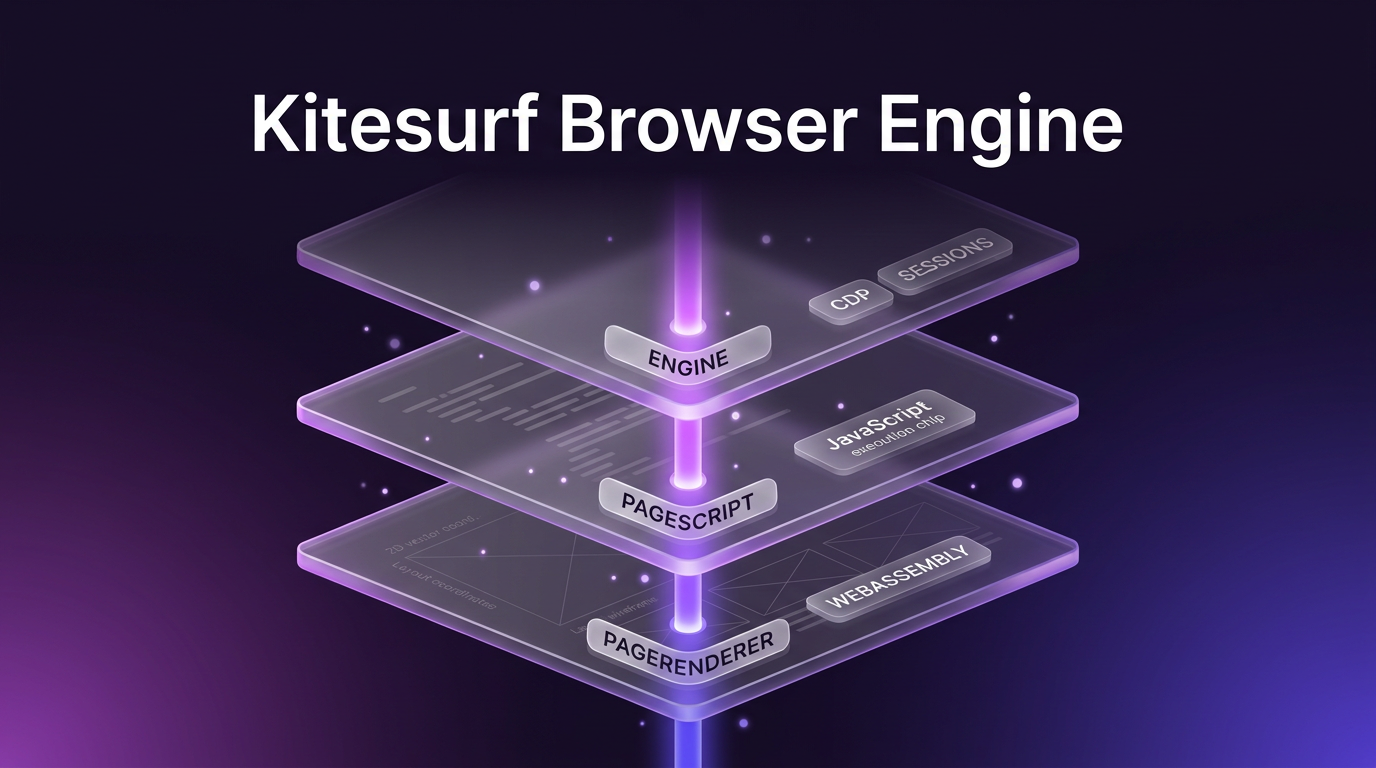
The repository organizes the Kitesurf browser engine into three distinct runtime layers located inside its packages folder. Understanding this division helps builders trace how data flows through the application during an active session.
1. The Engine
The Engine acts as the central coordinator. It accepts incoming WebSocket requests from automation frameworks, manages session initialization, and routes commands delivered through the Chrome DevTools Protocol. When an automation script requests a navigation event, the Engine establishes the session context and directs lower-level components to begin fetching assets.
2. PageScript
PageScript supervises the execution context of the target website. It executes page scripts, monitors DOM modifications, and maintains internal page state. Whenever an external agent triggers button clicks, form fills, or navigation changes, PageScript processes those operations inside the sandbox environment.
3. PageRenderer
PageRenderer translates layout calculations into graphic buffers. Once Stylo computes visual styles and Blitz determines spatial positions, PageRenderer draws the resulting pixels. This component produces screenshots and visual outputs that autonomous models use to visually understand document layouts.
Running and Testing the Engine Locally
Developers can test the Kitesurf browser engine on local machines before publishing it to a production account. The build pipeline requires standard Node.js development tooling along with Rust compilation targets. The initial setup requires cloning the repository and running dependency installation routines through pnpm:
git clone https://github.com/cloudflare/kitesurf.git
cd kitesurf
pnpm install --frozen-lockfile
pnpm run dev
The first build compiles the underlying Rust crates into WebAssembly bundles, which requires several minutes depending on workstation hardware. Subsequent runs utilize cached compiler artifacts. After compilation completes, the Wrangler utility starts a local development server at http://127.0.0.1:8787.
You can connect standard automation scripts directly to this local endpoint using Puppeteer Core. The following code snippet demonstrates connecting to the running instance and capturing a page screenshot:
import puppeteer from "puppeteer-core";

const browser = await puppeteer.connect({
  browserWSEndpoint: "ws://127.0.0.1:8787/devtools/browser",
});

try {
  const page = await browser.newPage();
  await page.goto("https://example.com/");
  await page.screenshot({ path: "page.png" });
} finally {
  await browser.disconnect();
}
Because the interface speaks standard Chrome DevTools Protocol commands, automation harnesses and autonomous agent frameworks can interact with the local port without requiring custom drivers.
Deploying to Cloudflare Infrastructure
Deploying the Kitesurf browser engine to a personal or enterprise account requires a Workers Paid plan. This requirement exists because the engine provisions Dynamic Workers on demand to isolate page execution contexts.
Deployment happens directly from the repository root using the command pnpm run deploy. Once published, your Cloudflare account hosts a private, autoscaling browser endpoint that charges based on worker invocation time rather than dedicated virtual machine uptime. This change significantly lowers idle costs for teams operating intermittent automated browsing tasks.
Practical Implications for Developers and Builders
For builders constructing automated workflows, the release provides several clear technical advantages. Traditional browser management often requires maintaining Docker containers running headless Chrome on virtual servers. These containers consume gigabytes of baseline memory and introduce cold-start latency when scaling up.
The Kitesurf browser engine scales on demand across edge locations. Because the memory footprint of WebAssembly modules is substantially smaller than a bundled Chromium instance, compute consumption remains low. However, teams should note that Kitesurf remains under active development. The engineering team notes that compatibility with full web platform standards is an ongoing focus, meaning complex, non-standard web applications may encounter occasional rendering differences compared to standard desktop browsers.
What This Changes for Client Builds
When designing Agentic AI Systems & AI Workforce solutions, managing browser overhead is a regular operational challenge. Traditional scraping and verification nodes require dedicated container hosting that runs continuously even when tasks are idle.
In practical AI automation projects, Wasif evaluates lightweight serverless options to reduce infrastructure overhead while maintaining reliable execution. Having the Kitesurf browser engine available as open-source software gives developers full transparency into browser operations. Teams can verify network behavior, eliminate unnecessary third-party dependencies, and establish cost-effective agent environments that scale dynamically.
Conclusion
The open-source release of the Kitesurf browser engine gives builders a lightweight, stateless alternative to resource-heavy browser containers. By combining Rust, WebAssembly, and Cloudflare Workers into a modular architecture, Kitesurf provides programmatic web interaction tailored for the demands of modern automation systems.
If you want to integrate serverless web extraction or autonomous agent workflows into your operations, feel free to reach out to discuss your project.