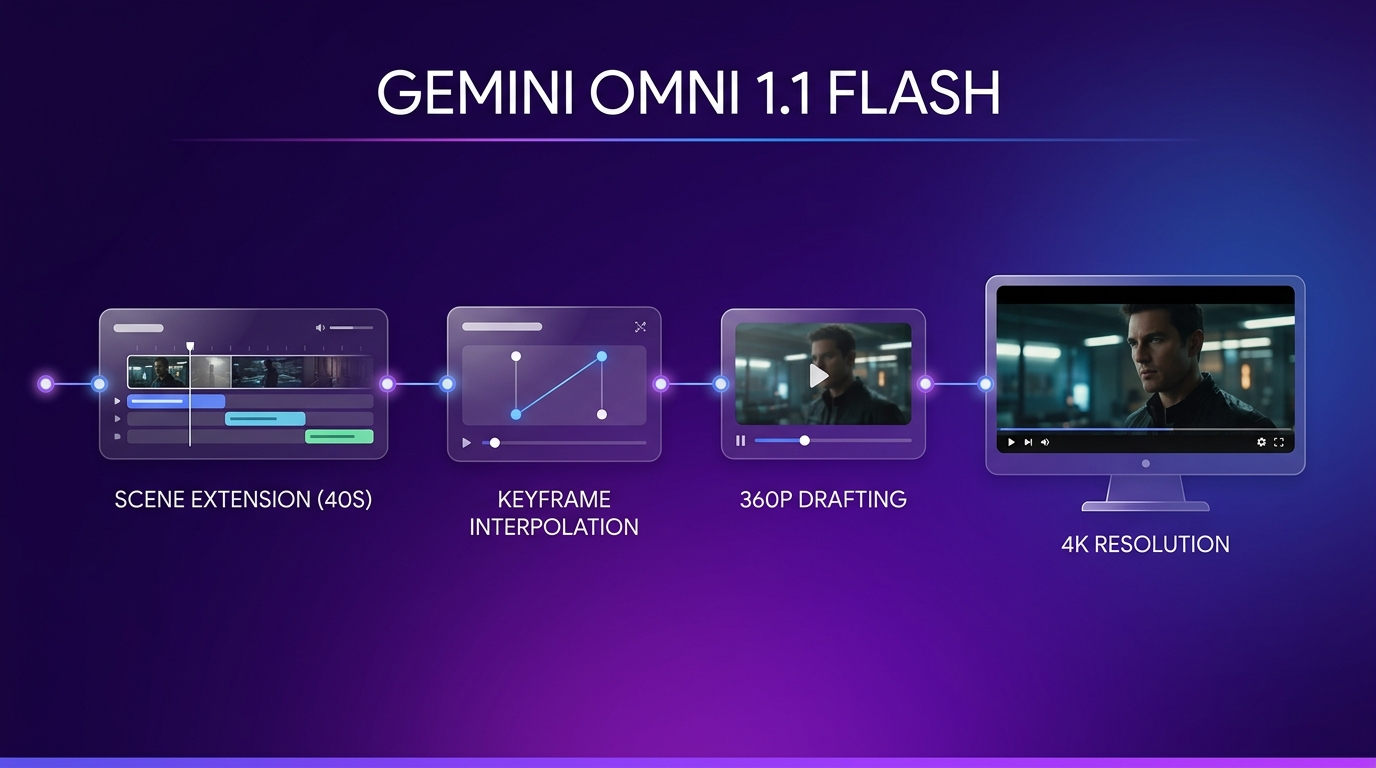
Google has released Gemini Omni 1.1 Flash, introducing developer controls designed for generative video workflows. The update focuses on precision editing features, including scene extension, keyframe interpolation between start and end frames, fast drafting options, and high-resolution 4K output. Developers can access the model through the Gemini API in Google AI Studio or via the Gemini Enterprise Agent Platform, as announced on the Google blog.
Key Features in Gemini Omni 1.1 Flash
The update addresses common constraints in generative video, specifically the lack of camera continuity and high compute costs during iterative testing. Rather than generating isolated video clips, developers now have granular parameters to manipulate narrative progression and visual framing.
- Extended Scene Generation: The model can analyze up to 10 seconds of prior footage, compared to the single second evaluated in previous versions. This enables sequential extensions in 10-second increments up to a total clip length of 40 seconds while maintaining visual consistency.
- First and Last Frame Interpolation: Developers can specify starting and ending image frames to direct camera movements, smooth transitions, and whip-pans without relying solely on text descriptions.
- Lightweight 360p Previews: A low-resolution drafting tier allows developers to generate preview videos up to 60 percent faster and at one-third of the standard 720p cost.
- 4K Resolution Output: Final video outputs can be rendered or upscaled to 1080p and 4K for production environments.
- Multimodal Video References: Developers can feed up to 3 seconds of reference video into prompts to guide motion styles, character actions, and scene context.
Better Narrative Consistency and Camera Control
Earlier text-to-video systems struggled to retain character appearance, lighting, and object placement across multi-shot sequences. By expanding the context window to evaluate up to 10 seconds of prior video, Gemini Omni 1.1 Flash reduces visual drift across extended renders.
The keyframe interpolation feature allows builders to define exact camera paths. By locking the starting frame and ending frame, the model fills in the intermediate motion. This simplifies complex camera directions like orbital rotations, continuous dolly-zooms, or transitions between different visual environments without jump cuts.
Drafting Economics for Production Workflows
Iterating on generative media has traditionally been resource-heavy. Developers often run multiple prompt variations before selecting a usable output, making high-resolution generation expensive during early testing phases.
Google addresses this with the 360p drafting tier. Because 360p rendering uses fewer compute resources, teams can test script pacing, camera angles, and character choreography at lower cost. Once a prompt sequence delivers the desired visual composition, the asset can be finalized in 1080p or 4K resolution.
For developers building custom video editors, social media creation tools, or media rendering pipelines, this separation between drafting and production rendering significantly improves workflow economics.
Practical Uses in Automation and Media Tools
The structured API support in Gemini Omni 1.1 Flash opens several integration paths for automated content pipelines and custom software applications:
- Real Estate and Product Showcases: Systems can take static photos of a property or physical item as start and end frames, rendering smooth walkthroughs or 360-degree inspection clips without human filming.
- Dynamic Media Pipelines: Using structured code calls, developers can chain scene generation requests sequentially, passing interaction IDs to build multi-scene promotional videos.
- Rapid Storyboarding: Content teams can prototype entire sequences using lightweight 360p clips before committing resources to final renders.
What This Changes for Client Builds
In client automation systems, generative media often proves difficult to manage when outputs lack predictability. When building automated pipelines across social media management or custom web platforms, dependable API control is essential.
Wasif monitors updates like Gemini Omni 1.1 Flash to assess how video generation can be reliably embedded into broader systems. Predictable keyframe transitions and cost-effective drafting make generative assets far more viable inside structured AI automation workflows and multi-step media pipelines.
If you want to integrate generative media or structured workflow automation into your business systems, reach out to Wasif Ahmed to discuss your project requirements.