Google has announced Gemini 4 Hydrogen, an execution model focused on everyday coding and rapid multi-agent workloads. Introduced by Google DeepMind on November 12, 2026, the model targets tasks requiring quick responses, steady instruction following, and lower operational costs across multi-model software stacks.
As detailed in the official announcement from Google, the model sits alongside frontier reasoning options such as Gemini 4 Carbon and Gemini 4 Argon. While Carbon and Argon handle deep, long-horizon architectural problems, Gemini 4 Hydrogen acts as a high-speed execution engine for writing code, verifying changes, and managing routine tool interactions.
Key Specifications of Gemini 4 Hydrogen
Gemini 4 Hydrogen introduces several significant architectural adjustments compared to previous lightweight offerings like Gemini 3.8 Flash. Google reports that the model finishes everyday tasks 2.5 times faster at its default high setting while reducing fabricated claims by more than five times. It is priced flat across its full 1 million-token context window at $1.50 per million input tokens and $7.50 per million output tokens, supporting up to 1 million output tokens.
The system is accessible across multiple environments from launch day. Developers can access it through Google AI Studio, the Gemini API, Gemini for business, and Google Search. It is also available to consumers through the Gemini mobile app, as well as paid Google AI Pro and Ultra subscribers inside Google Antigravity.
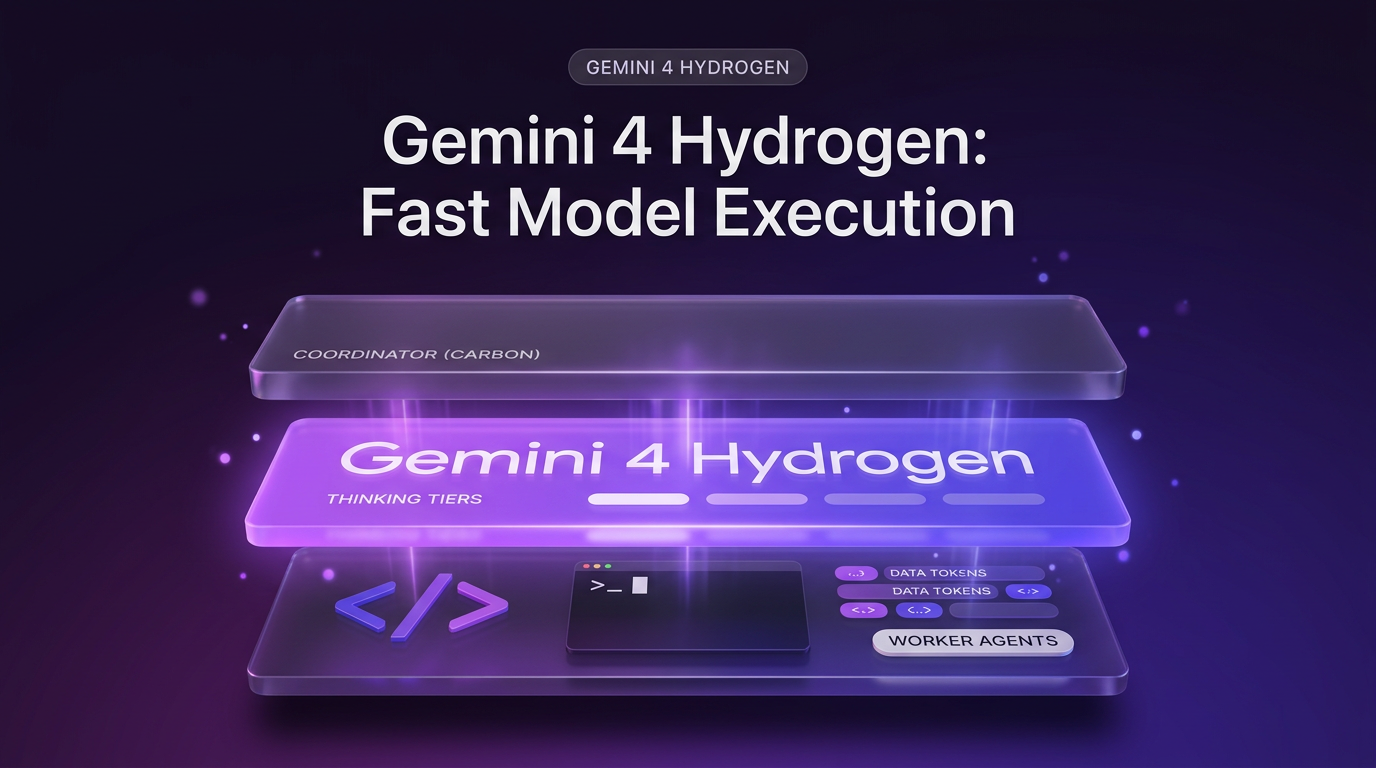
A core design element of the model is its four distinct thinking levels. Users can select between low, medium, high (the default setting), and a new xhigh configuration. These tiers allow engineering teams to trade latency directly for reasoning depth depending on whether a task is a simple format check or a multi-file bug diagnosis.
- Low thinking level: Designed for minimum latency and lightweight document extraction.
- Medium thinking level: Balanced for standard queries and basic code adjustments.
- High thinking level: The default setting, achieving a score of 51 on the Artificial Analysis Intelligence Index, outperforming Argon at 50.
- Xhigh thinking level: Maximizes reasoning depth for complex repository analysis, reaching a score of 54 on the Artificial Analysis Intelligence Index.
Multi-Model Workflows with Gemini 4 Hydrogen and Orchestrator
Google also introduced Orchestrator inside Google Antigravity to coordinate multi-model workloads automatically. Rather than keeping an expensive reasoning model active throughout an entire session, Orchestrator dynamically routes between Carbon and Gemini 4 Hydrogen based on the complexity of the current step within the same session.
In benchmark evaluations on Terminal-Bench 4.0, Google reported that Orchestrator maintained task success rates close to Carbon while consuming 24 percent less quota and completing tasks 19 percent faster. This approach addresses the cost and latency bottlenecks that often emerge when teams use frontier reasoning models for simple execution steps.
In practical parallel setups, Carbon acts as the coordinator while Gemini 4 Hydrogen powers worker and verifier agents. Worker agents write code and implement changes, while verifier agents run automated tests simultaneously across isolated workspaces. For businesses building custom setups through Agentic AI Systems & AI Workforce frameworks, this functional separation keeps overall token costs predictable during high-volume testing loops.
Developer and Enterprise Capabilities
For code repositories, Gemini 4 Hydrogen batches file-read and search calls natively in parallel instead of reading files sequentially. In early partner testing across complex graphs, SQL generation, and data-heavy enterprise workflows, this parallel execution ran 2 to 2.8 times faster while reducing token consumption between 12 percent and 23 percent compared to Gemini 3.8 Flash.
On Terminal-Bench 4.1, Google notes that the model achieved a 57 percent score compared to 18.2 percent for Gemini 3.8 Flash. In software engineering evaluations, the system outperformed similar-tier models on SWE-sweep, discovering and repairing bugs without breaking existing code. The model focuses on targeted edits across codebases, avoiding unintended modifications to unrelated files during automated updates.
The model also adapts cleanly when an external tool call fails or a search query returns empty. This error-handling resilience reduces script failures in autonomous execution environments, allowing workflows to proceed without constant human intervention.
Benchmark results shared by Google show the model scoring 58.8 percent on HLE-Diamond and ranking fifth overall on Agent Arena. In specialized vertical evaluations, it scored 52.3 percent on Vals Tax Agent Bench (ranking first overall) and 55.8 percent on Vals Legal Research Bench (tying for first). It also leads its class on AutomationBench-AA.
Multimodal Documentation and Web Prototyping
In multimodal knowledge tasks, the model pairs its 1 million-token input capacity with up to 1 million output tokens. This enables the synthesis of dense PDFs, spreadsheets, charts, audio recordings, and video files into structured, cited reports. On the Multimodal Knowledge Agent (MKA) benchmark, it scored 53.4 percent, and it achieved 71.6 percent on Agents' Last Exam v1.1 for professional workflows.
For front-end development, the model generates functional layouts with fewer corrective prompts. Demonstrated implementations include Geminisland, an interactive voxel island where single prompts generate explorable 3D structures. Paired with the Gemini front end design skill in Google Antigravity, the model built a functional e-commerce storefront in a single prompt, incorporating a WebGL2 topographic shader, four-stage scrollytelling, a thermal split-slider, a 3D wireframe card, and a live finish configurator.
Data processing tasks in productivity tools show similar optimizations. In Google Sheets canvas, financial forecasting models dynamically adjust across scenarios more than 30 percent faster than previous models. In another implementation, the model combined Python, native LET formulas, and conditional formatting to render an animated pixel canvas directly inside spreadsheet cells.
The system also converted YouTube keynote footage into a multi-slide presentation in Google Slides using an autonomous audit-and-fix loop to clean up overlapping text elements. For multimedia generation, it produced an interactive 3D globe with a Web Audio music engine powered by real-time lightning strike data, a WebGL2 water and glass visualizer using signed distance field textures, and an archival video reel assembled from public-domain footage.
Where This Fits in Real Projects
When Wasif Ahmed designs enterprise automation flows in Make.com and custom platforms, API costs and execution latency frequently determine project viability. Deploying massive reasoning models for basic data formatting, tool calling, or verification checks creates unnecessary expense and adds avoidable latency to critical business workflows.
Gemini 4 Hydrogen provides a balanced option: it can serve as a dependable execution layer while heavier models handle top-level decisions. In consumer contexts, the model follows multi-turn instructions closely and connects directly with tools like Airtable, Dropbox, Google Drive, and Gmail. Teams interested in integrating structured multi-model pipelines can explore modern AI automation configurations designed around these specialized tiers.
Frequently Asked Questions about Gemini 4 Hydrogen
What is the pricing structure for the model?
Gemini 4 Hydrogen is priced at $1.50 per million input tokens and $7.50 per million output tokens across its entire 1 million-token context window. This flat rate applies regardless of whether the context window is partially or fully utilized.
How does it differ from frontier models like Carbon and Argon?
Gemini 4 Carbon and Argon are designed for long-horizon planning and complex architectural design. Hydrogen is engineered for rapid execution, parallel tool use, code modification, and high-frequency tasks where speed and token efficiency are critical.
Can the model be paired with other systems?
Yes. Through tools such as Orchestrator in Google Antigravity, teams can pair Hydrogen with Carbon. In this arrangement, Carbon coordinates high-level planning while Hydrogen executes code generation, test runs, and verification steps in parallel.
Conclusion
Gemini 4 Hydrogen marks a practical shift toward modular, cost-efficient artificial intelligence architectures. By pairing predictable 1 million-token pricing with tiered thinking levels and dedicated orchestration, Google offers builders a practical execution model for autonomous agent teams. If you are planning an automation build or need help structuring your multi-model agent pipeline, reach out to Wasif Ahmed to discuss your project requirements.