Google DeepMind has introduced the EmbeddingGemma 2 model, an open, lightweight multimodal embedding model designed to run directly on consumer hardware. The release expands on the original text-only model by mapping text, code, images, video, and audio into a shared vector space under a permissive Apache 2.0 license.
As detailed in the official release announcement, the model is built on the Gemma 4 architecture. It gives software engineers and system designers the ability to build cross-modal search, retrieval-augmented generation (RAG), and local routing systems without transmitting raw media to external cloud APIs.
Key Architectural Updates in the EmbeddingGemma 2 Model
The original EmbeddingGemma release achieved more than 20 million downloads by providing a compact solution for local text embeddings. The EmbeddingGemma 2 model expands this scope to handle full multimodal processing while keeping the overall parameter count at 740 million.
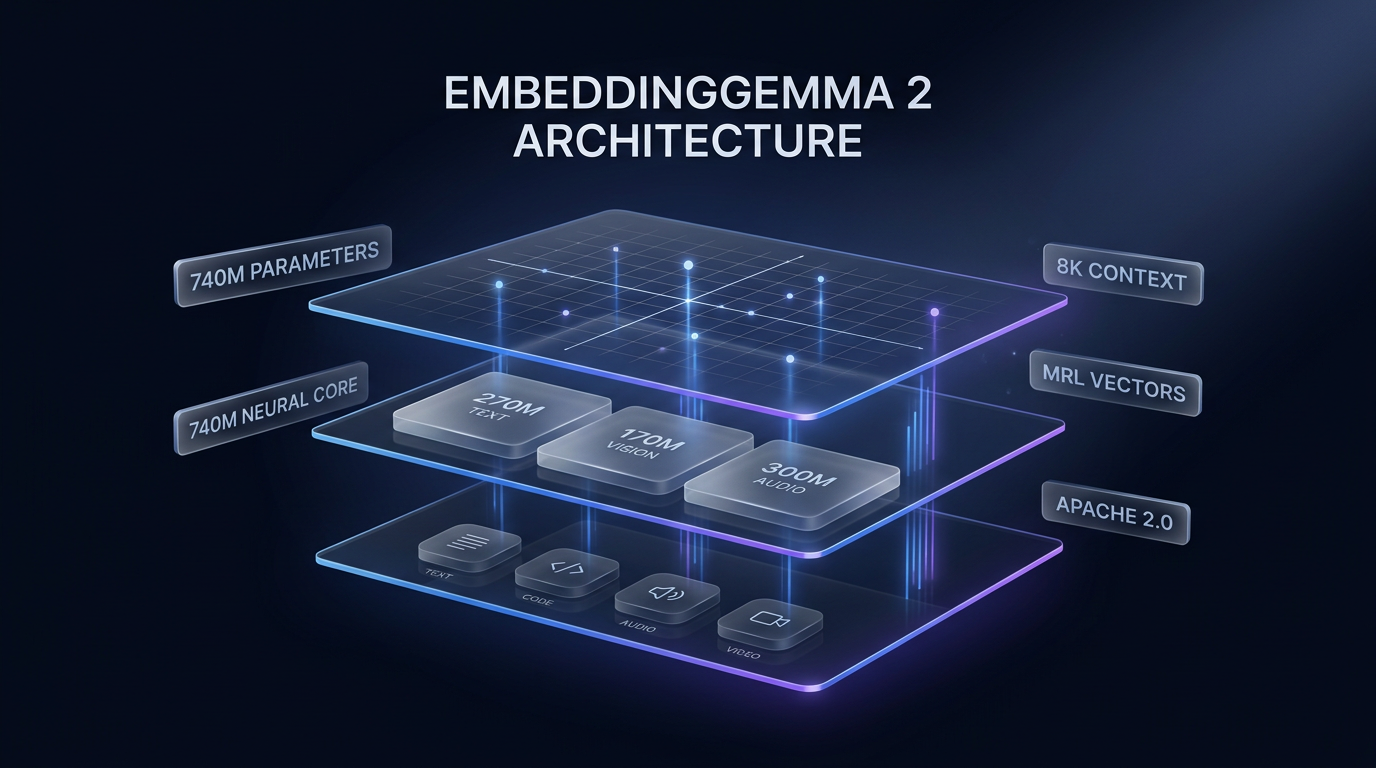
Instead of forcing developers to load a monolithic multi-gigabyte network, the architecture uses a modular breakdown. The system can run as a 270-million-parameter text-only encoder, or activate an optional 170-million-parameter vision encoder and a 300-million-parameter audio encoder as needed. When fully assembled, the total footprint remains small enough for real-time edge processing.
Memory consumption and vector storage also receive substantial optimizations through Matryoshka Representation Learning. Standard embeddings generate 768 dimensions, but developers can truncate vectors down to 512, 256, or 128 dimensions without retraining. This flexibility yields up to a 6x reduction in vector database storage, lowering RAM usage on resource-constrained devices.
- Parameter sizing: 740 million total parameters, configurable down to 270 million for text-only tasks.
- Quantized execution: Requires approximately 191 megabytes of active RAM for text weights and 567 megabytes for full multimodal weights on test hardware such as the Google Pixel 11 Pro.
- Expanded context: An 8K token context window, which is four times larger than the previous generation.
- Media ingestion: The expanded context window can ingest up to 5.5 minutes of audio, 29 images, 58 video frames, or interleaved combinations in a single pass.
- Licensing: Released under the commercially permissive Apache 2.0 license for unrestricted deployment.
Benchmark Performance Across Code, Vision, and Audio
Google DeepMind reports that the EmbeddingGemma 2 model achieves leading scores among sub-1B multimodal models on standardized benchmarks. The model matches the multilingual text capabilities of its predecessor while introducing a notable jump in code retrieval quality.
In the Massive Text Embedding Benchmark for Code (MTEB Code), the score increased from 68.76 in the prior version to 78.68. This 9.92-point gain makes the system well suited for local codebase indexing, technical documentation retrieval, and offline developer tools. The research team notes that the model also matches or exceeds the performance of several specialist models twice its size on the Massive Audio Embedding Benchmark (MAEB) and image evaluation suites.
Because the network shares a text tokenizer and audio encoder with Gemma 4, developers running both models locally can reuse cached representations. This architectural alignment decreases the combined memory footprint needed for end-to-end multimodal retrieval and generation pipelines.
Practical Capabilities Enabled by the EmbeddingGemma 2 Model
Moving multimodal embeddings directly to local hardware changes how private media and operational documents can be processed. Because the vectors are generated locally, applications can index private photos, voice memos, and recorded calls without transferring sensitive user data over the public internet.
A user can submit a text query or a short voice note to locate a specific video moment across an unorganized archive. In sample implementations demonstrated by Google AI Edge, such as Instant Media Search and Video Moments Finder, the model identifies exact matching scenes based entirely on semantic similarity rather than manual file tags.
For edge automation, developers can combine the EmbeddingGemma 2 model with the MediaPipe Decision Task API. This configuration enables real-time decision engines capable of classifying incoming media streams, routing customer support tickets that contain attached screenshots, or triggering automated actions based on voice prompts.
Deployment Frameworks and Tool Ecosystem
The model weights have been published on Hugging Face and Kaggle, with planned availability on the Gemini Enterprise Agent Platform Model Garden. For mobile and edge applications, Google provides optimized builds through the LiteRT community repository on Hugging Face.
Software engineers can run the EmbeddingGemma 2 model using familiar inference frameworks including transformers, sentence-transformers, llama.cpp, vLLM, SGLang, Ollama, LMStudio, and MLX on Apple silicon. Browser-based execution is supported via transformers.js and WebGPU. For vector storage, teams can route truncated embeddings directly into vector engines like Qdrant, while Unsloth provides documented workflows for domain-specific fine-tuning.
Frequently Asked Questions
What hardware is required to run the EmbeddingGemma 2 model?
The model is specifically designed for consumer and mobile hardware. When quantized, the text-only weights require around 191 megabytes of active RAM, while the full multimodal configuration runs in roughly 567 megabytes on mobile hardware like the Google Pixel 11 Pro.
Can the EmbeddingGemma 2 model run completely offline?
Yes. The weights can be loaded locally using tools such as LiteRT, llama.cpp, or transformers.js. This allows developers to run private search, local classification, and retrieval-augmented generation pipelines without any external network connection.
How does Matryoshka Representation Learning help with storage?
Matryoshka Representation Learning allows developers to shorten the default 768-dimension vectors to 512, 256, or 128 dimensions. This provides up to a sixfold reduction in vector storage needs without requiring separate model checkpoints or complex re-indexing steps.
Practical Value for AI System Architecture
Wasif builds custom AI automation workflows and structured systems for businesses that require dependable data handling. While cloud APIs remain standard for large-scale generative reasoning, running embedding tasks on edge instances helps teams avoid unnecessary per-token fees and reduces latency across repetitive search tasks.
For projects incorporating autonomous agents or multi-step logic, having an open 740M model capable of unifying code, audio, and visual inputs makes local document routing and semantic triage significantly easier to deploy. Teams exploring agentic AI systems can leverage these compact vector representations to filter incoming payloads before sending relevant summaries upstream.
The release of the EmbeddingGemma 2 model provides an accessible path toward lightweight multimodal indexing without enterprise server overhead. To explore how to integrate modern AI architecture and efficient vector retrieval into your business systems, contact Wasif Ahmed directly to discuss your project requirements.