OpenAI has announced ChatGPT visual ads as an upcoming display format alongside a collection of analytics integrations and suitability safeguards. The company shared that testing for this visual placement will begin later this month in the United States, targeted specifically at users on the Free and Go service tiers during active image generation. The company noted that with 1.2 billion weekly active users on ChatGPT, monetizing through sponsored experiences enables wider public access without relying solely on recurring subscription revenue.
The announcement represents an expansion beyond basic text promotions, placing visual creative into creative workflows while introducing third-party attribution and independent verification. Advertisers can review details directly in the official post published on the OpenAI ads blog, which outlines how the rollout will function across consumer sessions.
The Core Updates: How ChatGPT Visual Ads Function
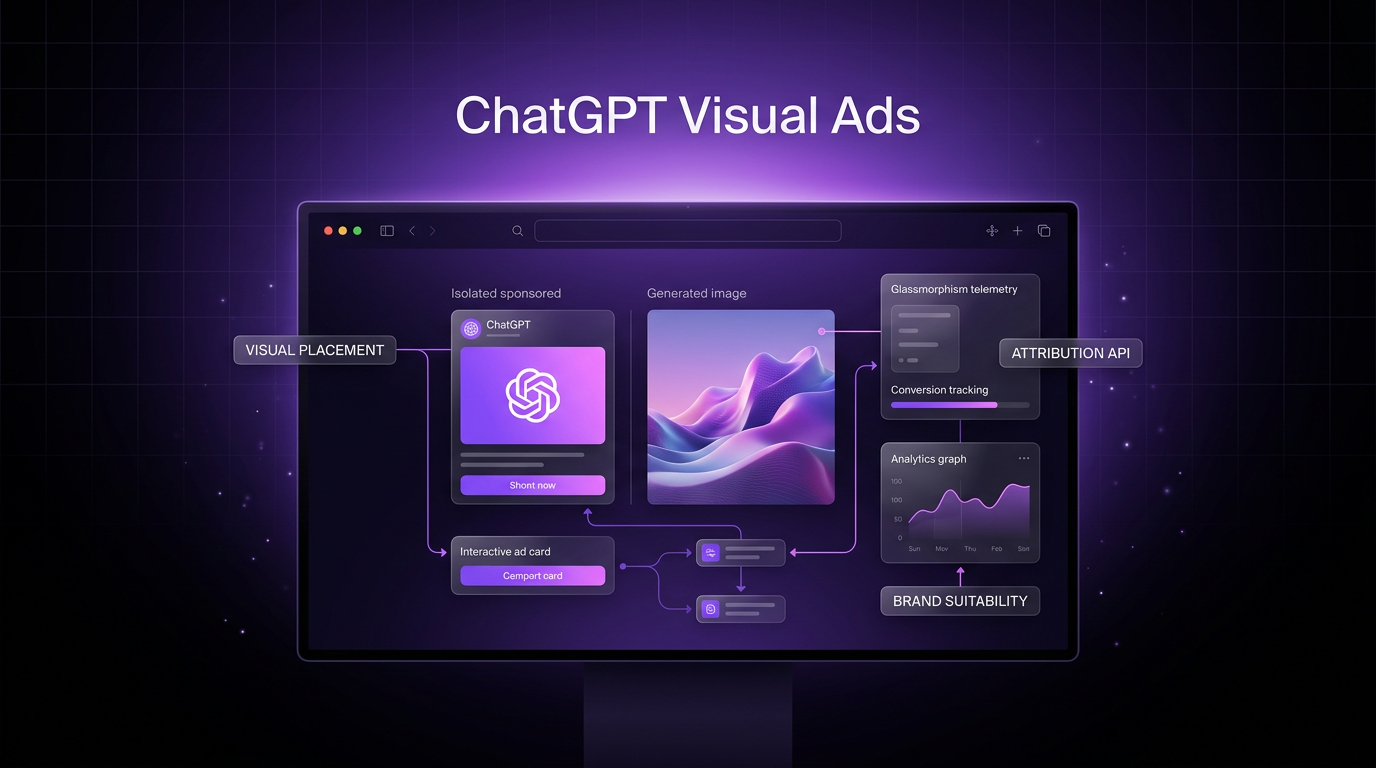
The headline feature of this rollout is an image-led placement tested while users generate pictures inside ChatGPT. The ad creative appears separately from the generated visual output and carries a clear sponsored label. OpenAI stated that these promotions do not alter or bias the organic conversational responses or media delivered by the model.
By introducing visual assets into conversational sessions, OpenAI wants brands to present product inspiration, actual use cases, and tangible experiences. Rather than depending exclusively on text summaries, ChatGPT visual ads allow businesses to demonstrate physical merchandise or service packages visually as prospective buyers consider options.
- Initial placement testing occurs strictly during image generation tasks for Free and Go subscription tiers in the United States.
- Advertisements carry explicit disclosure badges and remain isolated from the user’s generated image output.
- Negative Phrases are now available to qualifying businesses with strict brand parameters.
- Third-party validation trials with DoubleVerify and Integral Ad Science inspect contextual alignment without viewing private conversations.
- Customer data platform integrations with Hightouch, Tealium, and LiveRamp allow direct conversion syncing.
Expanded Measurement Partnerships and Attribution Infrastructure
Tracking conversion value has historically been a significant friction point for emerging digital formats. In response, OpenAI is introducing an expanded attribution framework designed around standard enterprise analytics stacks rather than requiring proprietary reporting tools.
To support server-side data delivery, OpenAI now connects directly with customer data platforms like Hightouch, Tealium, and LiveRamp. Advertisers using those platforms can transmit offline and online conversion events through a Conversions API. For mobile and multi-touch web attribution, the company supports a roster of tracking providers: AppsFlyer, Triple Whale, Adjust, DV Rockerbox, Northbeam, Branch, Singular, Kochava, Airbridge, and Tenjin.
The company is also collaborating with incrementality and geo-testing specialists, including Haus, Measured, INCRMNTAL, Fospha, and WorkMagic. These tools evaluate whether purchases happen because of campaign impressions or would have occurred organically.
Early Partner Performance and Brand Suitability Protections
In initial trials, OpenAI reported metrics collected by its measurement partners. DV Rockerbox recorded that WeightWatchers saw a 15.3 percent lower attributed cost per acquisition through ChatGPT visual ads when evaluated against its blended paid-search baseline. WorkMagic tracked incrementality for wellness company Dose, discovering that 67 percent of incremental orders originated from net-new buyers. Triple Whale noted that 93 percent of visitors referred to Portland Leather via early campaigns were first-time site visitors.
Brand safety remains an understandable priority when delivering media inside generative interfaces. OpenAI explained that its placement guardrails use both automated scans and human oversight to block advertisements during vulnerable, emotionally charged, or sensitive interactions. The model determines context dynamically before serving any creative.
For advertisers with defined brand restrictions, OpenAI has added Negative Phrases for qualifying accounts. Independent evaluation pilots with Integral Ad Science and DoubleVerify allow those organizations to evaluate safeguard reliability inside controlled test rooms without inspecting private individual dialogue.
Practical Implications for Digital Advertisers
For growth teams and media buyers, the rollout of ChatGPT visual ads offers a completely different channel context. Traditional social platforms display creative within continuous feeds where user attention is fleeting. Generative assistants capture deliberate, intent-driven sessions where users search for recommendations, draft plans, or produce assets.
Because early testing is limited to the US on non-paid and Go tiers, media planners should treat this as a pilot channel rather than a direct replacement for search or social media marketing. Teams should establish clean conversion pipelines first. Connecting existing data pipelines through platforms like Tealium or Hightouch ensures that baseline ROAS metrics can be accurately recorded from day one.
Teams investing in web designing and dedicated landing pages will need clear attribution parameters to separate conversational campaign traffic from conventional referral channels. Direct click attribution combined with third-party verification will be essential to evaluate whether conversion gains justify initial CPMs.
Frequently Asked Questions About ChatGPT Visual Ads
Where do ChatGPT visual ads appear inside the interface?
ChatGPT visual ads appear during image generation workflows for users on Free and Go accounts. The ad units are displayed alongside clear sponsorship labels and remain completely distinct from the visual content created by the generative tool.
Do ChatGPT visual ads influence the model’s text answers?
No, OpenAI confirmed that sponsored placements have zero influence on conversational outputs. The model delivers independent answers, and advertising does not bias prompts, recommendations, or editorial text generated during the interaction.
How can brands measure return on ad spend from these placements?
Advertisers can connect conversion data via a Conversions API integrated with platforms like Hightouch, Tealium, and LiveRamp. Tracking and attribution can be analyzed using supported partners such as Triple Whale, AppsFlyer, DV Rockerbox, and Northbeam.
Where This Fits in Client Marketing Systems
Wasif builds custom lead workflows, CRM routing, and web architectures that connect incoming traffic directly to operational pipelines. When new acquisition channels launch, the fundamental operational challenge is rarely just creative design; it is verifying attribution, routing leads into systems like Go High Level, and automating downstream follow-up without manual overhead.
For businesses exploring ChatGPT visual ads alongside structured AI automation, connecting server-side webhooks and CRM tags early ensures that customer discovery translates directly into measurable pipeline revenue.
If you want to prepare your tracking architecture and CRM systems for emerging marketing channels, contact Wasif Ahmed at https://wasifahmed.dev/contact/ to build your setup.