Recent industry surveys show that over 70% of companies test artificial intelligence internally, yet less than 20% achieve structured deployment across core departments. While individual employees rely on standalone chat interfaces daily, organizational business AI adoption requires connecting intelligent models directly to administrative operations. A clear analysis of AI adoption trends shared by Make.com highlights that sustainable growth depends on platform integration rather than ad-hoc prompting.
The Current State of Business AI Adoption
Most enterprise teams start their journey by giving staff access to conversational tools like ChatGPT or Claude. While this boosts individual writing speed, it creates isolated silos of information that do not update central databases. True business AI adoption happens when language models interact directly with software endpoints, database tables, and communication channels.
Transitioning from personal assistance to operational automation requires strict data governance and structured workflows. Organizations that skip process mapping often end up with fragmented data streams and inconsistent output quality.
Core Hurdles Holding Organizations Back
Understanding the friction points helps operational leaders avoid costly pivots during rollouts.
Unstructured Data and Security Concerns
Language models require clean, formatted context to produce accurate operational outputs. When companies feed raw emails or unstructured document dumps into AI modules, error rates spike and trust drops. Security policies also restrict sensitive customer records from being shared with public models without proper encryption layers.
The Gap Between Chatbots and System Architecture
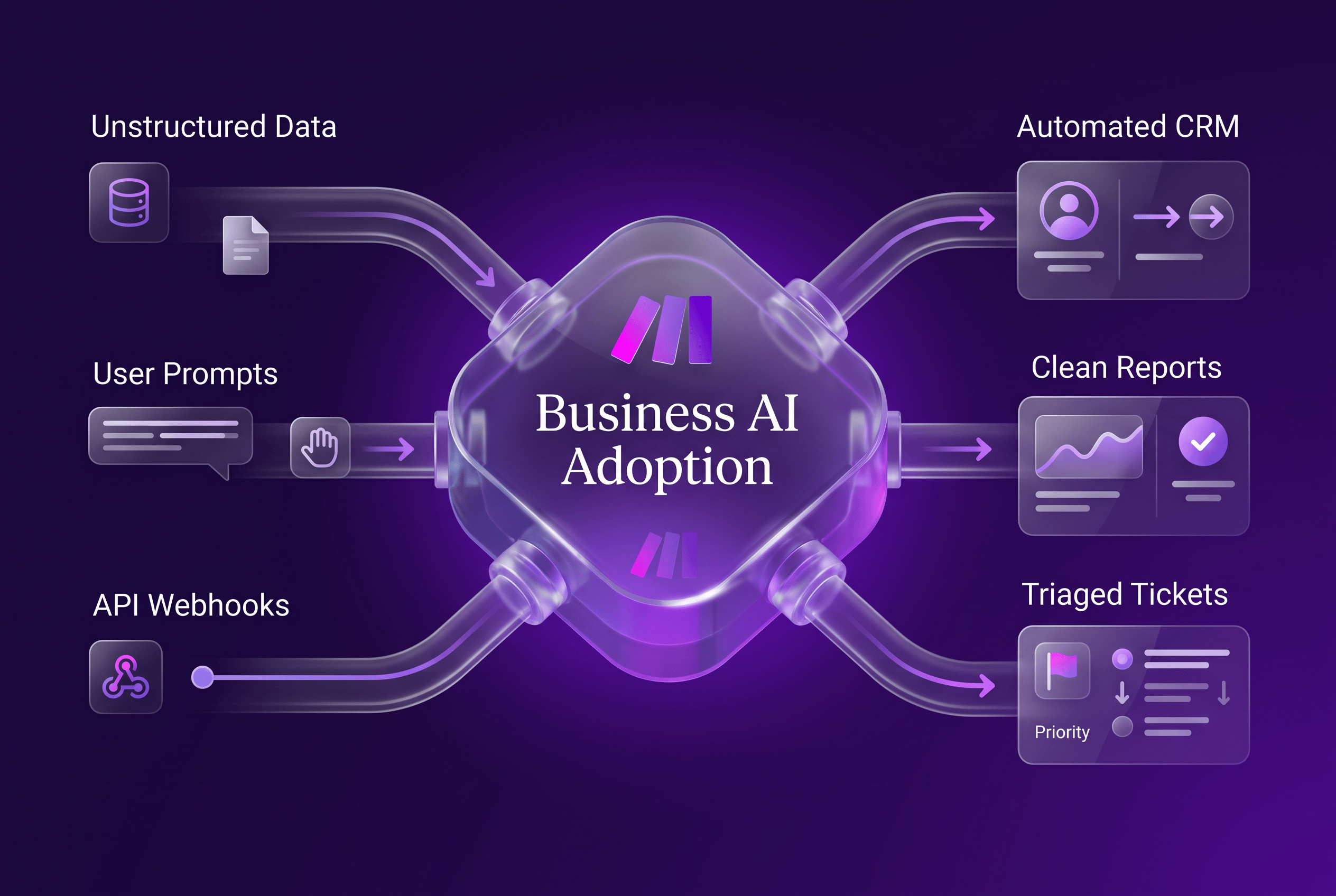
A standard chatbot interface cannot update lead statuses, generate custom contract PDFs, or trigger email sequences on its own. Connecting intelligent logic to existing software requires API endpoints, webhook listeners, and orchestrators like Make.com. Without custom software middleware, AI tools remain helpful writing assistants rather than automated team members.
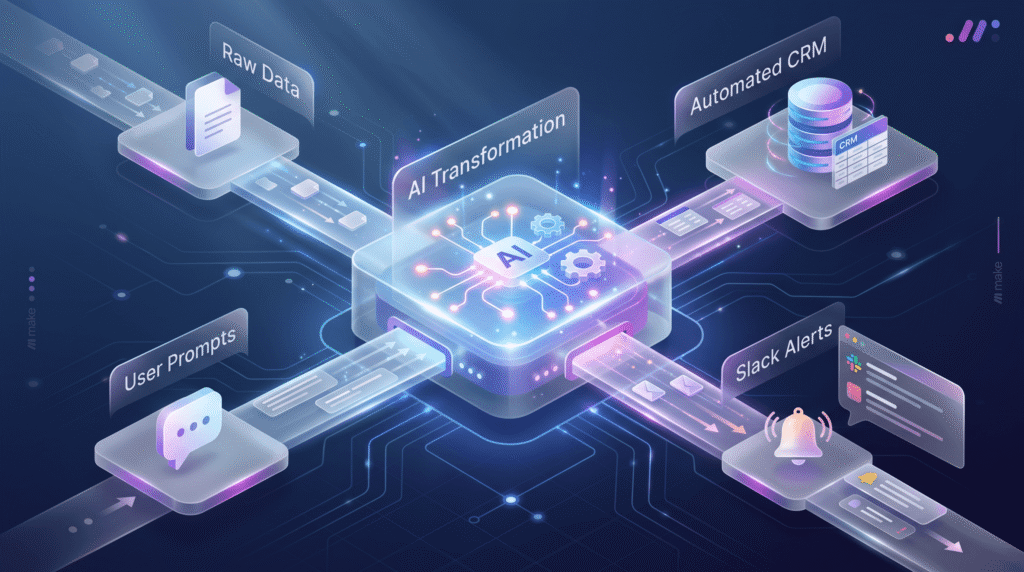
For example, a service company might receive 100 inbound support tickets per day through email. Instead of manual triage, a Make.com scenario captures the webhook, passes the text to an OpenAI module for categorization, updates the lead status inside a CRM, and routes urgent cases to Slack.
Tactical Priorities for Successful Rollouts
To move beyond basic prompt experimentations, companies must implement structured integration criteria:
- Identify repetitive, high-volume tasks that consume at least five hours of staff time weekly.
- Clean and standardize customer databases prior to passing parameters to external API endpoints.
- Implement human-in-the-loop validation steps for high-stakes customer communications or financial records.
- Establish clear data privacy rules regarding which data points can interact with third-party language models.
Moving from Standalone Tools to Connected Workflows
Replacing manual data entry requires viewing AI as an infrastructure layer rather than an isolated application. Combining flexible API connectors with specialized prompts allows teams to build robust AI automation pipelines that scale reliably.
When systems handle routine document classification and lead qualification, team members focus on client relationships and complex decisions. This balance protects operational accuracy while accelerating daily output.
FAQs
What is the main barrier to business AI adoption?
The primary barrier is the lack of integration between isolated AI interfaces and existing enterprise databases. Companies often struggle to format unstructured operational data so that language models can process it accurately and securely.
How does workflow automation improve AI adoption?
Workflow automation tools act as the connective tissue between software applications and AI processing modules. They handle trigger events, format payloads, enforce business rules, and deliver structured outputs back into core systems without human intervention.
Should companies build custom AI models or use API integrations?
Most organizations achieve higher returns by connecting established frontier models via APIs rather than training custom models from scratch. Standard API models offer faster deployment, lower maintenance costs, and continuous performance improvements from base providers.
Where This Fits in Real Client Builds
When evaluating technical debt across client operations, Wasif focuses on establishing reliable database structures before introducing AI processing steps. In practical agency deployments, combining Make.com scenarios with Go High Level management creates repeatable infrastructure that operates without constant supervision.
Building stable automation requires testing edge cases, setting up error-handling modules, and ensuring data remains structured across every pipeline step. Wasif designs these frameworks to ensure business operations remain dependable as call volumes and lead counts grow.
If you want to build automated workflows that connect your core tools directly to AI processing, feel free to reach out to Wasif to discuss your architecture.