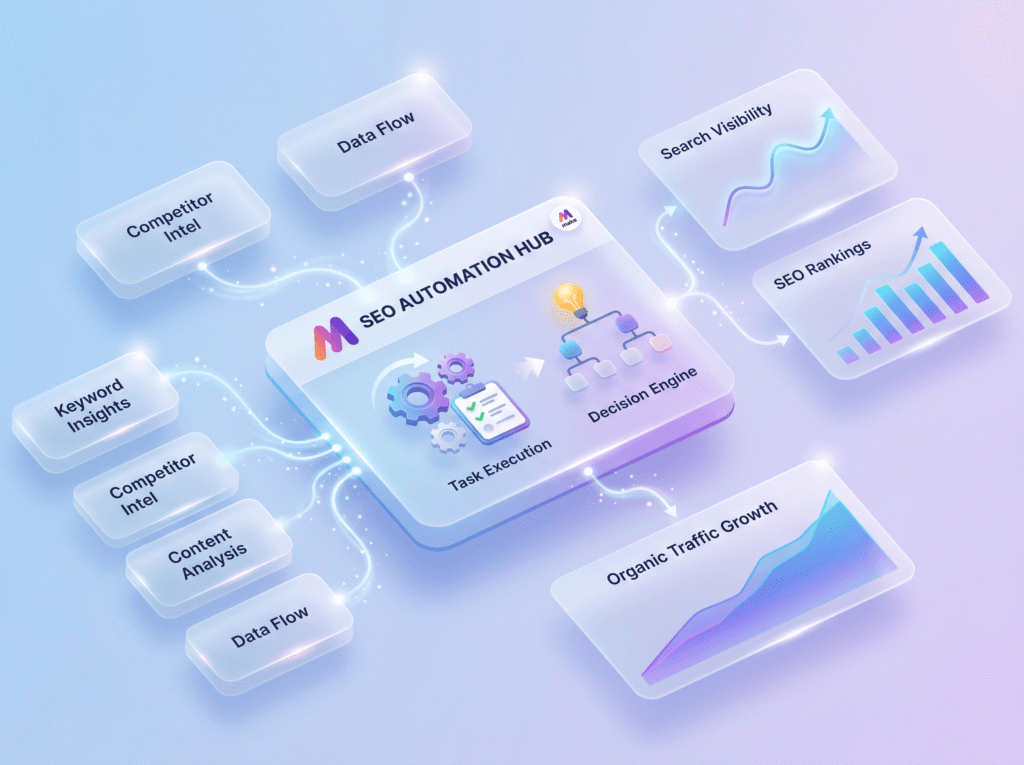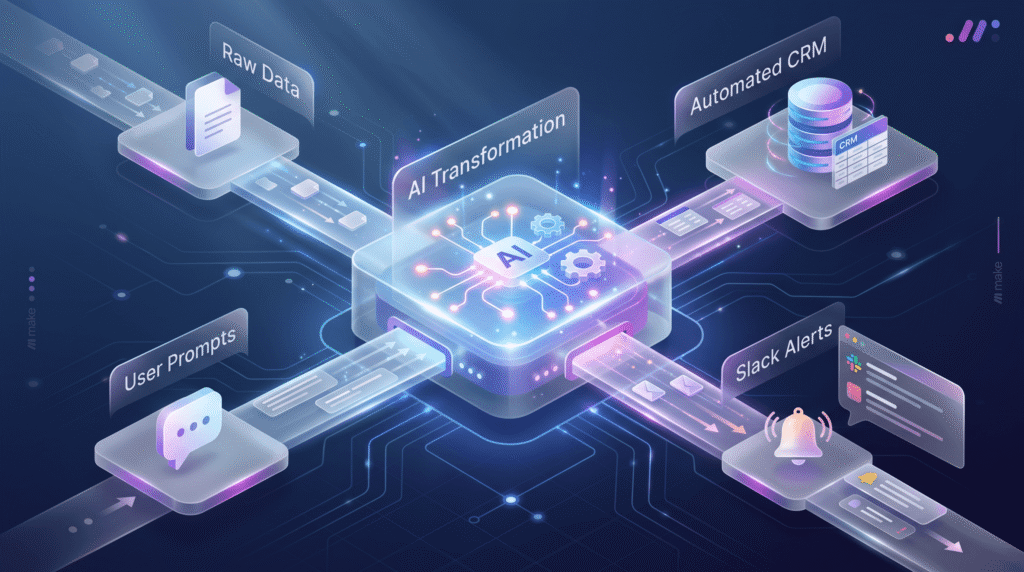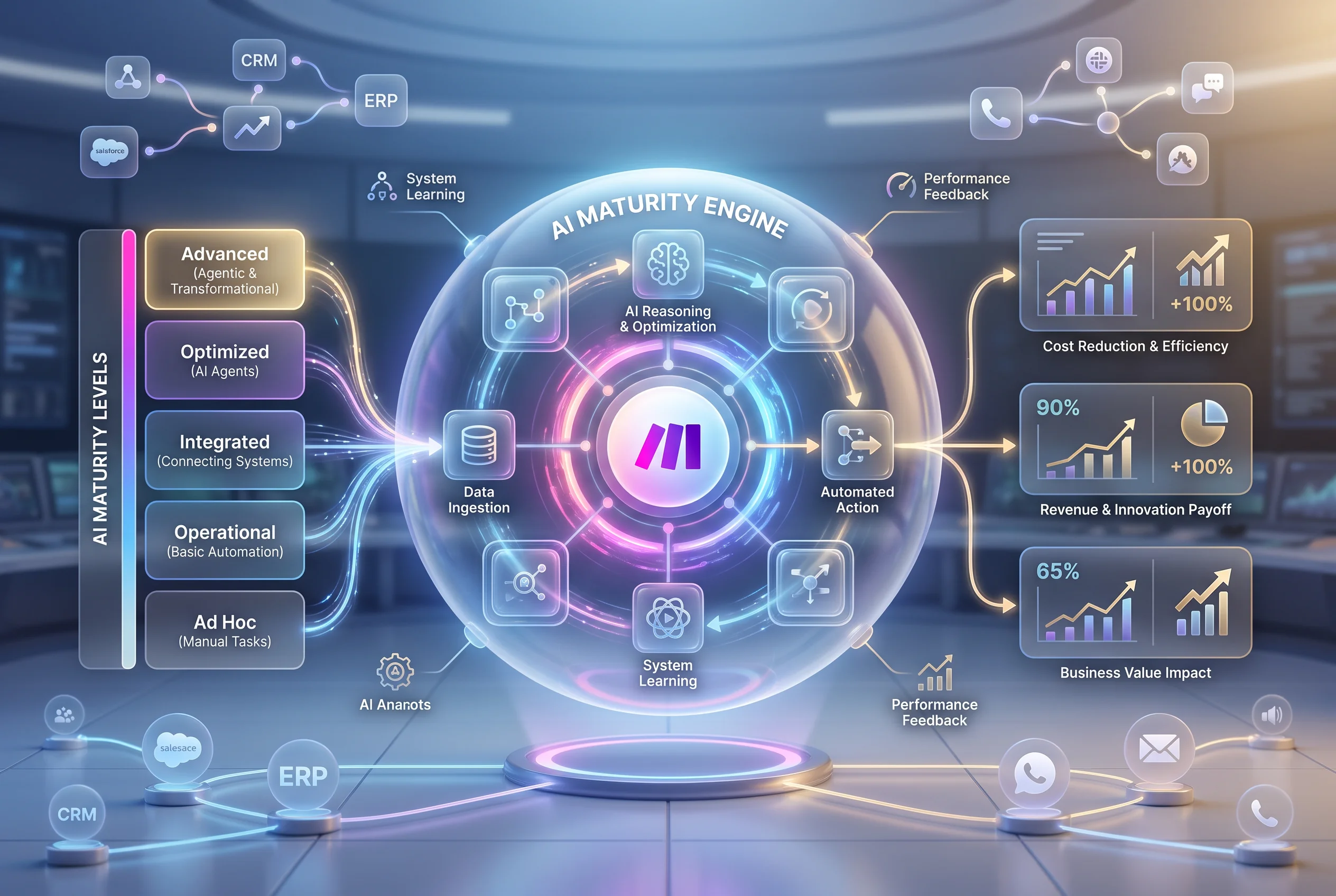
A business replacing manual data entry with a single automated API call is just the first step toward modern efficiency. While simple AI prompting saves individual employees a few minutes each day, the true financial return comes when those prompts are built into automated workflows. This shift defines the AI maturity payoff, where companies move from isolated tools to connected systems that run independently.
According to research and insights published on the Make.com blog, organizations that systematically integrate AI into their daily workflows experience compounding efficiency gains compared to those using ad-hoc tools. Moving up this maturity scale requires shifting focus from individual productivity to systemic business architecture.
Understanding the AI Maturity Payoff
The AI maturity payoff represents the exponential increase in efficiency and cost savings realized as an organization moves from basic tool adoption to fully integrated workflows. In the early stages of adoption, businesses often experience a plateau because their tools do not communicate with each other. Employees end up copying and pasting data between various browser tabs, which introduces human error.
When platforms like Make.com are introduced to bridge these gaps, the return on investment shifts from linear to exponential. Instead of saving minutes, businesses begin saving entire workdays. The payoff is not just about speed: it is about creating predictable, error-free operational pipelines that run twenty-four hours a day.
The Three Phases of the Maturity Curve
To reach the point of compounding returns, organizations typically transition through three distinct phases of operational maturity. Understanding where your business sits on this curve is essential for planning future technology investments.
Phase 1: Point-to-Point Automation
This phase involves simple triggers and actions. For example, a business might set up a rule that automatically saves email attachments from specific senders into a Google Drive folder. While helpful, these systems are rigid and cannot handle complex decision-making.
Phase 2: Orchestrated Workflows
In this phase, multiple systems are connected to handle multi-step processes. Data flows from a customer form, passes through an AI model for categorization, and updates a database. The systems begin to work together, reducing the need for human intervention during routine tasks.
Phase 3: Cognitive Systems
At the highest level of maturity, systems make dynamic decisions based on real-time data. These setups use structured logic to route tasks, handle exceptions, and self-correct when errors occur. They operate as digital infrastructure that scales effortlessly alongside business growth.
High-maturity systems generally share several key characteristics:
- Centralized error handling to prevent broken pipelines when external APIs change.
- Dynamic data routing based on real-time evaluations by language models.
- Standardized integrations instead of fragile, custom-coded workarounds.
- Continuous logging for performance auditing and compliance tracking.
Measuring the Financial Impact of High-Maturity Systems
A concrete example demonstrates how this transition works in practice. A real estate agency might start by manually copying lead details from Facebook Ads into a spreadsheet. At a higher maturity stage, they deploy a Make.com scenario that triggers automatically when a new lead arrives.
The scenario sends the lead details to OpenAI to categorize the buyer’s intent, updates the Go High Level CRM with custom tags, and drafts a personalized SMS response. This automation reduces response times from three hours to forty seconds. By eliminating manual delays, the agency increases its lead-to-booking conversion rate without hiring extra staff.
FAQs
What is the AI maturity payoff?
The AI maturity payoff is the compounding return on investment that businesses achieve when they transition from manual AI prompting to fully automated, integrated workflows across their operations. It represents the shift from saving individual minutes to reclaiming entire operational workdays.
How do you measure AI maturity in business operations?
Maturity is measured by how deeply AI is integrated into daily workflows, the reduction in manual data handling, and the ability of systems to make automated routing decisions. High-maturity businesses have systems that communicate with each other without requiring human copy-pasting.
Can small businesses achieve a high AI maturity payoff?
Yes, small businesses often achieve this payoff faster than enterprise organizations because they have fewer legacy systems and less bureaucratic friction. Using agile platforms like Make.com allows small teams to build highly sophisticated automated pipelines quickly.
How Wasif applies AI maturity models
Wasif helps businesses move past the experimental phase of technology adoption. Instead of building isolated tools that require manual oversight, Wasif designs end-to-end AI automation systems that connect existing software stacks. By structuring workflows around clear business rules, Wasif ensures that clients achieve a measurable AI maturity payoff. This approach turns fragile, manual processes into reliable, self-running operations.
To discuss how structured automation can improve your business operations, reach out directly at wasifahmed.dev/contact/.