Tavily has launched its official agentic web search certification, offering builders and engineers a structured way to validate their expertise in retrieval workflows and autonomous search. As announced on the Tavily blog, the credential evaluates how well developers handle the technical nuances of connecting autonomous AI agents to live internet data.
While many developers can call a search API inside an agent script, running web search safely, efficiently, and accurately in production presents distinct engineering challenges. The new proctored exam targets those exact operational gaps across retrieval-augmented generation (RAG) pipelines and multi-step agent architectures.
For builders, the agentic web search certification is a way to show you can run search well in production, not just call an API. Passing earns a digital badge valid for 3 years and 5,000 Tavily credits.
Whether the agentic web search certification fits you depends on how much of your work touches live web search and RAG.
What Changed With the New Certification
Tavily says the new agentic web search certification is intentionally tougher than its previous certification. The testing format requires candidates to complete a 60-minute, 24-question proctored exam that evaluates both conceptual understanding and implementation mechanics.
Passing candidates earn a digital badge that remains valid for three years, which can be displayed across technical portfolios and professional networks. Alongside the badge, passing builders receive 5,000 Tavily search credits to assist with prototyping and live testing in their own development environments.
Tavily confirmed that the assessment is intentionally more demanding than its earlier credential. Candidates who do not pass on their first attempt are encouraged to review the study materials, ask technical questions within Tavily’s community Discord, and retake the test when ready.
The Four Core Domains Evaluated in the Exam
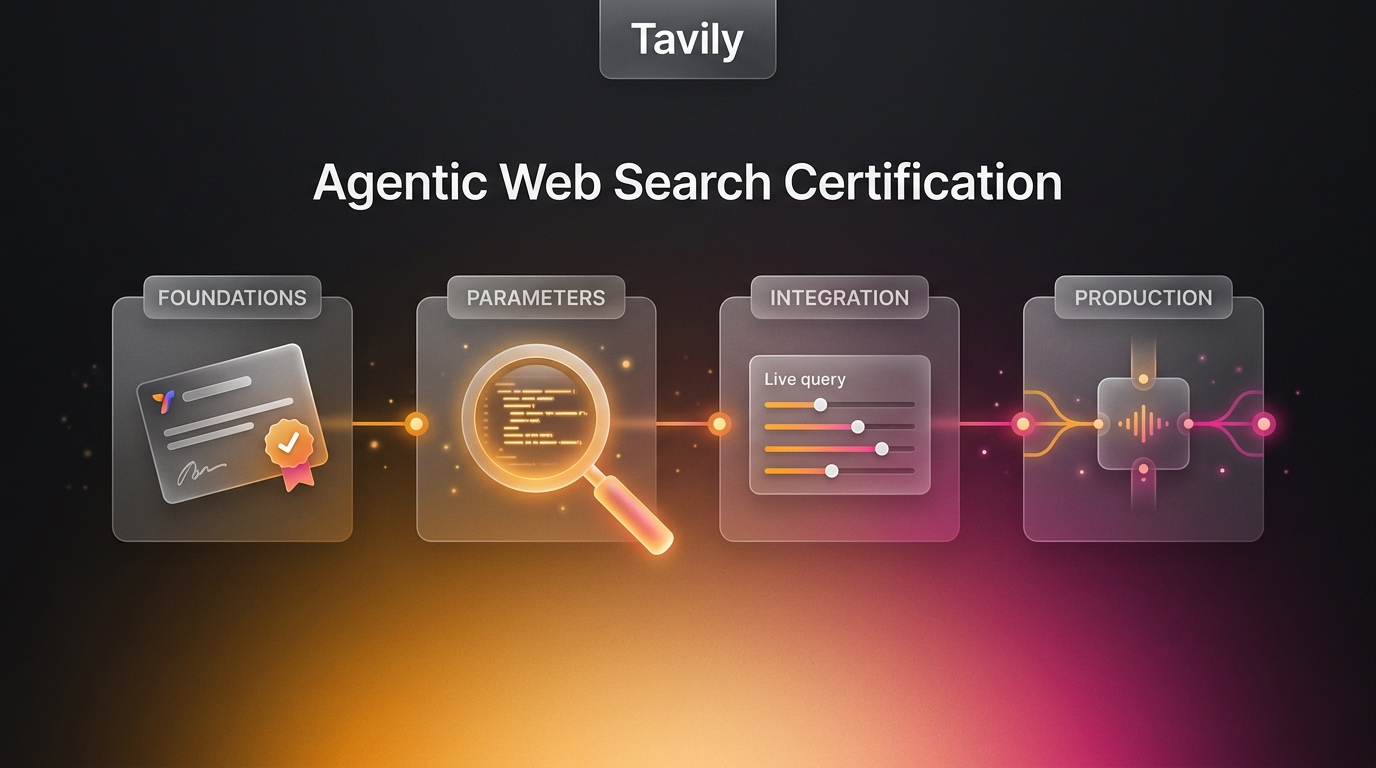
The assessment tests practical engineering decisions rather than simple syntax memorization. To earn the agentic web search certification, engineers must demonstrate competence across four specific domains outlined in the official exam guide.
1. Foundations of Agentic Web Search
This domain covers the decision-making logic of autonomous models. Candidates are tested on how agents determine when external search is necessary, how to formulate targeted search queries from ambiguous user inputs, and how to filter out irrelevant information before downstream processing.
2. Tavily Capabilities and Parameter Tuning
The second area focuses on specific API levers. Developers must know how to adjust search depth, configure domain inclusions or exclusions, set topic parameters, and optimize extraction controls to return clean context without inflating token usage.
3. Agent Framework Integrations
Connecting web retrieval tools to broader agent workflows forms the third test pillar. Questions review how search and extract functions wire into popular orchestration frameworks, handle tool-calling patterns, and pass structured data cleanly to language models.
4. Production Operations and Reliability
The final domain tests infrastructure resilience. Topics include rate limiting, caching strategies, fallback handling when queries return empty results, and latency management for user-facing applications.
Why This Credential Matters and Who Benefits
In autonomous agent design, inaccurate or ungrounded data retrieval remains one of the primary points of failure. The agentic web search certification signals that a developer understands how to ground model decisions in current web data without creating excessive latency or context window bloat.
Software engineers building RAG workflows benefit directly because the principles tested transfer beyond any single provider. Even though Tavily hosts and sponsors the test, the underlying questions evaluate web search architecture, source evaluation, and token efficiency holistically. Developers using alternative retrieval services can still apply these core operational concepts to their day-to-day architecture.
Technical leads and hiring managers also gain an objective signal. Reviewing an agentic web search certification allows teams to confirm that an engineer knows how to budget query latency, handle rate limits, and sanitize raw HTML data into structured prompts.
Preparation Materials and Study Paths
Tavily outlined clear preparation resources for developers planning to sit for the exam. Candidates can begin with the self-paced, hands-on agentic AI course hosted on Nebius Academy, which walks through practical code implementations and tool-use fundamentals.
In addition to the Nebius Academy course, candidates should review the official Tavily technical documentation. Key preparation tasks include:
- Reviewing best practices for query formulation and parameter selection across news and general search modes.
- Studying how raw web content is extracted, parsed, and converted into clean markdown or text chunks for model context.
- Practicing tool-use integration patterns within common agent frameworks.
- Testing timeout handling and defensive fallback routines when network requests fail or third-party sites block scrapers.
- Engaging with community discussions on Discord to clarify edge cases around rate limits and token economics.
Once builders work through the documentation and course exercises, registration takes place directly on the official certification page. Studying first makes the agentic web search certification far less of a gamble.
Practical Implications for Production Agent Builds
Treating search simply as an external tool call often causes hidden production issues. When an agent searches without query constraints, it frequently retrieves redundant links, consumes unnecessary tokens, and introduces hallucinations from outdated web pages. Preparing for the agentic web search certification forces builders to address these bottlenecks before shipping client applications.
For teams deploying agentic AI systems, structured web retrieval allows models to verify facts, cross-reference pricing, and monitor competitors in real time. Knowing how to tune parameters like search depth directly controls API costs while keeping response times fast enough for interactive use.
These principles also apply directly to operational workflows built with AI automation platforms. Whether an automated flow monitors industry alerts or enriches lead profiles with public company data, maintaining reliable search infrastructure prevents silent pipeline breakdowns.
What This Changes for Client Builds
Wasif designs custom automations and CRM systems where reliability and data grounding are mandatory. In real client deployments, bad web data can ruin automated reports, trigger incorrect follow-up messages, or mislead internal teams relying on autonomous research bots.
Holding verified knowledge across external search integrations ensures that automated pipelines only pass verified, relevant data into downstream systems. By structuring search queries tightly and configuring defensive fallbacks, production workflows stay fast and reliable even when third-party web pages shift format or drop offline. That is the real value of the agentic web search certification for teams.
Builders pursuing professional credentials can compare this release with other industry benchmarks on the certifications overview page. Either way, the agentic web search certification gives you a clear, checkable way to show your search skills.
Tavily has confirmed that registration for the new exam is now open to all developers. As autonomous models take on more complex research tasks, validating technical proficiency through the agentic web search certification offers a clear way to demonstrate production-grade retrieval skills.
If you want to discuss building grounded web search capabilities into your custom business workflows, feel free to reach out directly.