Choosing a dedicated agentic search API has become a core technical decision for teams deploying autonomous web agents. At its World of Tavily event during San Francisco Tech Week, search platform Tavily shared major milestone figures, detailed enterprise adoption metrics, and launched an expanded startup initiative. The gathering highlighted how autonomous software accesses live web information without relying on scrapers or static training cutoffs.
As detailed in the recap on the Tavily blog, the company outlined its shift from a single query endpoint into an infrastructure layer designed specifically for autonomous systems.
The Core Updates Announced by Tavily
Tavily began in 2023 to solve a clear structural limitation in large language models: cutoff dates and inaccurate external data. When users asked base models for current results, models returned outdated information. Conventional scraping often pulled advertising scripts, navigation headers, and boilerplate text that degraded reasoning pipelines.
The company announced several key operational milestones and program launches during the event:
- Scale and developer volume: Over 3 million developers now use the platform, generating more than 100 million requests each month across solo projects and production systems.
- Tavily Startup Program: Early-stage teams can apply for 100,000 free search credits, alongside direct technical support from forward-deployed engineers and partner introductions across the ecosystem. Standard free tiers continue to offer 1,000 monthly credits.
- Deep cloud integration: Following Tavily joining Nebius in February, the platform integrated with Nebius Token Factory to connect inference compute with external context retrieval.
- Post-training trajectory data: Search workflows are expanding beyond inference retrieval into fine-tuning datasets, as demonstrated by NVIDIA using Tavily search trajectories to train frontier research models.
- Next event scheduled: The team announced its next ecosystem gathering, World of Tavily NYC, taking place on November 12.
How an Agentic Search API Changes Web Retrieval
For three decades, the public web evolved around human visual browsing. Websites prioritize visual attention, display advertising, pop-ups, and navigation funnels. Autonomous agents interact with online data differently. An agent needs clean text, verified source attribution, and structured output that fits directly into a model context window.
A specialized agentic search API extracts raw web data and returns ranked, parsed passages without requiring custom HTML parsing scripts. Rather than parsing irregular document structures across dozens of domains, builders issue an API call that searches, filters, crawls, and structures information in one continuous run. This eliminates the maintenance overhead of managing scraping proxies and brittle extraction rules.
Inference Compute Meets Real-Time Context
During the event, Nebius VP of Inference Wei-Chen Wang and Tavily leadership framed the relationship between compute and data: inference engines reason over data, while an agentic search API delivers ground truth. By running retrieval pipelines adjacent to high-throughput inference clusters, latency decreases across multi-turn reasoning steps.
Neil Dahlke from LangChain joined the stage to discuss real-world agent orchestration. When orchestration frameworks coordinate multi-step workflows, each search step must return factual context quickly so the supervising model can evaluate next actions without stalling.
Enterprise Case Studies and Performance Benchmarks
The platform presented several documented enterprise implementations illustrating how automated search functions across sensitive operational environments:
Financial crime research: Mastercard and BMO use the platform for anti-money laundering (AML) research workflows. Compliance analysts and automated review agents verify entity histories and current regulatory filings against live records.
Cybersecurity response: Bell Cyber reported six times faster response times after replacing legacy web discovery steps with automated search endpoints.
Account research automation: Software provider Rox reported shortening commercial account research cycles from multiple weeks of manual aggregation down to seconds of agentic execution.
Post-training model development: NVIDIA utilized Tavily to conduct roughly 80,000 live web research runs. Their team filtered those sessions into approximately 67,000 high-grade execution trajectories. NVIDIA used that trajectory dataset to fine-tune Nemotron 3 Super, which achieved the top position on DeepResearch Bench. This benchmark confirms that search outputs are now serving as training data to teach agents how to conduct rigorous multi-step research.
Live Demonstrations and Agentic Search API Pipelines
Technical leaders from Nebius and Tavily demonstrated live retrieval pipelines during the session. Waqas Makhdum and Harsh Kataria walked through a dynamic planning pipeline, generating a verified, three-day itinerary in real time. The demonstration illustrated that the underlying pipeline remains identical whether an agent structures a travel schedule, evaluates competitor pricing, monitors regulatory filings, or assesses vendor software.
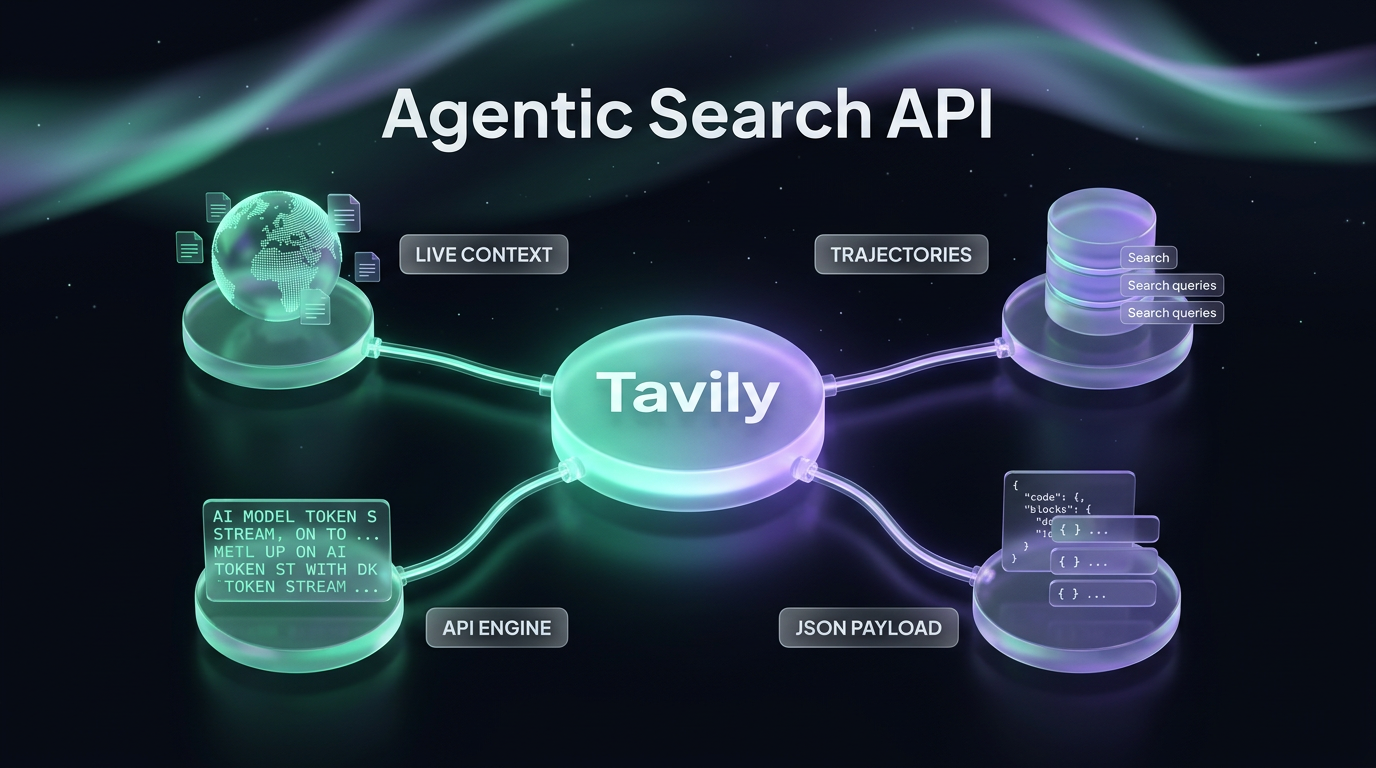
In each scenario, the agentic search API handles query expansion, retrieves candidate URLs, strips clutter, extracts core arguments, and returns clean JSON structures. The language model then synthesizes those factual extractions rather than inventing details to fill context gaps.
What This Changes for Client Builds
For builders assembling Agentic AI Systems & AI Workforce solutions, reliable web retrieval is mandatory. When Wasif Ahmed configures autonomous research agents or automated intake pipelines, the primary vulnerability is usually hallucination caused by stale or poorly parsed context data.
Integrating a dedicated agentic search API into business automation pipelines removes the fragility of web scraping. Instead of writing custom scrapers that break whenever a vendor alters a site layout, systems receive clean, structured JSON payloads. This directly improves reliability in complex AI automation workflows, whether monitoring market movements or enriching lead data inside a CRM.
FAQs
What is an agentic search API?
An agentic search API is a search service engineered for autonomous software agents rather than human browsers. It returns structured, clean text, metadata, and verified source citations instead of advertising-heavy search result pages.
How does Tavily differ from standard search engines?
Traditional search engines optimize for human clicks, page visits, and ad placements. Tavily filters out boilerplate code, cookie prompts, and ads, providing clean context blocks optimized for language model token limits.
What is included in the Tavily Startup Program?
The Tavily Startup Program offers qualifying early-stage companies 100,000 free search credits. It also includes direct technical guidance from forward-deployed engineers and network introductions across partner ecosystems.
To explore how an agentic search API can ground your operational workflows and autonomous systems, discuss your architecture with Wasif Ahmed through the contact page.