Adobe announced its new Adobe marketing toolkit series, titled Open for Business: Marketing Edition, during Adobe MAX on November 10, 2026. The release targets solopreneurs, freelance creators, and independent founders who want structured guidance to promote their work without building an in-house marketing department from scratch.
According to research cited by Adobe, 62 percent of Americans report they would rather run their own venture than work for someone else. However, many founders discover that executing client work and handling outbound promotion require completely separate operational skills. The Adobe marketing toolkit was built to address that exact knowledge gap through step-by-step documentation, asset templates, and software configurations across Adobe Express and Adobe Acrobat.
The Core Structure of the Adobe Marketing Toolkit
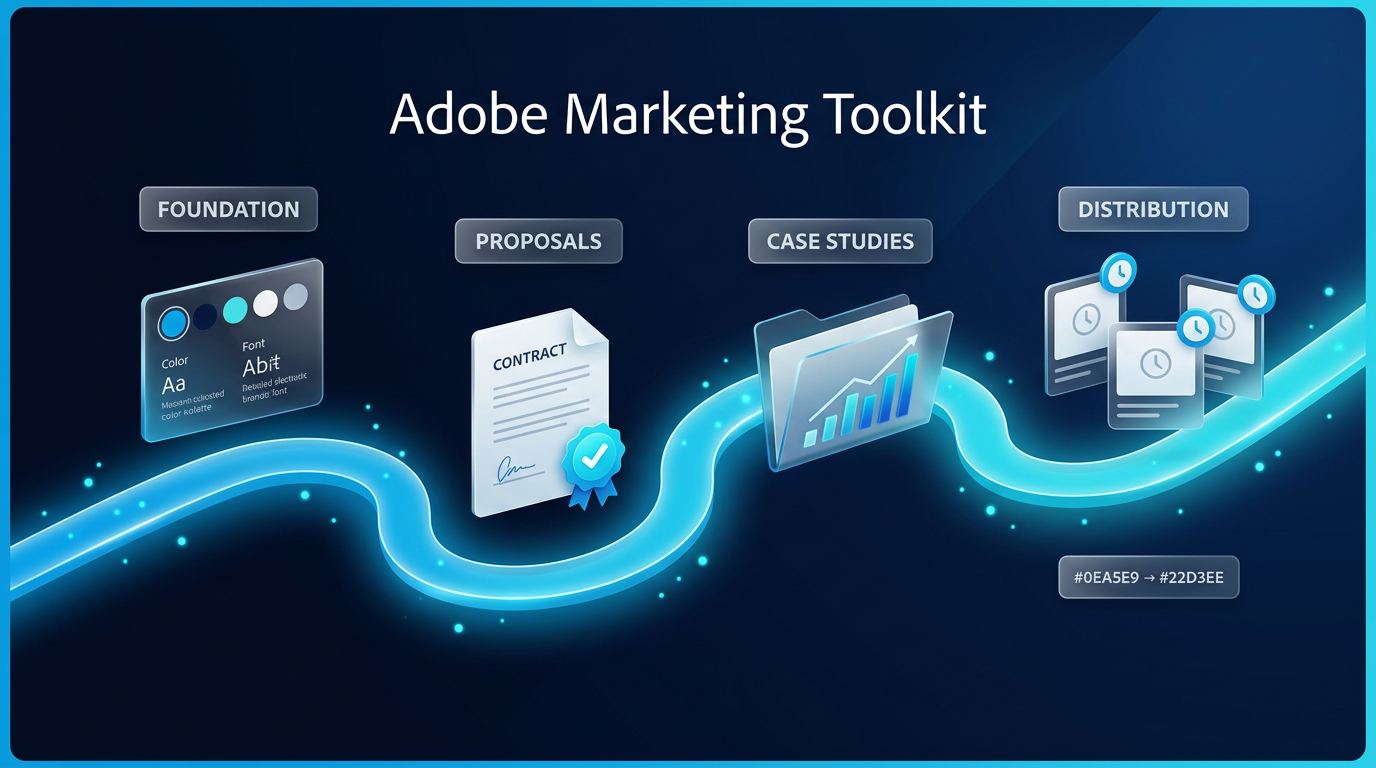
The first edition of the Adobe marketing toolkit divides small business customer acquisition into four distinct operational phases. Rather than offering scattered design tips, the curriculum follows a sequential arc from early identity planning to ongoing audience amplification.
Chapter One: Build Your Marketing Foundation
The opening chapter focuses on documenting core business details once so business owners avoid writing proposals from a blank screen. This stage guides users through assembling brand narratives, visual identity assets, standardized service descriptions, and baseline pricing schedules. Centralizing these details early prevents contradictory messaging across client touchpoints.
Chapter Two: Win New Customers
Converting prospect inquiries into signed contracts requires clear sales collateral. The second chapter provides customizable templates for introductory pitch decks, detailed project proposals, formal client agreements, and client onboarding welcome kits. The emphasis sits on turning early interest into enforceable agreements quickly.
Chapter Three: Make Every Win Count
Once a project concludes, independent operators often move immediately to the next task without documenting client outcomes. Chapter three shows founders how to capture project metrics and format those findings into concise case studies. These assets feed directly into a business portfolio that provides proof of past performance for future sales conversations.
Chapter Four: Amplify Your Story
The final chapter tackles ongoing distribution. It pairs professionally designed social media templates with practical routines for sharing, repurposing, and scheduling promotional posts. The objective is to keep previous project successes visible to target audiences over extended periods without demanding daily manual design work.
Integrated Software Across Express and Acrobat
Rather than relying on abstract marketing theories, the Adobe marketing toolkit ties every workflow directly to two established applications: Adobe Acrobat and Adobe Express.
Adobe Acrobat serves as the document and contract hub. Adobe positions Acrobat as an AI-supported environment where operators can review source documents, extract key insights, and turn plain text into client-ready agreements. Founders can draft contracts, send them for formal review, and collect verified electronic signatures within a single interface, eliminating friction during deal closings.
Adobe Express operates as the creative and scheduling engine. Within Express, small business teams establish reusable brand kits with locked brand fonts, official color palettes, and logos. The software includes tools to quickly draft visual marketing collateral and queue a full month of social media updates using its native calendar scheduler.
- Document and proposal standardization managed through Adobe Acrobat e-signatures and file analysis.
- Visual identity kits, promotional graphics, and multi-channel post scheduling configured inside Adobe Express.
- Pre-built pitch decks and welcome documents ready for direct personalization.
- Direct portfolio generation workflows designed to transform finished client projects into evergreen case studies.
Expert Workflows and the LinkedIn Connected App
Alongside template downloads, the Adobe marketing toolkit integrates operational advice from founders who built recognizable independent brands. Chef and restaurant operator Kristen Kish contributed strategies on balancing daily operational delivery with brand building, emphasizing that owners must pair technical tools with authentic personal taste.
Design strategist Chris Do provides tactical advice on applying precise typography and photography choices to raise brand perception. Entrepreneur Daymond John outlines the necessary structural components needed inside an effective pitch presentation to persuade prospective clients.
Simultaneously, Adobe announced that Adobe Express now operates as a LinkedIn connected app. When business owners produce social media and marketing materials regularly using Express, their LinkedIn profile can display their creative activity. This feature verifies ongoing creative output directly on the platform where professional clients evaluate contractors and agency owners.
Practical Implications for Independent Operators
For solopreneurs, adopting the Adobe marketing toolkit shifts outreach from an occasional panic into an organized business system. Many freelancers only market when their client pipeline dries up, which creates unstable revenue spikes and troughs. Establishing reusable assets minimizes the administrative overhead of continuous marketing.
Having a documented brand kit and standard contract templates also protects small teams from scope creep. When product descriptions, service limits, and standard rates are documented clearly in advance, founders spend less time negotiating informal agreements over email.
Teams that combine structured assets with reliable social media management routines can maintain consistent audience touchpoints without sacrificing core project delivery hours.
Where This Fits in Modern Systems
When Wasif builds client infrastructure, marketing assets cannot exist in isolation from sales software. An official contract template or a polished pitch deck from the Adobe marketing toolkit delivers the highest return when connected directly to automated customer pipelines.
For example, when a prospect fills out an intake form, an automated workflow built with AI automation can generate a personalized agreement in Acrobat, send it for e-signature, and alert the team in Go High Level when the client signs. Systematizing creative templates is the first step; connecting those templates to automated delivery pipelines ensures consistent operations across the entire client lifecycle.
FAQs
What is included in the Adobe marketing toolkit?
The Adobe marketing toolkit includes four sequential chapters covering brand foundation, sales proposals, case study documentation, and social media promotion. It provides downloadable templates, step-by-step guides, and expert advice integrated with Adobe Acrobat and Adobe Express.
Do I need advanced design skills to use the toolkit?
No design background is required. The resources rely on ready-made templates inside Adobe Express and Adobe Acrobat that allow business owners to insert their own copy, pricing, and visual assets without starting from an empty document.
How does the LinkedIn connected app integration work?
Adobe Express connects directly to a user’s LinkedIn profile. Consistent creation and publishing through Express can display verified creative activity on the user’s profile to demonstrate active portfolio work to prospective partners and clients.
Conclusion
The release of the Adobe marketing toolkit gives independent operators a clear blueprint for organizing their outreach, closing deals with formal contracts, and amplifying past project results. By uniting Adobe Acrobat documents with Adobe Express content templates, business owners can establish repeatable marketing operations that support sustainable, long-term business growth.
To discuss how to integrate your brand assets into automated client acquisition systems, reach out to Wasif directly.