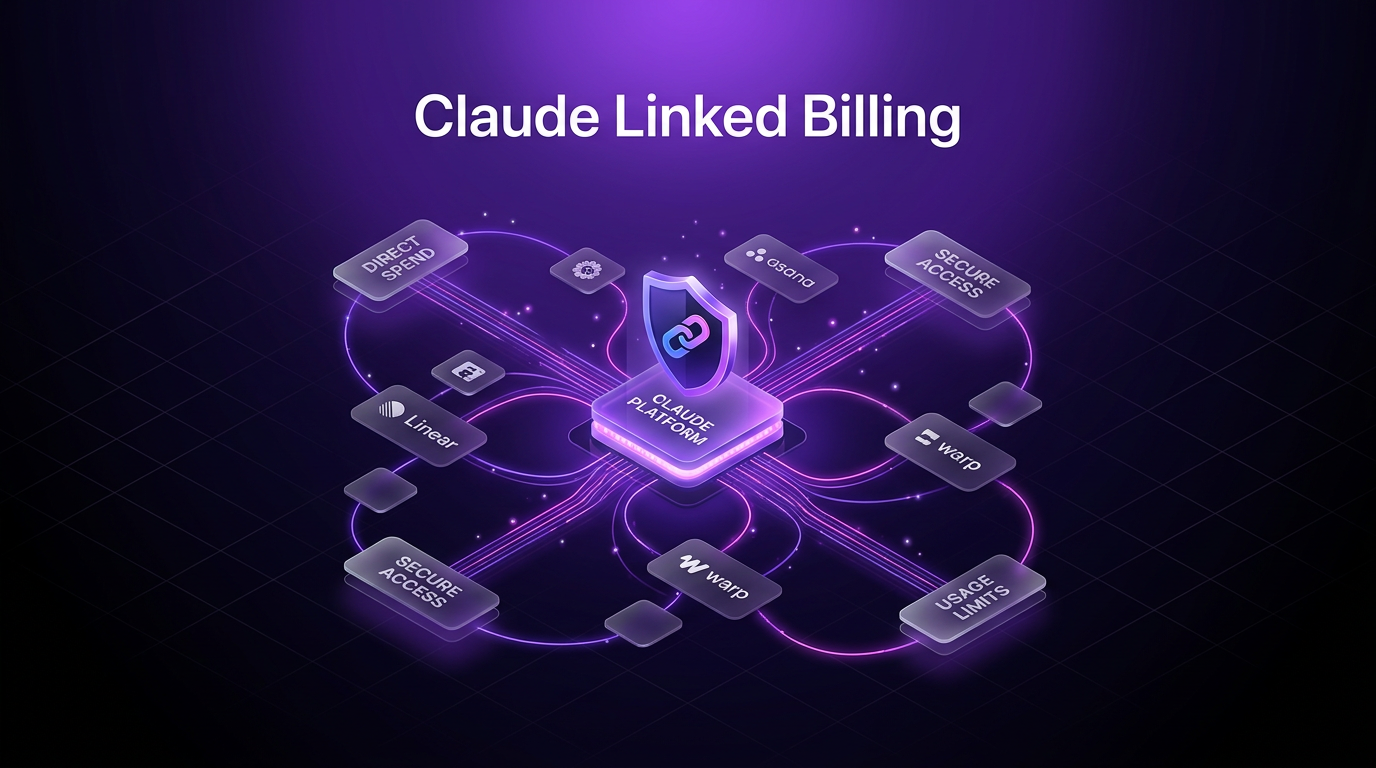
Anthropic has introduced Claude linked billing in beta on the Claude Platform, creating a secure mechanism for software platforms to let end customers pay for model requests without exchanging secret API keys. The update directly tackles a persistent credential management problem in modern software integration.
As outlined in the official release announced on the Claude Platform resources page, third-party software products like coding assistants and automation services can now connect to a customer’s Anthropic account. Instead of generating and pasting sensitive authentication tokens into external tools, administrators approve access via a hosted authorization flow.
What Changed with Claude Linked Billing
Historically, connecting an external developer tool or workspace assistant to Claude required generating an API key inside the Anthropic Console and pasting it into the third-party application. An API key acts essentially like a permanent password. Anyone holding that key can execute requests billed directly to the owner, forcing software providers to build internal vaults to encrypt, store, and rotate client keys.
Under Claude linked billing, that credential exchange disappears entirely. End customers link their Anthropic organization to the external product. Usage charges flow straight to the linked organization account, while the API keys remain isolated within the customer console.
Third-party software providers can inspect request counts, token volumes, and specific models used by each customer through the Console or programmatically through the beta Usage and Cost Analytics API. Furthermore, platforms can dynamically choose whether the platform or the end customer pays on an individual request basis.
Key Capabilities for Customers and Platforms
The introduction of Claude linked billing alters operational workflows for both software creators and business users who rely on external AI tools.
- Organization-wide authorization: An account owner, admin, or billing manager approves the integration once, covering access across team members.
- Granular spend caps: Customers can define monthly budget limits for each linked platform independently or configure a shared default limit.
- Direct cost visibility: Account admins monitor exact expenditure per connected tool inside the Anthropic Console.
- Self-service disconnection: Organizations can revoke a connected platform’s permissions at any moment from their dashboard.
- Flexible payment models: External providers can run promotional or included tiers on their own balance, then seamlessly pass intensive usage to the client account.
- Elimination of key management: Engineering platforms avoid the liability and operational overhead of storing third-party secrets.
Supported Launch Platforms
Anthropic launched the beta with immediate support across a broad group of developer tools, enterprise platforms, and workflow systems. Supported platforms at launch include Asana, ClickHouse, Factory, Gumloop, Harness, Higgsfield AI, Kilo Code, Linear, Major, Mintlify, Omni, OpenArt, Niteshift, Railway, Ramp, Runlayer, Tessera, Tines, and Warp.
In developer environments, tools such as Linear and Railway use the system to let engineers run coding agents against their company’s committed model spend without manual secret sharing. Similarly, enterprise automation and project management suites like Asana and Tines use Claude linked billing to run autonomous workspace tasks and multi-step actions without requiring IT departments to generate individual credentials for every connected workflow.
Architecture and Security Considerations
While Claude linked billing significantly mitigates the danger of leaked API credentials, Anthropic clarifies an essential technical boundary regarding execution environments. When requests are submitted via a connected platform, the execution technically runs inside the third-party platform’s Anthropic organization, even though billing routes to the customer.
Because the execution occurs within the third-party platform’s organization, certain security parameters configured inside the customer’s personal Anthropic organization do not apply to those requests. These include custom IP allowlists, proprietary customer-managed encryption keys, and specific organization-level data retention rules. Teams operating under strict compliance mandates must evaluate how third-party platforms handle session isolation before approving connections.
Nevertheless, the isolation of raw API tokens removes a major attack vector. When an employee leaves a company or a third-party service suffers an intrusion, no dormant API keys exist on external servers waiting to be intercepted.
Practical Implications for Teams and Workflows
For organizations already operating structured AI automation stacks, this beta provides immediate administrative relief. Finance teams gain predictable billing since users can draw down from pre-existing committed enterprise spend contracts rather than submitting expense reports for fragmented SaaS AI surcharges.
Software providers also benefit from reduced onboarding friction. Instead of explaining credential generation and permission scoping to non-technical users, applications can redirect users through Anthropic’s verified connection flow. This accelerates user activation while keeping spend visible in a single dashboard.
FAQs About Claude Linked Billing
What is Claude linked billing?
Claude linked billing is an account integration mechanism on the Claude Platform that allows external software platforms to charge API usage directly to a customer’s Anthropic account. It removes the necessity of generating and copying API keys between services.
How does Claude linked billing handle monthly spend limits?
Customers can establish individual monthly spending limits for every authorized third-party platform inside the Anthropic Console. Once a connected service hits its allocated ceiling, further requests are blocked unless an administrator increases the limit.
Can an organization disconnect a platform at any time?
Yes. Account owners, administrators, and billing managers can view all connected services in their dashboard and unlink any integration instantly without needing to modify application code or revoke central keys.
Putting It to Work
In production environments and client deployments, credential leakage and unmonitored token consumption remain frequent points of friction. Wasif builds custom integration workflows and agentic AI systems that connect enterprise tools, databases, and language models across platforms like Make.com and custom application backends.
Shifting toward token-free authorization models simplifies governance for technical leads. By isolating credentials and establishing hardware-level spending guardrails directly within Anthropic, teams can deploy agentic capabilities across multiple specialized tools without losing visibility over consumption or exposing foundational infrastructure.
If you are planning to modernize your AI infrastructure or configure secure automation across your business, reach out to Wasif to discuss your architecture requirements.