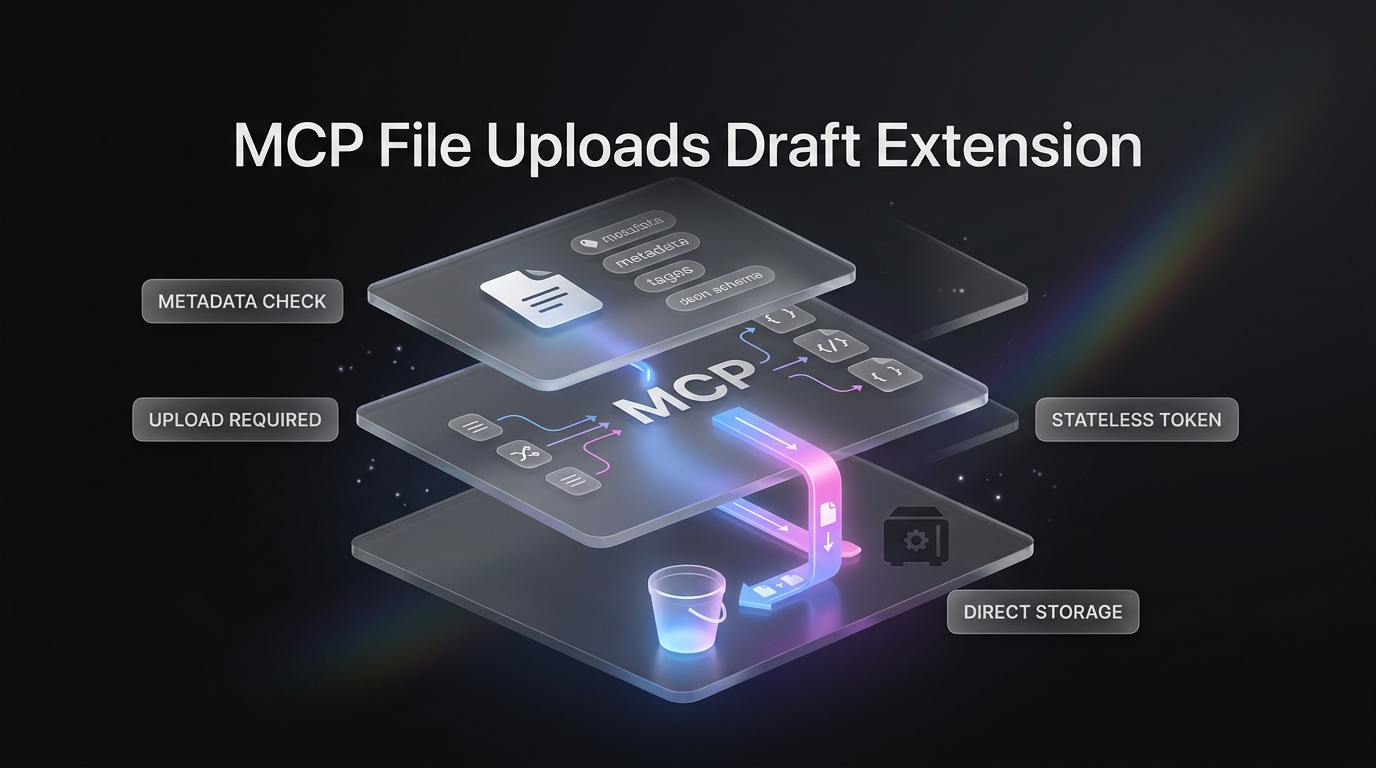
The Model Context Protocol community has introduced an experimental proposal for MCP file uploads, addressing one of the most frequent requests from developers building autonomous agents. As announced on the Model Context Protocol blog, the File Uploads Working Group has spent the past month outlining an optional specification that allows clients and servers to exchange data files directly without forcing large payloads through language models.
Over the past two years, developer projects running on the protocol have expanded from basic tool calling into complex workflows. Agents frequently need to export conversation summaries as PDF documents to cloud storage, ingest large CSV spreadsheets into isolated code sandboxes, or transfer complete presentation decks inside ZIP archives. Until now, handling these actions required bespoke transfer conventions and custom mechanisms for every server implementation.
Why MCP File Uploads Needed a Standardized Specification
When language models interact with external systems, passing raw binary files directly through the prompt context is inefficient and expensive. Large documents quickly consume token allowances, increase execution latency, and risk truncation. In typical file transfer tasks, the model only needs to understand the metadata of a document, such as its name, type, and intended destination, while the binary content travels straight to storage.
Without a shared protocol standard, teams were repeatedly building individual workarounds for MCP file uploads. Some servers accepted pre-authenticated web links, while others forced base64 strings into ordinary tool arguments. The new draft specification aims to eliminate these redundant patterns by defining a predictable contract between clients, language models, and host servers.
The working group emphasizes that this specification remains an active experiment. There is currently no reference implementation because the mechanics are expected to evolve as developers test integrations with live cloud storage providers and database export tools. The protocol authors plan to iterate on the design in production environments and expect to finalize a stable extension before the end of the year.
How the Draft Extension Handles MCP File Uploads
The proposed extension identifies itself as io.modelcontextprotocol/files and operates with protocol revision 2026-07-28 and later releases. In keeping with the design philosophy of the protocol, the extension is entirely optional. Existing clients and servers require no code modifications if they do not intend to support file transfers.
Servers advertise capability support during the server/discover phase. A server declares the upload flag if it accepts out-of-band transfers and specifies maxInlineBytes if it can accept small files directly. Clients declare their own capabilities in request metadata, signaling whether they can upload out of band or accept download targets.
Marking Arguments in Tool Schemas
To differentiate standard inputs from files, servers apply an x-mcp-file annotation to argument schemas. This marker signals to the client software that human or client intervention is required to supply the file object, removing that responsibility from the underlying model.
The schema allows developers to define accepted MIME types and maximum byte sizes through an accept list and a maxSize value. The client can supply files inline as base64 strings inside a data property, provided the total payload remains below the advertised maxInlineBytes threshold. When a file exceeds that inline limit, the data property is omitted, and the system switches to an out-of-band transfer workflow.
Early Permission Checks and Metadata Validation
Before any data moves across the network, the host application requests user approval or verifies automated agent policies. Once approved, the client initiates the tool call by transmitting only the file metadata, such as its identifier, name, MIME type, and size in bytes.
Sending metadata first provides an important operational safeguard for MCP file uploads. The destination server can evaluate folder permissions, user authentication, and storage quotas before any large upload begins. If a destination folder is set to read-only or an account lacks space, the server returns a standard tool error immediately, preventing users from wasting bandwidth uploading dozens of megabytes.
Out of Band Transfers and Stateless Resumption
If all metadata checks succeed, the server halts execution and returns a new upload_required response structure. This response contains an array of upload instructions, including a target URL, required HTTP headers, expiration timestamps, and an opaque state token named requestState.
The client then uploads the raw binary file directly to the provided destination using an HTTPS PUT request or an HTTPS POST multipart form. This transfer takes place completely outside the JSON-RPC connection, preserving network efficiency and preventing protocol bottlenecks.
Once the upload completes with a successful HTTP 2xx status, the client triggers the original tool call a second time, attaching the unchanged requestState token. This multi-round-trip pattern maintains the stateless architecture of the protocol. Because all unfinished task context is encapsulated within the protected token, any server instance with access to shared storage can verify the state and finish the tool execution without persistent memory sessions.
Practical Implications for Builders and System Architects
For organizations engineering agentic AI systems, this draft standard establishes a clear architectural path for document ingestion and artifact storage. Developers who previously avoided file-based tool calls due to context window limits can soon structure agent workflows around external storage targets.
Several practical considerations emerge from the current proposal:
- Storage decoupling: File contents bypass the inference pipeline entirely, routing straight from user devices or sandboxes into object storage buckets.
- Quota protection: Servers reject invalid jobs before data transfer begins, safeguarding backend bandwidth and storage costs.
- Client backwards compatibility: Clients that do not support the extension simply treat file inputs as standard objects, allowing servers to provide fallback URLs when necessary.
- Duplicate prevention: Stateful tool actions can mark the requestState token as used in a shared database to prevent repeated uploads from creating duplicate assets.
These capabilities complement broader enterprise workflows where models coordinate tasks while leaving heavy data movement to dedicated infrastructure, an approach frequently seen in production AI automation pipelines.
FAQs
How do MCP file uploads protect token context windows?
The extension allows clients to send only document metadata to the model and server during the initial tool invocation. The actual file bytes travel directly to external storage targets through standard HTTPS requests, meaning raw binary data never enters the prompt context.
Are servers required to support MCP file uploads?
No, the file extension is fully optional. Servers and clients negotiate support during initial handshake discovery, and servers can omit file-dependent tools or offer alternative link-based inputs when communicating with unsupported clients.
When will the MCP file uploads extension become stable?
The protocol working group describes the current specification as experimental and subject to change based on real-world testing. The maintainers plan to refine the design alongside third-party service providers and expect to reach a stable release before the end of the year.
What This Changes for Client Builds
When Wasif builds production integrations and agentic systems, handling unstructured assets like invoices, customer exports, and reports often requires fragile webhooks and custom upload portals. Having a unified specification for MCP file uploads will simplify how autonomous agents interact with external data environments.
Standardizing these handshakes allows tools to focus on business logic rather than file transport protocols. While the extension remains in active development, understanding its stateless multi-round-trip design helps developers plan storage architectures that will align with official client releases once the standard stabilizes.
Conclusion
The draft extension for MCP file uploads addresses a fundamental operational hurdle in modern agent development. By separating metadata inspection from out-of-band binary transfers, the proposed standard keeps models lightweight while giving agents reliable access to cloud storage. Teams building on the Model Context Protocol should monitor the experimental repository as real-world testing refines the specification ahead of its planned stabilization later this year.
To explore how structured agent workflows and modern automation architecture can assist your organization, feel free to reach out to Wasif directly.