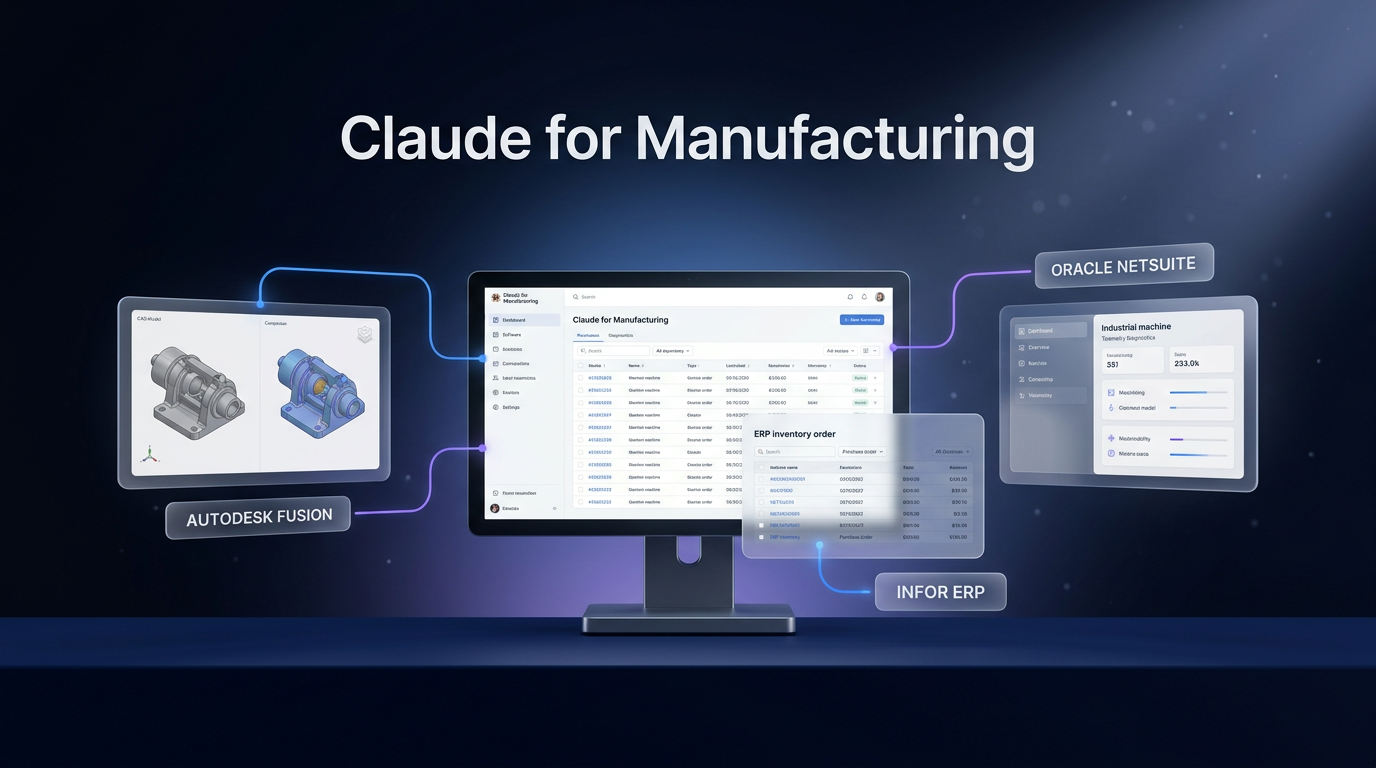
Claude for Manufacturing is officially here as a dedicated plugin designed to connect Anthropic’s AI with operational factory records. The new release introduces seventeen purpose-built skills spanning quoting, quality control, maintenance diagnosis, supplier sourcing, and plant reporting. Rather than leaving production teams to copy data across isolated software silos, the plugin bridges day-to-day operations with enterprise records through direct connectors to Autodesk Fusion, Infor, Microsoft 365, and Oracle NetSuite.
What Changed with Claude for Manufacturing
According to research from the Manufacturing Leadership Council cited by Anthropic, 79 percent of manufacturers still enter data manually across their operations. Plant staff frequently spend hours pulling numbers from enterprise resource planning systems, chasing design files, or transcribing field notes. Claude for Manufacturing addresses that friction by assembling disparate records into structured drafts ready for human approval.
The announcement, announced on the Anthropic website, explains that the system works inside Team and Enterprise tiers. When an organization installs the plugin and tells Claude to start setup, the assistant checks connected software, verifies credentials, and reports which skills are ready to run.
Crucially, the tool does not operate physical machinery directly. Anthropic confirmed that physical machinery control remains outside the scope of this plugin. Instead, the company is separately developing the Model Hardware Standard, an exploratory preview intended to help programmable equipment share telemetry, operational thresholds, and safety limits in a uniform format.
The 17 Skills Inside Claude for Manufacturing
The core capability of the plugin centers on seventeen discrete skills designed to manage single tasks or execute sequential procedures until human sign-off is required. These workflows target administrative bottlenecks across six functional areas: sales, quality, operations, supply chain, design, and production configuration.
- Quoting and estimation: Reading incoming customer project requirements, noting missing technical parameters, evaluating past job costs, and drafting customer proposals.
- Failed inspection reviews: Documenting non-conformance incidents, cross-referencing historical defect logs for matching root causes, ranking failure vectors, and preparing corrective action documentation.
- Machine breakdown diagnostics: Parsing telemetry exports, technician notes, repair imagery, and equipment manuals to rank likely mechanical faults for field staff.
- Alternative supplier sourcing: Preparing requests for quotation, parsing incoming vendor submissions, and highlighting variance across pricing and delivery schedules.
- Design variation evaluations: Interfacing with Autodesk Fusion models to produce design variants, evaluate alternatives against target specifications, and write engineering memos.
- Plant production summaries: Compiling daily shift metrics into plant-level reports tracking actual output against quotas alongside downtime costs.
Anthropic stated that these initial seventeen skills serve as an operational baseline. The company plans to introduce additional manufacturing procedures over time while allowing organizations to configure workflows tailored to proprietary plant routines.
System Connectors and ERP Integration
A primary bottleneck in plant administration is software isolation. Claude for Manufacturing establishes direct touchpoints with foundational engineering, productivity, and ERP platforms to pull necessary context directly into the conversation.
For computer-aided design teams, the Autodesk Fusion connector lets engineers explore design iterations without rebuilding base models from scratch. Within Infor environments, planners and procurement buyers can verify current stock levels and review existing purchase orders before initiating purchases.
The Oracle NetSuite integration allows estimation teams to price incoming projects against verified production runs, current inventory valuations, and past labor allocations. For unstructured communication, the Microsoft 365 connector searches shared inboxes, standard operating procedures, and exported spreadsheets to centralize evidence inside one work session.
Plants running legacy tools without built-in connectors can still leverage Claude for Manufacturing. Staff can export standard reports into shared Microsoft 365 folders, allowing Claude to parse files and compile summaries or cost estimates from the exported documentation.
Bi-Directional Action Through Infor
Read-only lookup solves only half of the administrative burden on plant floors. Alongside this launch, Infor released its own dedicated companion plugin that expands the integration from basic querying into active record modification inside Infor environments.
The distinction between the two tools is practical. While the standard connector in Claude for Manufacturing enables lookups, Infor’s companion plugin allows approved personnel to apply adjustments directly from the chat interface. For instance, if raw material shipments encounter unexpected delays, a procurement officer can query Claude to identify affected customer contracts and evaluate inventory across alternate warehouses.
Once the procurement specialist reviews and confirms the proposed resolution, Claude can draft and issue a replacement purchase order to an alternate supplier while rescheduling dependent manufacturing orders inside Infor. Every operation respects the authenticated user’s existing permissions inside Infor, preventing unauthorized data adjustments.
Human Verification and Governance
Industrial workflows carry financial and safety risks, which makes autonomous unverified execution hazardous. Claude for Manufacturing enforces human oversight checkpoints across every supported routine. Workflows are designed to pause whenever critical determinations arise.
An estimator must personally verify pricing assumptions and margins before a formal quote goes to a client. Similarly, a quality lead must inspect and sign off on a corrective action report before it enters vendor records. To assist with auditing, the model displays direct links back to the source documents, database fields, and sensor logs used to construct its recommendations.
This verification structure mirrors broader design patterns across agentic AI systems, where assistants synthesize unstructured files while leaving final commitments to licensed operators. By keeping calculations traceable to source files, teams can audit assertions quickly before committing funds or issuing work orders.
Practical Implications for Factory Operations
For mid-sized and enterprise manufacturers, deploying Claude for Manufacturing shifts how back-office overhead is handled. Instead of estimators spending full mornings calculating material takeoffs and sorting through spreadsheets, the initial research stage happens in minutes.
Maintenance engineers receive structured candidate fault lists derived from equipment manuals and past maintenance logs before opening an electrical cabinet. This capability complements modern AI automation architectures that streamline data flow between customer front ends and internal plant software.
Because the plugin runs on existing Team and Enterprise subscriptions, companies do not need to construct bespoke machine learning pipelines to test basic document parsing and estimation drafts. Plants already using Infor or NetSuite gain immediate utility without re-architecting their underlying operational database layer.
Where This Fits in Real Client Builds
When Wasif designs operations workflows for businesses, data synchronization between operational software and communication channels is typically the primary point of failure. Tools like Claude for Manufacturing illustrate how software vendors are beginning to provide structured connectors directly to core databases rather than forcing builders to stitch together complex multi-app webhooks for routine queries.
In custom system architecture, Wasif frequently pairs structured data extraction with approval dashboards. Adding standard industrial connectors to large language models allows operations teams to focus attention on critical judgment calls rather than manual record matching. Organizations preparing to integrate these features must ensure their core ERP roles, document repositories, and employee permission levels are thoroughly organized first.
Conclusion
Claude for Manufacturing establishes a structured framework for connecting generative AI to industrial software like NetSuite, Infor, and Autodesk Fusion. By packaging seventeen predefined plant skills behind strict human review checkpoints, the release focuses on relieving administrative bottlenecks in quoting, maintenance, and quality reporting while keeping production decisions securely under human control.
To discuss building automated workflows and data systems for your business, reach out through the contact page.