An unmonitored AI agent infinite loop can drain hundreds or thousands of dollars in API credits in a single night. When an autonomous model calls an external tool that fails, standard runtime environments offer no built-in pause button. The model receives the error, attempts to solve the problem by running the tool again, and repeats the cycle indefinitely until someone notices or the account balance empties.
Tool calling errors compound quickly because autonomous agents resend the full dialogue history on every iteration. In a technical guide detailed in OpenRouter’s tutorial, benchmarks show that recurring failures cause prompt sizes to balloon from 131 tokens to several thousand tokens within minutes. Mitigating this risk requires strict controls at the agent, runtime, and provider levels.
Why an AI agent infinite loop happens in production
An autonomous agent loop continues until the language model returns a response without requesting an external tool. When a connected tool fails, such as an external invoice endpoint timing out, the model receives an error string back in the conversation log. Because system prompts typically instruct agents to complete their task no matter what, the model interprets the failure as a temporary setback and calls the same tool again.
Without custom state logic, standard agent loops do not track previous attempts. Every failed attempt is appended to the message history, which increases the token count for subsequent turns. In testing documented by OpenRouter using their Agent SDK (@openrouter/agent version 0.11.0), input token counts grew from 131 to 3,262 tokens during a prolonged failure cycle. This compounded token load nearly quadrupled the individual cost of each turn.
Model behavior can also vary across identical test conditions. In test runs across models such as Mistral Large 4.0, GPT-6 Luna, and Grok 4.7, identical prompts produced wildly different retry counts before terminating. Grok 4.7 recorded 41 calls in one test run and 12 in another under the same conditions. These variations demonstrate that prompt engineering alone cannot guarantee that a model will step away from a broken task.
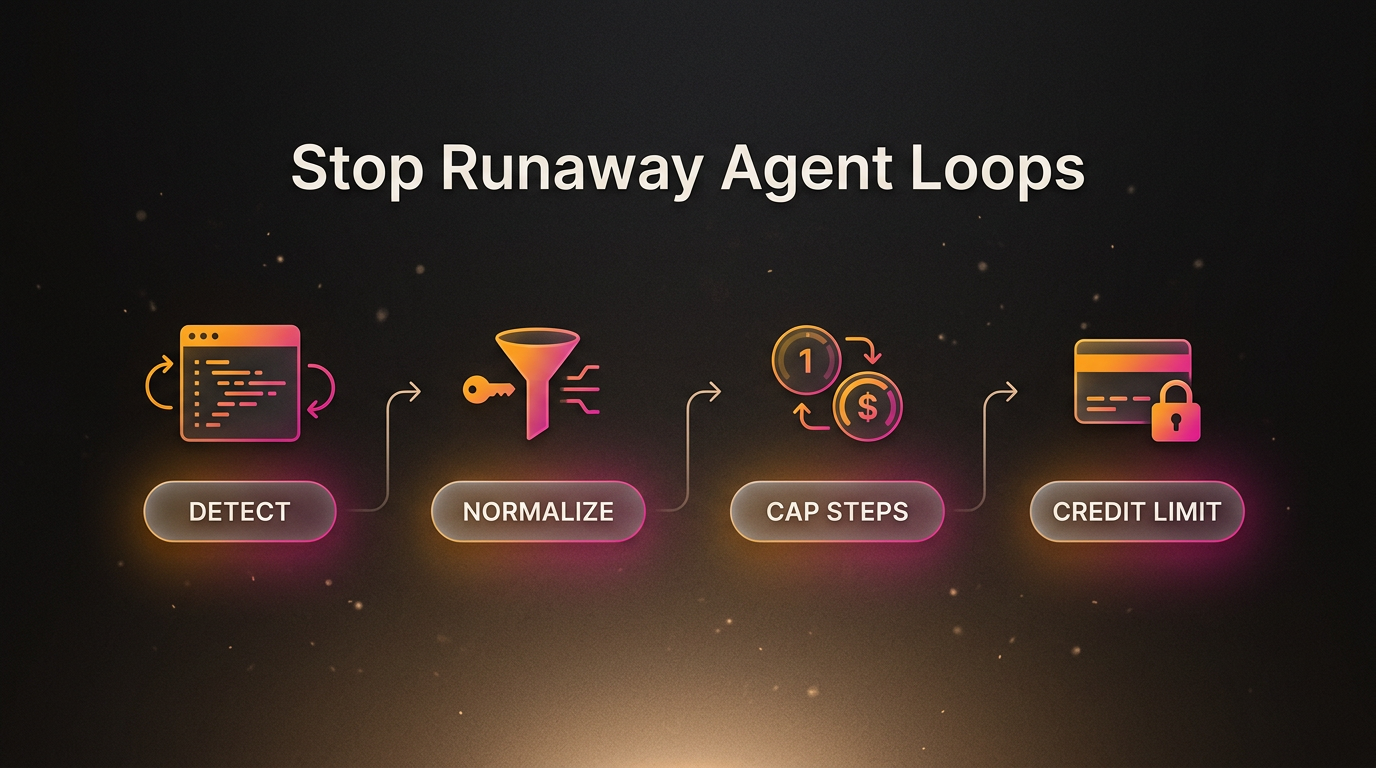
Four guards to stop an AI agent infinite loop
Stopping a runaway execution loop requires defense at multiple boundaries. Implementing safeguards within the execution SDK alongside provider-level spend caps provides reliable containment without interrupting legitimate multi-step workflows.
1. Turn on automated doom-loop detection
The primary defense against repeated failures is automated pattern detection at the SDK level. OpenRouter’s Agent SDK includes a built-in flag called doomLoop that tracks identical tool executions across consecutive turns. When enabled via doomLoop: true inside the callModel configuration, the runtime fingerprints each tool call by combining its function name and parsed arguments.
The system uses an escalation ladder based on consecutive identical calls:
- Streak 2: The system enters an observe state without altering execution.
- Streak 3: The runtime blocks execution, skips running the tool, and returns a synthetic error telling the model that repeated calls will fail.
- Streak 6: The engine forces a hard stop, setting the session termination reason to doom_loop.
In benchmark tests across six models including Claude Haiku 5.5, Gemini 3.8 Flash, and DeepSeek V4.1 Flash, enabling doom-loop detection cut total tool executions from 314 down to 64 across 18 test runs. This reduced overall benchmark spend from $0.29 to $0.05. Most models read the block error at streak 3 and immediately generated a fallback answer for the user.
2. Normalize arguments with a custom loop key
Standard fingerprinting relies on exact argument matching. However, when models encounter a blocked tool call, they frequently attempt minor variations to circumvent the restriction. During benchmark evaluations, Mistral Large 4.0 bypassed simple fingerprinting by alternating case sensitivity, switching between INV-2291 and inv-2291. Similarly, GPT-6 Luna bypassed detection by appending trailing whitespaces and newlines to parameter values.
To prevent this bypass, developers can define a loopKey function on tool definitions. This function normalizes arguments before the fingerprint hash is computed. For an invoice lookup tool, a regular expression that strips non-digit characters ensures that INV-2291, inv-2291, and trailing whitespace strings all resolve to the same internal key. Normalizing inputs ensures that small formatting shifts do not reset the streak counter.
3. Cap steps and session cost per execution
Pattern matching addresses identical retries, but an AI agent infinite loop can also occur when a model cycles through different tools without making progress. Enforcing ceiling limits on total steps and run expenses provides an essential safety net.
Using the stopWhen parameter in the Agent SDK allows builders to pass composite limits like stepCountIs(n) and maxCost(x). Setting a hard limit of 20 or 40 steps ensures that unexpected behaviors terminate before token usage spirals out of control. Similarly, setting a maximum run cost ensures that high-priced reasoning models do not exhaust team budgets if a complex reasoning step hangs indefinitely.
4. Set provider-level API credit limits
Application-level guards can fail if runtime code encounters unhandled exceptions or deployment bugs. The final layer of protection must live directly within the API provider account. Configuring a hard credit limit on the specific API key isolates potential financial exposure.
When an agent exceeds an account-level limit on OpenRouter, the gateway rejects subsequent calls with an HTTP 402 status code and returns limit_source: openrouter_key_limit. Because this boundary is enforced upstream by the provider infrastructure, runaway scripts cannot exceed allocated funds even if local agent containers crash or loop indefinitely.
Common mistakes in agent loop management
A frequent mistake when deploying autonomous agents is relying entirely on system instructions to dictate termination. Telling a model to give up after three attempts often fails because language models do not reliably track internal counters across complex state changes. Hard code barriers must enforce execution limits rather than soft prompt constraints.
Another common oversight is ignoring token escalation during long-running tasks. Every failed tool response adds context to the ongoing prompt. If an agent does not prune previous error logs or summarize past attempts, input costs rise exponentially with each subsequent turn. Applying token budgets and windowing strategies alongside loop detection keeps operational costs stable.
FAQs
How does an AI agent infinite loop affect API billing?
An AI agent infinite loop rapidly inflates billing because each iteration resends the entire conversation history, including previous tool arguments and failure outputs. As context expands, every additional turn costs significantly more than the preceding one, multiplying expenses exponentially during sustained retries.
What is the difference between doomLoop detection and step caps?
Doom-loop detection specifically identifies and blocks identical, repetitive tool calls while allowing diverse workflows to continue. Step caps enforce a hard numerical limit on the total number of actions an agent can take, acting as a global fail-safe regardless of tool variety.
Can prompt engineering alone prevent recursive agent errors?
Prompt instructions asking a model to stop after a failure are unreliable during edge cases. Models frequently miscalculate retry attempts or make slight argument changes when pressed to solve an objective. Deterministic code logic and provider-level spend caps are necessary for production reliability.
What this changes for client builds
In client environments, silent failures and unbounded retries are unacceptable risks. When Wasif develops agentic AI systems and end-to-end AI automation workflows, multi-tier guards are implemented by default. Automated pattern detection catches stuck tasks early, input normalizers prevent argument drift, and rigid runtime budgets protect client balances against unexpected API charges.
Conclusion
Autonomous agents require rigorous boundaries to operate safely at scale. Relying solely on model compliance leaves applications vulnerable to costly retries and degraded user experiences. By combining automated detection ladders, normalized argument keys, execution step caps, and upstream provider limits, developers can stop an AI agent infinite loop before it impacts infrastructure stability.
If you need resilient automation architectures designed with enterprise-grade guardrails, visit Wasif Ahmed’s contact page to discuss your project requirements.