Always-on agents are gaining renewed attention as foundational models become more dependable and less expensive to operate over extended tasks. In an analysis on building always-on agents, Anthropic highlighted that long-horizon tasks have benefited from steep price declines. On one long-horizon coding evaluation, Opus 5.5 cost 78 percent less per solved task than Opus 5, compared with a 40 percent decrease on standard workloads. These lower costs make proactive background systems realistic to operate at commercial scale.
An always-on agent is defined by two traits: it is stateful and proactive. Rather than waiting passively for an operator to submit a prompt, these systems retain context between sessions and carry out actions without direct supervision. Understanding their underlying architecture helps builders structure reliable autonomous workflows.
The Mechanics of Always-On Agents Between Runs
Despite the name, always-on agents do not run continuously in an infinite compute loop. That phrase simply describes how the end user experiences the software. In actual execution, the system spends most of its operational life asleep.
Work happens in discrete bursts called runs. When an event arrives, a background worker wakes the agent up. The agent evaluates the trigger, carries out tool calls, writes updates back to persistent storage, and returns to sleep. A single run operates within a session transcript containing the history of messages and actions. Once the task finishes, the session state is preserved so that future runs can reference it.
This cyclical pattern keeps cloud compute costs manageable. Instead of leaving an expensive model inference thread open, the architecture relies on standard infrastructure components to govern when the agent wakes up, what context it loads, and where its actions go.
Five Primitives That Power Always-On Agents
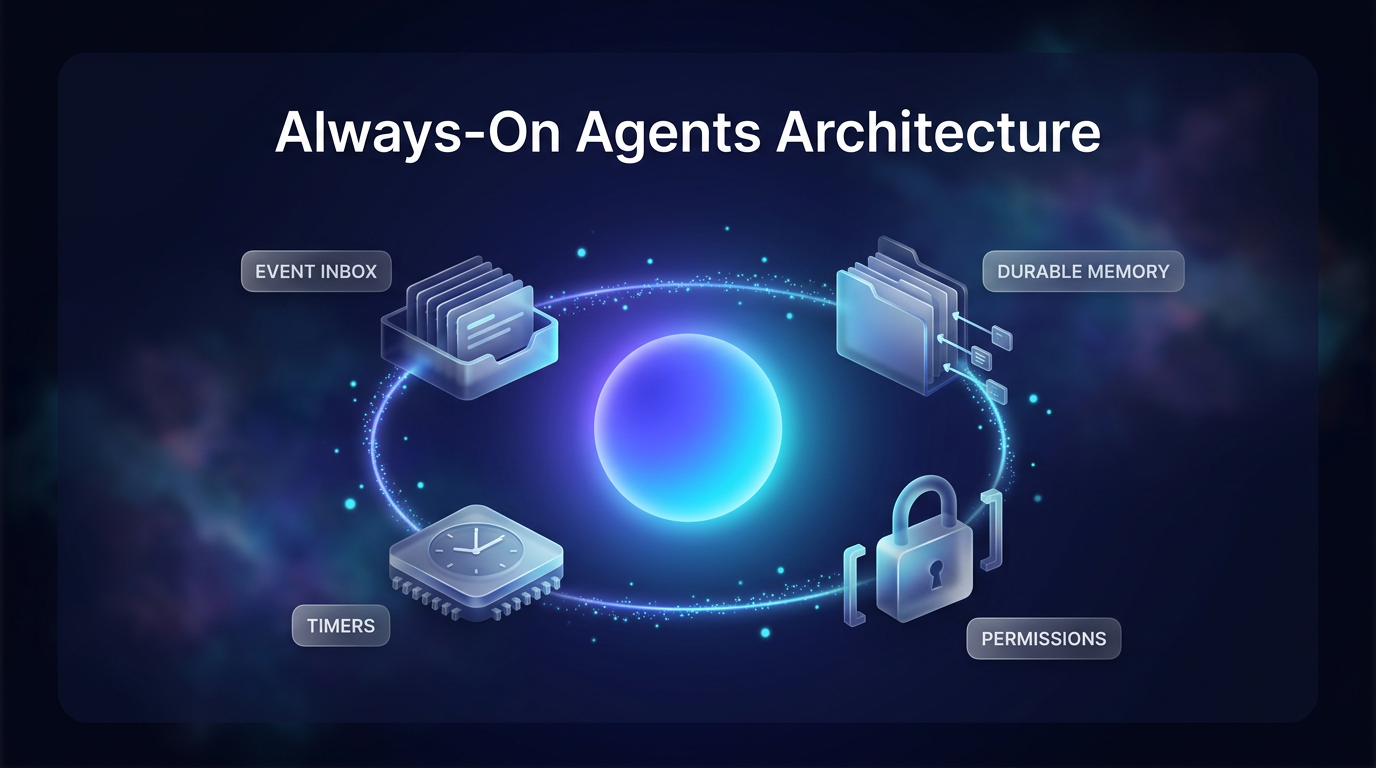
Building always-on agents requires five core architectural primitives: an event inbox, timers, durable memory, permission boundaries, and an outbox. Each primitive solves a specific failure mode that occurs when running automated models without human supervision.
1. The Event Inbox
Conventional chatbots only execute when a person submits text into a dialogue box. By contrast, always-on agents respond to diverse triggers, such as incoming webhooks, background database updates, and queued user replies. Connecting these external sources directly to model execution creates severe failure points, including race conditions and lost requests if a worker crashes.
An event inbox acts as an asynchronous buffer between event producers and the agent worker. A basic inbox contains three main parts:
- A durable database table that stores raw events and tracks their status.
- An HTTP handler or endpoint that appends incoming events to the table quickly.
- A background worker service that reads pending rows and launches the agent loop.
Fast acknowledgment from the handler is critical because many third-party webhook providers treat slow HTTP responses as network timeouts. Deep verification steps, like scanning for prompt injection, belong inside the worker run rather than the ingest handler. To prevent split-brain conflicts, each inbox queue should have only one active worker assigned at a time. If new events arrive while a run is already in progress, the worker can batch those events into the next cycle.
2. Scheduled and Follow-Up Timers
Timers supply the proactive behavior that distinguishes always-on agents from reactive integrations. These timers generally split into two categories: follow-ups and recurring schedules. A follow-up is a single deadline the model sets for itself, such as checking whether a client replied after forty-eight hours. A recurring schedule runs at fixed intervals, such as generating an operations summary every weekday morning.
Timers reside in their own persistent database table rather than mixing directly into the inbox. A dedicated scheduler service periodically polls this table to identify records that are due. When a timer matures, the scheduler updates the record and pushes a fresh event into the inbox, prompting the worker to wake up and begin processing.
3. Multi-Session Durable Memory
Because always-on agents execute across fragmented sessions, they require persistent memory that outlives any single worker process. If a data point already exists in an external tool, such as a customer record in a CRM, the agent should store a pointer to that record instead of copying raw data.
The memory layer typically organizes information into clear categories: fixed user instructions, recorded behavioral notes, summaries of past conversations, and task progress trackers. Keeping progress logs in durable storage allows a newly awakened agent to see what previous runs completed and what remains pending. Over time, background curation routines can review past transcripts to consolidate duplicate entries and remove obsolete guidance.
4. Context Window Assembly
Before launching tool execution, the agent loads system instructions, tool definitions, and memory indexes into its context window. This overhead consumes tokens on every single run. Using prompt caching techniques helps keep recurring operational expenses down.
When a session transcript becomes too large, the system must either compact older messages or archive the session and start a new one. Crucial state updates must be written to external memory files before compaction occurs, ensuring critical context is not erased during context pruning.
5. Permissions and Safe Execution
Unattended execution increases security risk because the agent holds access credentials without an operator verifying each step. The permission layer must determine whether an action should execute automatically, get blocked outright, or halt until a human approves the request through an outbox notification. Protecting credential vaults and maintaining clear action boundaries prevents unauthorized modifications to connected software.
Practical Considerations for Production Systems
Engineering always-on agents requires careful attention to infrastructure reliability. Developers must treat model calls as unstable dependencies that can experience latency spikes, rate limits, or context errors. Storing intermediate run states in relational databases ensures that if a background server restarts mid-run, an incoming event is retried safely rather than dropped.
Managing costs is equally important. Even with pricing decreases across modern model families, waking an agent on every minor webhook creates cumulative token expenses. Batching related events together inside the inbox prevents unnecessary runs and minimizes repetitive context overhead.
FAQs
What is the primary difference between standard chatbots and always-on agents?
Standard chatbots operate reactively, running only when an end user manually submits a message. Always-on agents are stateful and proactive, waking up from timers, webhooks, or scheduled jobs to complete tasks without direct user intervention.
How do always-on agents manage memory without exceeding context limits?
These systems store persistent memory in external files or database records rather than keeping entire session histories in context. When a run begins, the agent only loads core instructions and relevant memory indexes, reading detailed files only when specific tasks require them.
Why is an event inbox necessary instead of calling the model directly?
Direct calls make systems vulnerable to race conditions when multiple events arrive simultaneously. An event inbox stores incoming triggers durably in a database first, allowing a dedicated worker to process events sequentially or batch them safely.
Where This Fits in Real Automation Builds
In client implementations, Wasif incorporates these asynchronous primitives when designing advanced agentic AI systems and end-to-end AI automation workflows. Rather than connecting raw webhooks directly to language models, reliable production architecture requires message queues, deduplication tables, and strict human-in-the-loop review triggers for sensitive actions.
By separating the ingestion layer from the execution loop, client operations stay protected against unexpected downtime and erratic token spikes. This structured approach allows proactive systems to monitor customer data and trigger timely follow-ups without manual staff supervision.
Conclusion
Building always-on agents requires treating autonomous AI as a durable, event-driven cycle rather than a continuous live session. By combining an event inbox, polling timers, external memory storage, and guarded permissions, developers can deploy proactive systems that operate reliably at predictable costs.
If you are planning to implement proactive agent systems or need assistance architecting resilient business workflows, reach out to Wasif Ahmed to discuss your project requirements.