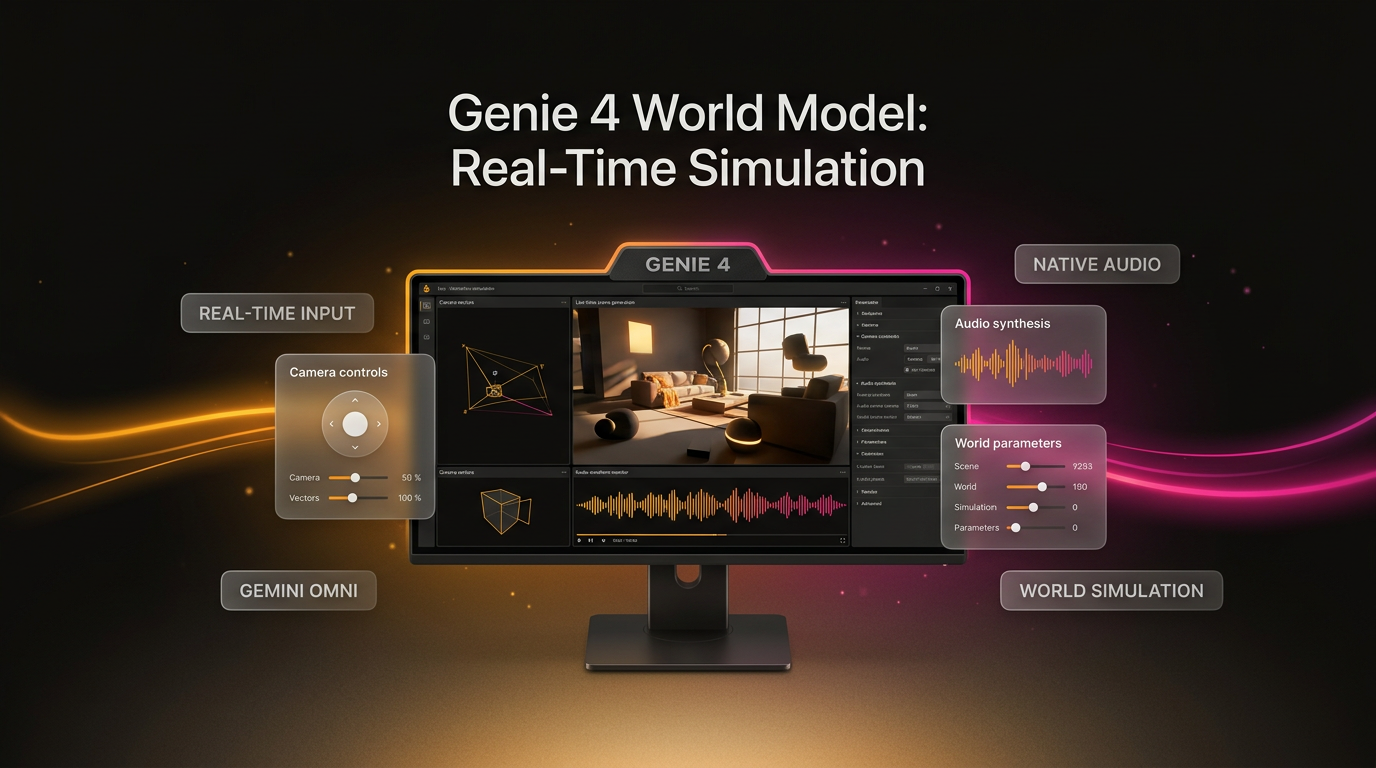
Google DeepMind announced the Genie 4 world model on October 27, 2026, introducing research into real-time interactive simulation powered by foundational models. The release focuses on generating responsive environments that users can navigate, alter, and hear in real time through natural language instructions.
As detailed in the research announcement on the Google DeepMind blog, the architecture integrates existing systems from the Gemini ecosystem. The system pairs visual generation with audio synthesis to construct coherent spaces on demand.
What the Genie 4 World Model Introduces
The primary development in the Genie 4 world model is its transition from static video generation to interactive, steerable simulation. Earlier generations of generative video produced fixed clips based on a single prompt. In contrast, this new system keeps a simulation running continuously while accepting new instructions from the user on the fly.
Users can adjust scenes dynamically using plain text commands. These adjustments include moving the virtual camera, altering weather conditions, or adding new characters into the ongoing environment. Because the simulation operates in real time, changes take effect immediately without requiring the model to regenerate the entire sequence from scratch.
Audio synthesis is also native to the platform. Rather than adding post-production sound effects, the system generates ambient sounds, background music, and contextual dialogue simultaneously with the visual stream. The audio responds directly to interactions taking place inside the simulated environment, ensuring soundscapes remain synchronized with changes in camera position and character movement.
How the Genie 4 World Model Integrates Gemini Systems
To keep interactive spaces stable over time, the Genie 4 world model relies on specialized components from the Gemini family. Maintaining continuity in an interactive environment requires both sensory fidelity and logical consistency across extended frames.
- Gemini Omni integration: Anchors the simulation in physical appearance and real-world behavior, ensuring light, textures, and movement follow believable visual patterns.
- Reasoning models: Supply the multi-step logic required to preserve object permanence, spatial continuity, and narrative coherence as users modify the scene.
- Native audio generation: Produces synchronized dialogue, music, and environment audio directly inside the simulation pipeline.
Without foundational reasoning, interactive worlds frequently suffer from visual drift, where objects disappear once the camera turns away. DeepMind indicates that incorporating Gemini reasoning models helps the simulation maintain spatial memory and state persistence during extended interactions.
By combining these capabilities, the architecture addresses the balance between fast frame generation and consistent spatial logic. When a user prompts a change, such as turning a street corner or altering weather from clear skies to rain, the underlying reasoning models calculate how objects and lighting should behave based on prior frames.
Target Industries and Operational Use Cases
Simulated environments serve distinct roles across technical development and digital media production. DeepMind positions world modeling as an important developmental step toward artificial general intelligence, particularly for testing autonomous systems.
Robotics development represents a primary application for the Genie 4 world model. Training physical robots in the real world presents risks of hardware damage and safety hazards. Real-time simulations allow engineers to train physical and software agents in safe virtual environments that mirror real-world physics and unpredictability before deploying them to physical hardware.
Digital creative teams in gaming, filmmaking, journalism, and manufacturing also stand to use these interactive capabilities. In film production, directors can test virtual camera angles, lighting conditions, and scene pacing before principal photography begins. In manufacturing, teams can simulate floor operations and equipment layouts under varying environmental stress.
Software developers building autonomous systems, including builders exploring Agentic AI Systems & AI Workforce workflows, require test environments where simulated agents can interact with unpredictable variables without breaking operational databases. Simulated worlds offer an isolated sandbox to test agent decision loops before running tasks on live enterprise systems.
Current Availability and Planned Rollout Schedule
The company has not launched the system as a public open-access tool. Instead, DeepMind has started rolling out the Genie 4 world model to a limited group of trusted testers for evaluation and safety testing.
General consumer access is planned for Google AI Ultra subscribers through an interface called Project Genie. For technical teams, API access will arrive later through early access programs in Google AI Studio and the Gemini API, allowing software engineers to connect interactive simulations into custom pipelines.
Because the rollout remains restricted, exact API rate limits, pricing tiers, and compute hardware requirements have not been published. Teams planning around world models should treat current capabilities as preview research rather than immediate production infrastructure.
Technical Considerations for System Builders
While the demos show responsive environments, running real-time neural simulation demands significant compute resources. Traditional game engines achieve high frame rates through pre-rendered 3D assets, polygon meshes, and deterministic physics engines. A neural world model generates pixels and audio frames probabilistically at inference time.
This fundamental difference means latency and compute costs will dictate how quickly developers can adopt the technology. For organizations currently deploying standard AI automation pipelines, neural simulation remains a distinct category aimed at spatial testing rather than text processing or API orchestration.
Developers will need to evaluate how effectively the model accepts external inputs, whether state files can be exported, and how reliably the environment reproduces specific physical conditions during repeatable benchmark tests. Until latency figures and API endpoints are standardized, production architectures will continue to isolate deterministic workflows from generative simulations.
Frequently Asked Questions
How does interactive steerability work in real-time simulation?
Users guide the environment by submitting natural language instructions while the scene is active. The system updates properties such as lighting, camera trajectory, and character behavior on the fly without stopping the continuous video and audio generation stream.
How does the Gemini family contribute to the system?
In the Genie 4 world model, Gemini Omni grounds visual rendering and physical appearance, while additional Gemini models supply high-level reasoning to preserve spatial memory and continuity across changing scenes. This setup prevents visual hallucination and maintains object permanence.
Who can currently access Project Genie and the simulation API?
Access is currently limited to trusted testers. Google plans to release Project Genie to Google AI Ultra subscribers, followed by developer access through the Gemini API and Google AI Studio for early access partners.
What This Changes for Client Builds
Wasif monitors developments in world modeling to evaluate how virtual environments might eventually assist automated testing and training for complex client projects. Most businesses currently rely on deterministic test beds and mock APIs to verify automated workflows before production launch.
As the Genie 4 world model matures and gains broader API access, the ability to spin up self-contained visual and spatial sandboxes could offer new ways to evaluate interactive agents before they touch live business logic. For now, production automation remains focused on reliable API execution, structured CRM data, and clear logic rules.
Following the progression of the Genie 4 world model provides valuable insight into how interactive simulation will intersect with autonomous software in the coming years. To explore practical automation architecture or integrate automated systems into your business operations, reach out to Wasif directly.