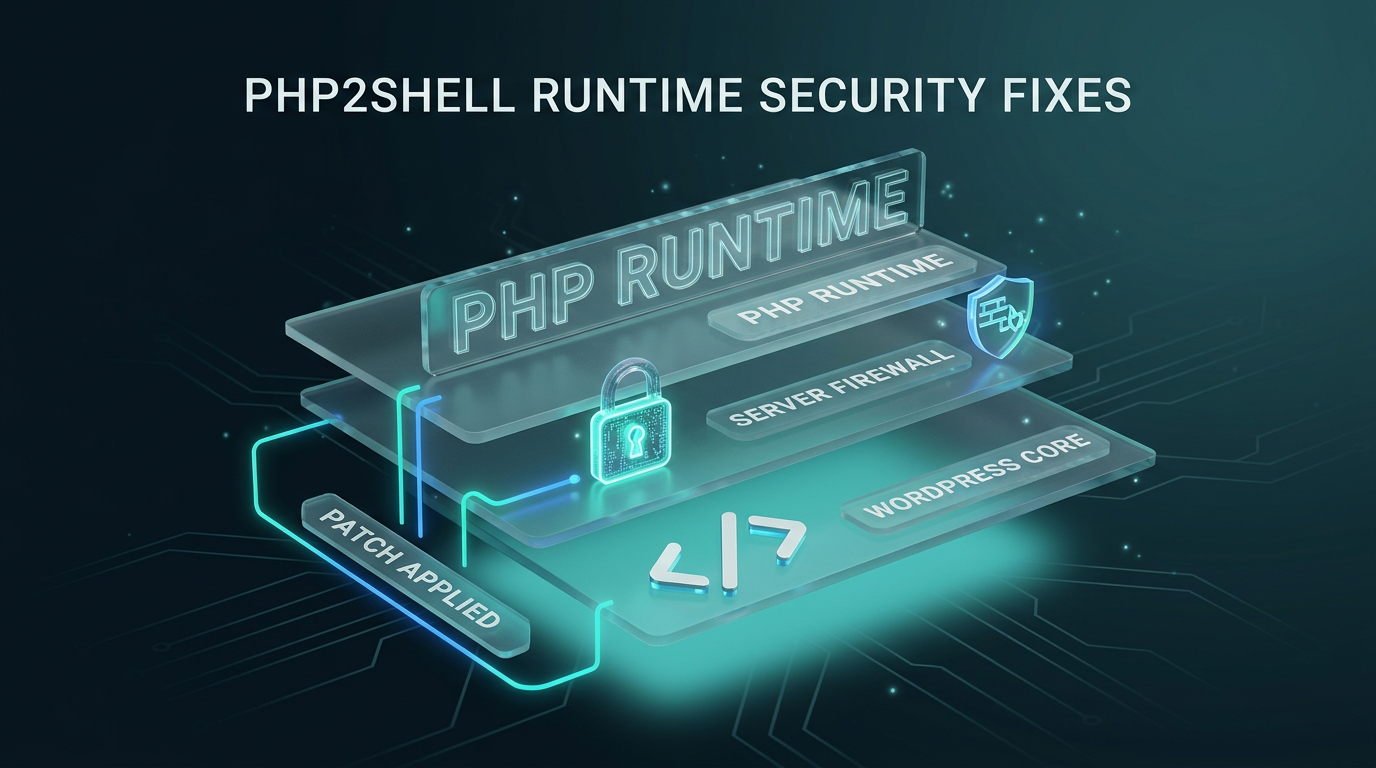
On October 21, the PHP project released emergency security patches for two severe flaws in the PHP runtime, cataloged as CVE-2026-109618 and CVE-2026-109619. Known collectively as the PHP2Shell vulnerability, both security defects carry a severity rating of 9.2 out of 10. Because the flaws exist within PHP itself rather than application software, site administrators must look directly at their server infrastructure to confirm their platforms are protected.
As detailed in an advisory announced on the Elementor blog, the response window required immediate coordination among hosting providers. While managed services pushed automated server-level fixes, websites hosted on unmanaged or self-configured environments must verify their runtime versions manually to prevent unauthorized exploitation.
Understanding the PHP2Shell Vulnerability at the Runtime Layer
The PHP2Shell vulnerability stems from how the PHP core runtime processes requests that disconnect or get cut off partway through transfer. When an incoming transmission aborts unexpectedly, memory allocated during that session is improperly handled by the underlying execution engine. Attackers can exploit this specific memory retention pattern to execute malicious commands on the server.
A notable aspect of the PHP2Shell vulnerability is its historical scope. The affected code path has been present in the language since the release of PHP 5.4 in 2012. Over more than a decade of server software iterations, this handling behavior remained embedded in the language core across thousands of hosting infrastructures worldwide.
Because the flaw exists in the programming runtime, ordinary application hardening offers zero direct protection against it. Writing defensive code in custom WordPress functions, updating theme templates, or switching security plugins will not remediate the PHP2Shell vulnerability. Only a rebuild or upgrade of the underlying PHP binary can close the flaw permanently.
Verifying Patches for the PHP2Shell Vulnerability Across Hosts
Site operators must inspect their host configuration to verify that the PHP2Shell vulnerability has been addressed. In a standard WordPress setup, you can check this without logging into command-line server tools by visiting the administrative dashboard.
Navigate to Tools, select Site Health, and click on the Info tab. Expanding the Server panel will show the precise PHP version currently handling incoming requests. To be fully secured against the PHP2Shell vulnerability, your server runtime must match or exceed the following patched releases:
- PHP 8.5 branch: version 8.5.12 or newer
- PHP 8.4 branch: version 8.4.27 or newer
- PHP 8.3 branch: version 8.3.36 or newer
- PHP 8.2 branch: version 8.2.35 or newer
Version numbers must be checked carefully down to the minor patch segment. For example, running version 8.3.35 means the server remains unpatched, whereas version 8.3.36 contains the verified security release. If your server reports a build number lower than these baselines, your hosting provider has not completed the necessary updates.
Unsupported Branches and Urgent Upgrade Paths
The patch distribution reveals serious challenges for legacy website stacks. The PHP project did not issue any fixes for PHP 8.1 or older branches. Those versions reached the end of their security maintenance schedule before the PHP2Shell vulnerability was discovered. Environments still running PHP 7.4, 8.0, or 8.1 cannot be patched in place.
For administrators operating older environments, the only valid path to eliminate the PHP2Shell vulnerability is upgrading to an active runtime branch. PHP 8.2 represents the oldest release line that received a security patch, but its security support window ends on December 31, 2026. Technical managers should target an upgrade to PHP 8.3 or newer to maintain ongoing stability.
When an immediate runtime upgrade is prevented by legacy codebase conflicts, hosting providers can implement intermediate mitigations against the PHP2Shell vulnerability. These measures include enforcing edge firewall inspection to drop anomalous multipart requests, lowering file upload limits, and turning off PHP upload progress tracking. These settings narrow the exposure area, but only a patched binary resolves the vulnerability entirely.
How Hosting Providers Handled the Rollout
The discovery of the PHP2Shell vulnerability highlighted operational differences across hosting architectures. Providers managing runtime environments directly were able to intervene before public exploits spread across the broader internet.
Elementor Hosting reported initiating an emergency response prior to the release of official upstream packages. The hosting team introduced network-edge filtering to detect and block specific payload patterns while compiling patched runtime binaries across all supported versions. By rolling out updated builds automatically, they eliminated user intervention for their customer base.
On standard shared or unmanaged cloud servers, update workflows operate differently. Many hosting panels present a dropdown selector for PHP versions but do not force runtime upgrades on existing accounts. Site owners on these systems must open their administrative consoles and manually apply the update to neutralize the PHP2Shell vulnerability.
What This Changes for Client Builds
For builders who manage client assets, runtime updates require systematic monitoring rather than passive trust. In modern web designing and ongoing site maintenance, server hygiene is just as foundational as frontend design or content delivery. Wasif structures website deployments around managed infrastructure to ensure critical runtime vulnerabilities are patched without breaking active client operations.
When maintaining custom applications or integrations, automated notification systems ensure version discrepancies do not linger unaddressed. Addressing the PHP2Shell vulnerability promptly ensures long-term stability and security across every production server.
If you need assistance verifying server security or updating your web infrastructure, contact Wasif at wasifahmed.dev/contact to review your deployment setup.