Selecting and deploying GPT-6 models requires balancing intelligence, latency, and operational expense across varied technical environments. In a recent published guide on building with GPT-6, OpenAI laid out practical patterns for taking systems from prototype testing to full production. The guidance focuses on aligning specific tiers with targeted workloads, managing context windows efficiently, and coordinating long-running autonomous tasks.
Building sustainable systems with modern language engines is no longer just about writing a detailed prompt. Engineering teams must structure context caching, calibrate reasoning effort per request, and establish distinct boundaries for when an agent should proceed independently or ask for human direction. This guide details how to implement these recommendations effectively.
Understanding the Three GPT-6 Models and Their Pricing
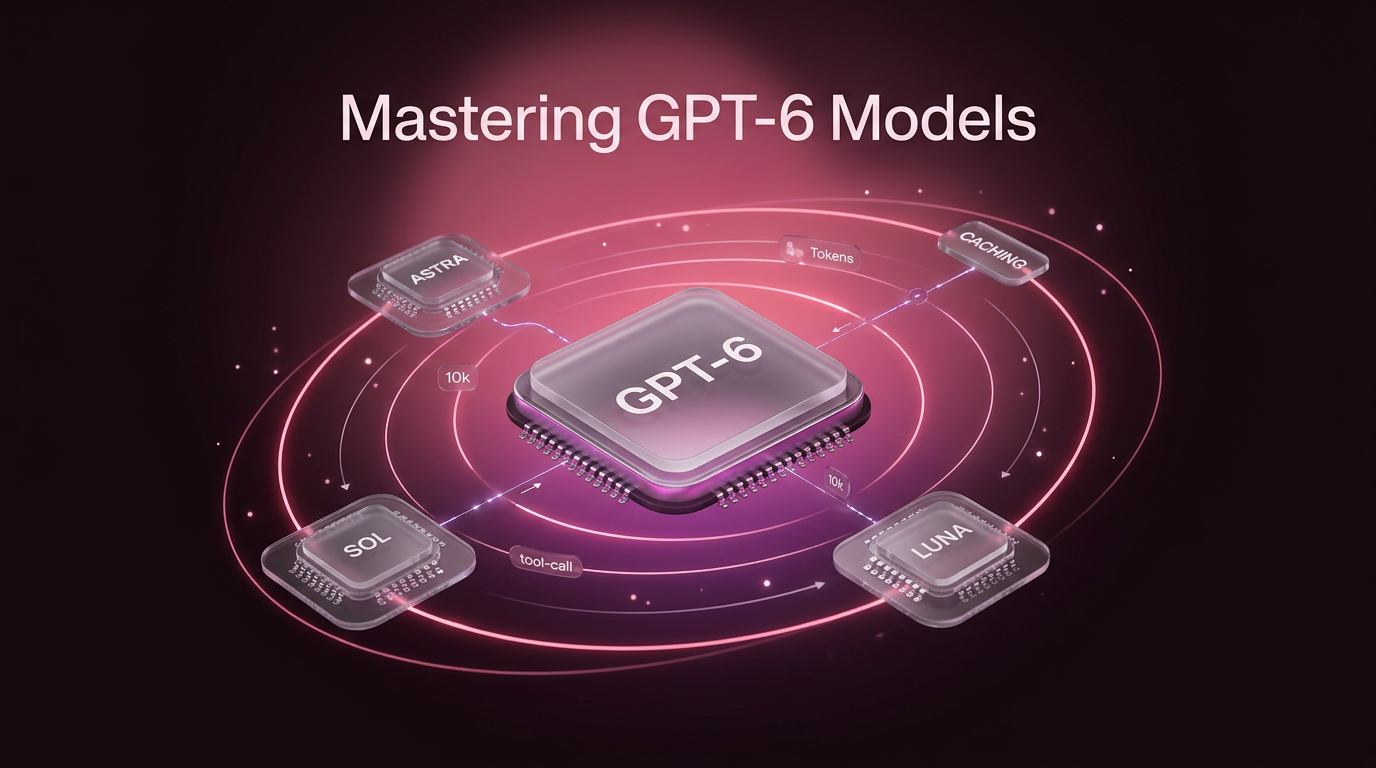
The GPT-6 family divides workloads across three distinct model tiers. Each tier targets specific performance requirements and cost constraints, giving teams options depending on whether they need complex judgment, code execution, or high-volume data handling.
GPT-6 Astra represents the highest intelligence tier. It is designed for demanding reasoning work, deep architecture design, and critical evaluations where accuracy takes precedence over cost. Astra is priced at $10.00 per million input tokens, $50.00 per million output tokens, and $1.00 per million cached input tokens.
GPT-6.1 Sol sits in the middle tier. It provides intelligence close to Astra at one-fifth of the price, running at $2.00 per million input tokens, $10.00 per million output tokens, and $0.10 per million cached input tokens. Sol is built for complex coding tasks, detailed research, computer use, and coordinated subagent routines.
GPT-6 Luna is the high-efficiency tier for focused, high-volume operations. It operates at $0.10 per million input tokens, $0.50 per million output tokens, and $0.01 per million cached input tokens. Luna handles structured extraction, classifying incoming records, and generating standard summaries where tasks follow consistent patterns.
- GPT-6 Astra: Best for high-complexity reasoning, advanced debugging, and structural analysis.
- GPT-6.1 Sol: Built for coding, research, multi-agent workflows, and computer tool use.
- GPT-6 Luna: Designed for structured extractions, routing, and high-volume data processing.
Production Optimization: Context Management and Prompt Caching
Running GPT-6 models effectively at scale requires deliberate context management. Unchecked prompt growth inflates token usage and increases request latency. To mitigate this, developers should eliminate context that a task does not directly need while retaining required evidence.
Prompt caching offers major cost savings when running repetitive operations. Depending on the model selected, cached input tokens cost up to 95 percent less than standard uncached inputs. For example, cached inputs on GPT-6.1 Sol drop from $2.00 down to $0.10 per million tokens. To maintain high cache hit rates, static content such as system instructions, schemas, and reference guidelines must be placed before dynamic task data. Keeping tool definitions consistent across runs ensures that cache invalidation does not occur unexpectedly.
For long interactions, developers should employ compaction. Compaction reduces the overall context size while preserving the critical state needed for the model to continue the conversation. Monitoring tools such as the caching dashboard help teams track where prompt reuse breaks down across production runs.
Configuring Reasoning Levels and Execution Speeds for GPT-6 Models
The API provides controls over reasoning effort and execution speed, allowing developers to balance latency and computational depth. Rather than using fixed compute for every call, teams can adjust how hard the model works based on task complexity.
Reasoning levels range from Low to Max. Low reasoning fits routine activities such as small text edits or basic entity extraction. Medium reasoning applies to tasks requiring judgment, such as drafting feature plans or comparing two approaches. High reasoning is reserved for deep analysis, intricate debugging, and thorough reviews. Extra High or Max settings are intended for edge cases where standard high reasoning fails, provided the latency and token expense are justified by measurable improvements.
In the API, reasoning effort can be altered mid-conversation without invalidating the existing prompt cache. This allows a workflow to process standard turns at lower effort and elevate compute only when a complex problem arises.
Execution speed can also be customized. Fast mode is available in the API to deliver faster, more consistent response times for interactive tools and chat interfaces at a higher token rate. Ultrafast mode is offered for GPT-6 Astra in both Codex and the API. It accelerates token generation independently of the chosen reasoning effort, making it suitable for rapid coding iterations where developer wait time must be kept low.
Managing Long-Running Work and Multi-Agent Workflows
As tasks expand to run over hours or days, systems require mechanisms to maintain control without restarting entire execution loops. The GPT-6 API introduces three core techniques to manage extended tasks: steering, asynchronous tools, and subagent delegation.
Mid-turn steering allows developers to send instructions or corrections through the Responses WebSocket API while an operation is in progress. These steering messages are queued and do not cancel running tools or undo finished steps, letting developers correct trajectory without breaking workflow state.
Asynchronous tool execution prevents slow external systems from blocking model progress. When an application initiates a slow task, such as running a test suite or querying an external database, asynchronous tool calling lets the model proceed with independent analysis while waiting. The parent application returns the tool output when ready, and the model incorporates the result before starting dependent steps.
For complex investigations, GPT-6.1 Sol supports multi-agent workflows in the Responses API, which is currently in beta. A primary agent can assign independent research subtasks to dedicated subagents, such as inspecting separate modules of a repository, and combine their findings into a single coherent output.
Structuring Prompts and Setting Operational Boundaries
Working with newer models requires a shift in prompt engineering. As OpenAI developer experience lead Eric Provencher noted, “Models have gotten much better at understanding nuance and ambiguity, so overly specific guidance can now hinder results where it previously helped.”
Instead of rigid step-by-step scripts, instructions should provide a clear assignment: the desired outcome, target audience, technical constraints, and criteria for completion. When setting up instructions in an AGENTS.md file or system prompt, teams should define clear decision boundaries. Rather than instructing a model to ask permission before every action, explicitly list actions that can proceed independently, such as executing tests with disposable local data, versus actions requiring administrative sign-off, such as changing project scope.
Persistence must also be clearly defined. Teams should specify what constitutes a completed task. For software engineering workflows, this typically includes making the code edit, running the test suite, reviewing failures, and applying fixes before handing off the result.
FAQs
Which model should I choose for daily automation tasks?
GPT-6 Luna is the practical choice for high-volume, routine tasks such as extracting fields from documents, categorizing customer messages, and producing structured data. It offers low latency and costs $0.10 per million input tokens, making it economical for high-frequency operations.
How does prompt caching lower operating expenses?
Prompt caching reuses previously processed token blocks, reducing input token costs by up to 95 percent depending on the specific model. To benefit from caching, place static system prompts and tool definitions at the beginning of the context window before dynamic inputs.
What is the difference between Fast mode and Ultrafast mode?
Fast mode is an API setting that accelerates standard response times for interactive applications at a higher per-token rate. Ultrafast mode is available specifically for GPT-6 Astra in Codex and the API, increasing raw token generation speed independently of reasoning effort.
Can GPT-6 handle multi-agent tasks out of the box?
GPT-6.1 Sol supports multi-agent coordination in the Responses API while currently in beta. This feature allows a primary agent to delegate distinct tasks to subagents and combine their results into one final delivery.
Where This Fits in Real Client Builds
In real-world implementations, Wasif integrates these architectural patterns into AI automation pipelines and structured agentic AI systems. Production success rarely comes from simply connecting the largest model to an API endpoint; it comes from routing queries through the correct tier.
By deploying GPT-6 Luna for high-frequency data classification and escalating difficult edge cases to GPT-6.1 Sol, systems stay fast and cost-controlled. Incorporating prompt caching and explicit approval boundaries ensures that automated workflows remain reliable when running continuously.
If you are planning to implement or refine production GPT-6 models across your business operations, reach out to Wasif Ahmed to discuss your architecture.
Bottom line: GPT-6 models are best approached as a family, so match the right model to each production workflow. When you plan with GPT-6 models, start small, measure the results and scale what works, because GPT-6 models reward careful, practical building.