A two-way SMS API allows your application to deliver text messages from dedicated phone numbers and process incoming responses as structured data. Traditional business text configurations often run through disconnected gateways, forcing teams to isolate customer conversations away from social channels or support software. Modern multi-channel platforms simplify this workflow by unifying text channels with existing customer contact streams.
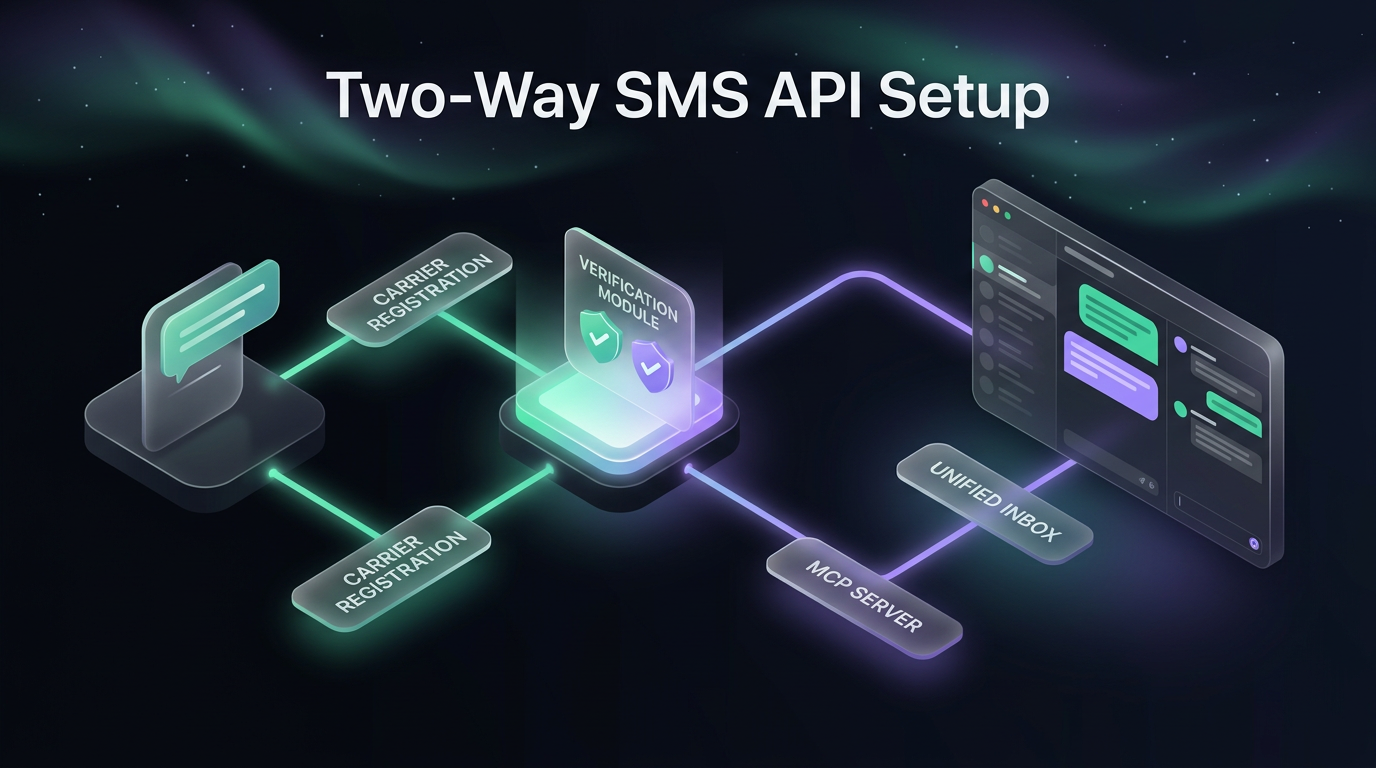
As detailed in the announcement published on the Zernio blog, adding mobile messaging no longer requires separate infrastructure. A two-way SMS API routes inbound text threads into the exact same conversation queue as social direct messages and chat channels, eliminating split conversation records.
Understanding the Scope of a Modern Two-Way SMS API
Modern telecommunication tools combine carrier connections with operational tools that engineering teams previously had to assemble manually. A reliable two-way SMS API handles inbound webhooks, local regulations, and message assembly under a single authentication key. A solid two-way SMS API keeps every conversation in one thread.
Platforms like Zernio provide access to SMS and MMS delivery alongside existing configurations for WhatsApp, voice calling, and social messaging. Teams can handle both plain text and rich multimedia while avoiding duplicate tooling. Key technical capabilities supported by this architecture include:
- Message formats: Plain text SMS and multimedia MMS including images with optional text descriptions.
- Segment capacity: Multi-part message concatenation up to 10 segments, translating to 1,530 standard characters or 670 Unicode characters.
- Sender configurations: Local SMS-capable numbers, ported lines, or branded alphanumeric sender IDs for international one-way transmissions.
- Unified conversation threads: Automatic routing of inbound texts into a single shared inbox alongside social messaging apps.
- Compliance handling: Built-in 10DLC registration, toll-free verification, and automated carrier-level STOP opt-out synchronization.
- Safe operations: Idempotency keys to prevent duplicate transmissions on retries, plus carrier line lookups before dispatch.
Teams deploy a two-way SMS API across four recurring operational scenarios: transactional delivery updates with tracking links, one-time authentication codes, two-way helpdesk support, and automated appointment confirmations that handle text replies. Choosing the right two-way SMS API saves hours of integration work.
Three Steps to Deploy Your Two-Way SMS API
Setting up outbound and inbound messaging takes three core steps. Developers configure a verified phone number, complete required carrier compliance for regional paths, and trigger outbound payload requests through REST endpoints or programming language SDKs.
Step 1: Acquire or Enable an SMS-Capable Number
Every messaging workflow begins with a real phone line. Not all numbers support short messaging, so the interface allows developers to search for and buy numbers with SMS capability pre-checked. Teams can also port existing business numbers to preserve customer recognition, or enable SMS capabilities directly on existing voice numbers in their account. Teams get real value from a two-way SMS API that unifies channels.
When turning on SMS for a number, the system inspects the carrier record directly. The resulting response confirms whether the line supports standard SMS, whether MMS media delivery is available, and which carrier registration path must be submitted before sending outbound traffic.
Step 2: Complete Carrier Compliance Registration
Mobile networks in the United States require registration before businesses can deliver messages to subscribers. An effective two-way SMS API exposes this compliance flow through code, allowing teams to submit local 10DLC or toll-free paperwork directly.
Unregistered US numbers will fail before reaching carrier lines. In the Zernio implementation, attempting to transmit from an unapproved US sender yields a 403 response immediately, alerting engineering teams in server logs rather than silently dropping texts downstream. Outside the United States, numbers can begin transmitting immediately once the SMS capability is active on the account.
Step 3: Dispatch Payload and Handle Incoming Responses
Dispatching an outbound message requires an HTTP POST request carrying sender, recipient, and message text parameters. If developers include an array of media file links, the payload automatically processes as an MMS delivery.
The API response provides the unique message identifier, current dispatch state, and the conversation thread ID. The same payload structure operates across standard REST requests or official SDK libraries covering Python, Go, Node.js, Ruby, Java, PHP, .NET, and Rust. Because the system threads responses automatically, any inbound answer appears under the same identifier.
Navigating US 10DLC Registration Through the API
US carriers mandate that application-to-person business messaging runs across verified numbers via The Campaign Registry. Using a modern two-way SMS API enables developers to automate and maintain 10DLC registration directly through code rather than filling manual carrier forms.
The 10DLC registration architecture splits into two logical components:
- The Brand: Details identifying the legal entity, including registered business name, tax identification number, physical address, and public website.
- The Campaign: The specific messaging operational purpose, complete with detailed use case descriptions, subscriber opt-in workflow links, opt-in/opt-out keywords, and two representative message samples.
The platform streamlines registration by letting organizations reuse an approved campaign across multiple newly purchased numbers without paying repeated brand review fees. For agency workflows where end clients own the corporate entity, the API can create a single-use onboarding form link valid for 7 days. Clients submit their tax and business details without gaining administrative dashboard access. If a carrier rejects an application, teams can update the flagged parameters and submit an appeal within the same endpoint call.
Integrating with AI Agents and the MCP Server
Teams building automated systems increasingly connect communication infrastructure directly to autonomous models. Rather than writing custom webhook listeners and calling endpoint libraries manually, developers can expose the two-way SMS API to AI models using the Model Context Protocol (MCP).
Zernio provides its communication capabilities across a pre-built MCP server. AI agents operating in environments such as Claude Code, Cursor, or Codex connect via OAuth without pasting raw credentials into local project settings. When an agent needs to reach a customer, it selects the assigned number, checks the compliance status, and queues the message. In advanced multi-task automations, an agent can manage cross-channel actions simultaneously, answering public social media questions while triggering an SMS verification update to an active lead.
Consolidating Multi-Channel Threads into a Unified Inbox
The primary friction with a standalone two-way SMS API has historically been data fragmentation. When SMS records sit in one third-party service while web chat and social direct messages live in another, staff members face divided customer context.
With a shared inbox backend, incoming text replies land in the same conversation thread as WhatsApp, iMessage, Telegram, and social DMs across Facebook, Instagram, Bluesky, X, and Reddit. Every inbound text generates a standardized message event webhook. This allows backend applications to process replies, update external database records, and run custom support tools through a single event structure.
Pricing and Alphanumeric Sender IDs
Usage-based billing allows businesses to scale messaging volume predictably. Outbound messages start at $0.008 per segment, with rates varying by destination network. In the US, local numbers run at $3 monthly with calling included, while standard 10DLC or toll-free campaign hosting costs $20 monthly.
For global delivery outside North America, businesses can use alphanumeric sender IDs. These send one-way branded text using 3 to 11 characters instead of numeric digits, functioning similarly to airline and banking notifications. Sender IDs send text-only alerts without incoming replies and come with baseline allocations of 500 messages daily, scalable up to 25,000 upon request.
FAQs
What happens when a customer replies to a message sent via a two-way SMS API?
Incoming messages trigger an immediate webhook event containing the sender details, message body, and attachment links. In platforms with unified routing, the reply automatically threads into the customer conversation alongside their other channels.
How does carrier opt-out work with a two-way SMS API?
When a customer replies with standard keywords such as STOP, the carrier blocks subsequent sends to that number. The API records the opt-out status and exposes a synchronized blacklist to protect compliance.
Can an AI agent send text messages without custom backend code?
Yes, by connecting the two-way SMS API through an MCP server. AI systems can select registered phone numbers, verify registration status, and dispatch texts autonomously over direct OAuth connections.
Where This Fits in Real Client Builds
Wasif designs and implements production systems using AI automation to help organizations streamline customer operations. Rather than managing fragmented software tools with separate webhook pipelines, Wasif integrates unified communication APIs with automated workflows in Make.com and custom platforms. This keeps inbound customer text messages, social inquiries, and CRM updates inside an organized data flow that operational teams and autonomous agents can manage reliably.
If you want to integrate unified messaging and automated communications into your business systems, reach out to Wasif Ahmed to discuss your architecture.