The root KSK rollover is officially scheduled for October 11, 2026, marking only the second time in internet history that the root zone of the Domain Name System replaces its top cryptographic trust anchor. As detailed in an update announced on the Cloudflare blog, the root zone is transitioning from the older KSK-2017 key to a replacement key designated as KSK-2024. This operational switch ensures the global DNS Security Extensions (DNSSEC) validation framework remains dependable across recursive resolvers worldwide.
DNSSEC relies on cryptographic signatures to verify that DNS responses are authentic and have not been altered in transit. Because the root zone sits at the very top of the naming hierarchy, it has no parent zone above it to verify its signatures. Instead, validating resolvers rely on an explicitly configured starting point known as a trust anchor. The upcoming transition replaces this root anchor, requiring resolving software across the internet to recognize and trust the new key before the switch takes place.
The Key Changes in the Root KSK Rollover
The DNS root maintains two distinct key types to operate DNSSEC. The Zone Signing Key (ZSK) signs everyday DNS records within the root zone, including Delegation Signer (DS) records that point to top-level domains such as .com or .org. The Key Signing Key (KSK) signs the entire DNSKEY record set published by the root. Resolvers use their trusted KSK to validate that list of keys, after which they use the verified ZSK to confirm everything else. Teams planning the root KSK rollover should start early.
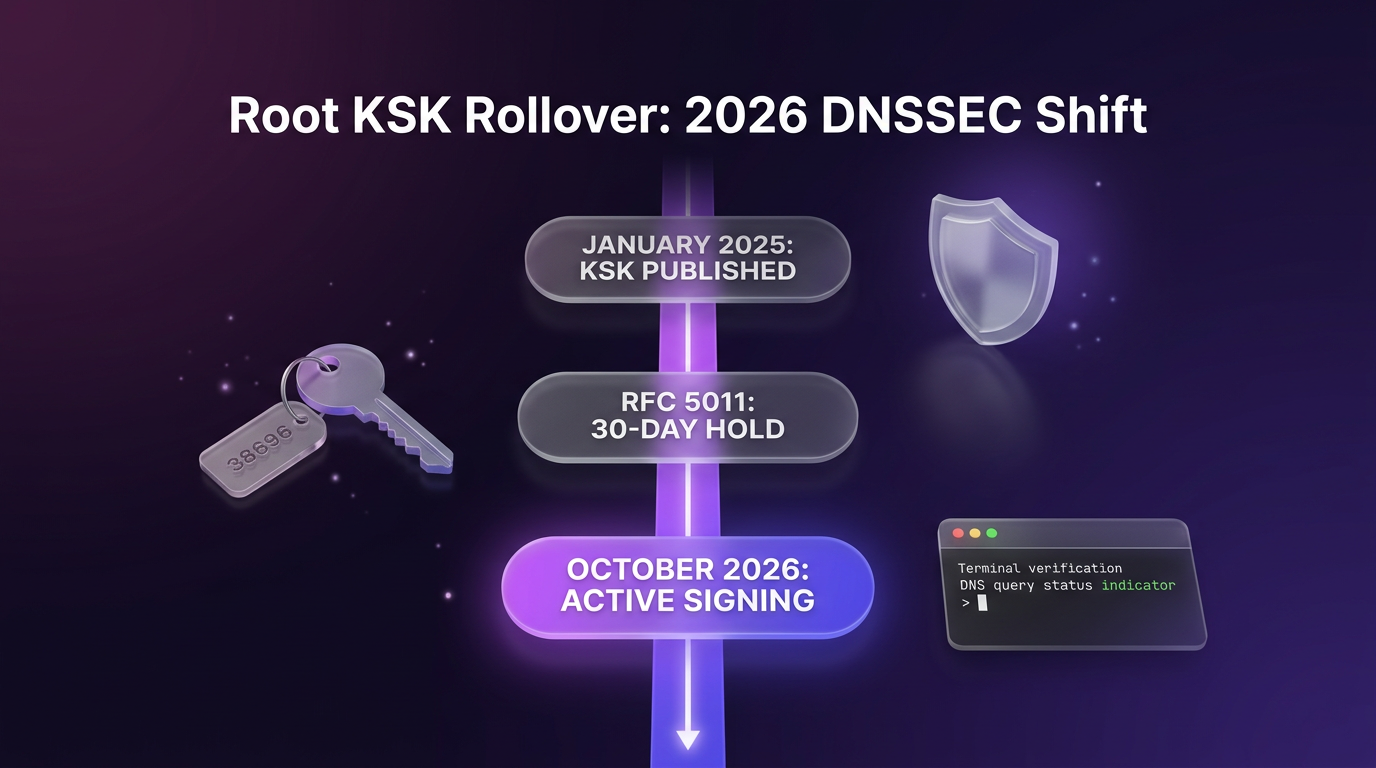
The scheduled root KSK rollover replaces KSK-2017, identified by key tag 20326, with KSK-2024, identified by key tag 38696. Both keys use the RSA/SHA-256 cryptographic algorithm. The Internet Assigned Numbers Authority (IANA) maintains an idealized target of rotating this key roughly every three years to manage key lifespan and verify that operational rollover mechanisms continue to work as intended. While earlier discussions suggested a key rotation might also introduce newer algorithms, this event keeps the existing algorithm while refreshing the key material itself.
To give resolvers ample time to ingest the replacement key, KSK-2024 has been published in the root zone’s DNSKEY record set since January 11, 2025. Publishing the key nearly twenty-one months ahead of the signing rollover provides automated update mechanisms sufficient runway to detect, hold, and confirm the new trust anchor. Every operator should treat the root KSK rollover as a routine but critical change.
How Resolvers Learn Trust Under RFC 5011
Most modern validating resolvers follow RFC 5011 to learn new trust anchors without requiring manual administrator intervention. Under RFC 5011, a resolver tracking the root zone monitors the signed DNSKEY set over time. When it sees a new key like KSK-2024 published alongside the active KSK-2017, it begins an automated verification timeline.
The resolver requires a mandatory waiting period of at least thirty days before trusting the new key. During this thirty-day hold-down period, the incoming key must remain continuously present in the root zone’s signed records. Once that timer expires and the resolver confirms the new key in another signed query, it stores KSK-2024 as an active trust anchor. This delay prevents temporary network disruptions or transient injection attempts from poisoning a resolver’s trust configuration. A calm root KSK rollover depends on resolvers that already trust KSK-2024.
However, automated learning has historical edge cases. During the first key replacement in 2018, operators observed that some resolvers lost learned trust state following operating system updates, software reboots, or migrations between virtual machines. Because of that reality, resolver distributors often hardcode the replacement anchor directly into newer software releases. For example, Cloudflare added KSK-2024 directly into its resolver software package in July 2024 alongside KSK-2017 so that systems trust the new anchor immediately upon startup without waiting on thirty-day discovery cycles.
Why the Root KSK Rollover Matters for Infrastructure
If a validating resolver fails to trust KSK-2024 by October 11, 2026, the consequences are immediate for any client device sending queries through it. A resolver that cannot validate the root’s DNSKEY record set will treat all DNSSEC responses down the entire chain as invalid. When DNSSEC validation fails at the root level, the resolver returns a SERVFAIL response for requests across every top-level domain. Testing before the root KSK rollover is far cheaper than debugging after it.
Past regional rollover incidents involving country-code top-level domains like .de and .al demonstrated that perfectly healthy, functional origin servers become completely unreachable to end users whenever validation checks fail upstream. Because the root anchor underpins every signed domain online, resolver validation failures during a root KSK rollover cut off access to broad sections of the internet.
For standard website operators and businesses, this root KSK rollover requires zero configuration changes on origin servers. Website owners do not need to update their own domain DNSSEC keys, change their registrar settings, or adjust zone records. The operational responsibility falls almost entirely on system administrators who operate recursive DNS resolvers and the network vendors that supply them. The root KSK rollover is a good moment to audit every validating resolver.
Practical Implications and Testing with RFC 8509
Operators who manage local DNSSEC-validating resolvers, such as internal enterprise recursive servers or local Unbound and BIND instances, should confirm their software configuration. Best practices for confirming resolver readiness include:
- Checking resolver configuration files to confirm that key tag 38696 is registered as a trusted anchor.
- Updating recursive DNS packages to current vendor versions that bundle KSK-2024 by default.
- Verifying that local write permissions permit the resolver daemon to save updated RFC 5011 state files to disk across server reboots.
- Executing diagnostic sentinel queries to test whether upstream recursive forwarders recognize the new key.
Testing resolver status was difficult during the 2018 rollover because administrators could not easily inspect the internal trust table of an upstream resolver. To solve this, the Internet Engineering Task Force established RFC 8509, known as the Root Key Trust Anchor Sentinel for DNSSEC. This standard allows any client to ask a validating resolver whether it trusts a specific root key by querying specially formatted domain prefixes. Clear monitoring makes the root KSK rollover much less stressful.
The mechanism uses two query prefixes: is-ta-38696 and not-ta-38696. When a resolver supports the sentinel specification, it checks whether key 38696 is trusted:
If KSK-2024 is trusted, querying is-ta-38696 returns a standard valid DNS answer, while querying not-ta-38696 deliberately returns a SERVFAIL error code. Conversely, if KSK-2024 is not trusted by that resolver, the results invert: is-ta-38696 returns SERVFAIL, while not-ta-38696 returns a valid answer. Cloudflare makes this test available using names under dnstest.dev, allowing operators to run direct command-line queries like dig @1.1.1.1 root-key-sentinel-is-ta-38696.dnstest.dev. A to verify that the upstream resolver validates the new key as expected.
A Grounded Outlook for Resolvers
The transition scheduled for October 11, 2026, represents a controlled exercise in internet resilience. Because KSK-2024 has been publicly visible in the root DNSKEY set since early 2025, validating resolvers using RFC 5011 have already completed multiple thirty-day confirmation windows. Managed recursive services like 1.1.1.1, Gateway DNS, and major public resolvers already include the new trust anchor in baseline code, meaning regular users of these services do not need to intervene.
For independent network administrators running self-hosted validation stacks, the priority over the coming months is straightforward: audit resolver configurations, confirm persistent storage for RFC 5011 state, and test upstream forwarders using RFC 8509 sentinel lookups.
Where This Fits in Production Systems
Wasif Ahmed tracks changes in DNS infrastructure and core web protocols to keep hosting environments, domain configurations, and client systems operating smoothly. When Wasif delivers web designing projects, reliable DNS resolution forms the quiet foundation that keeps business portals, automated funnels, and web applications accessible to users worldwide.
Understanding how the root KSK rollover functions ensures that mission-critical infrastructure avoids surprise resolution failures when global security standards update. If you need assistance auditing your business web infrastructure or setting up resilient web systems, feel free to reach out to Wasif directly.