Clarity AI visibility just got a useful update. Microsoft Clarity has updated its analytics platform by allowing website owners to customize Brand Terms inside the AI Visibility dashboard. The update builds directly on the query segmentation capabilities introduced in August, which initially separated citations into branded and non-branded categories. For the original announcement, see the Microsoft Clarity blog.
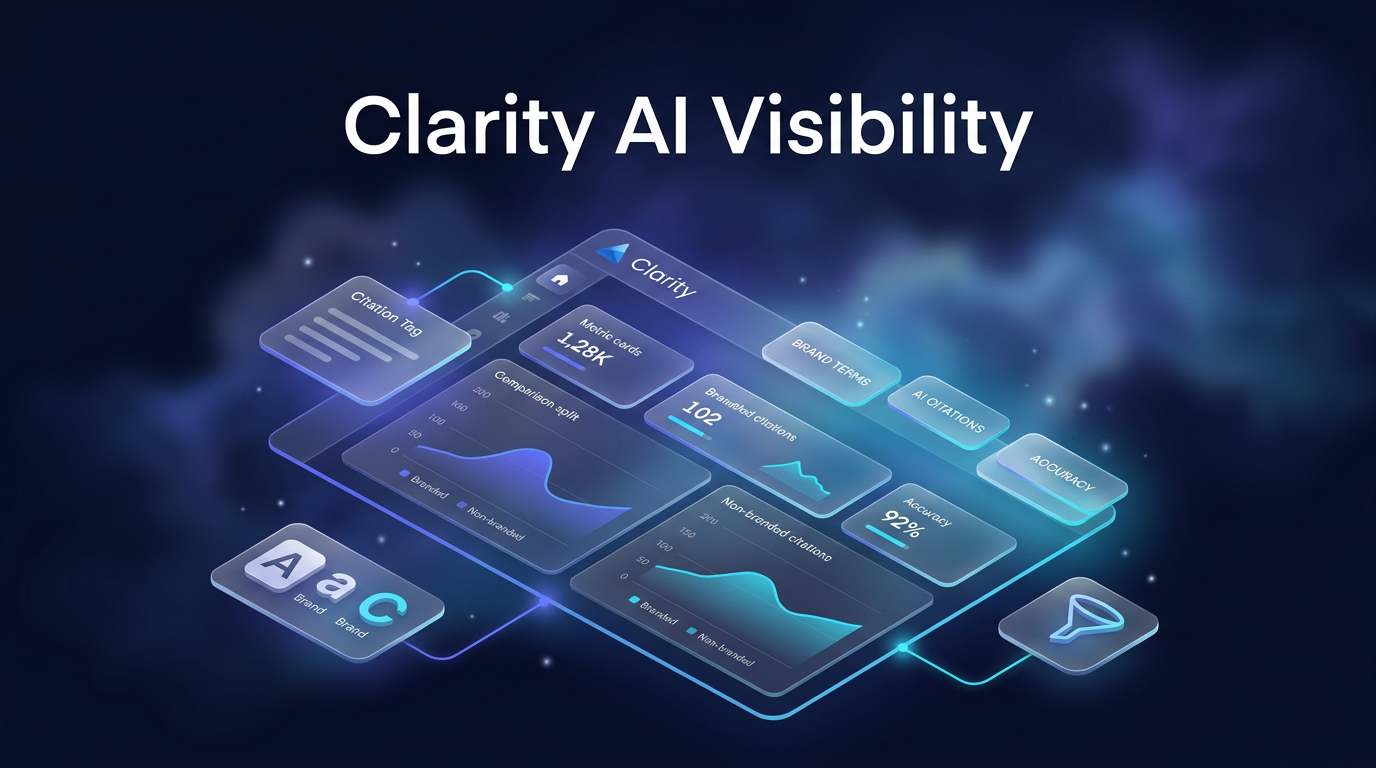
Tracking brand presence across synthetic answer engines requires precise taxonomy. The new configuration tools give teams direct administrative control over how artificial intelligence platforms attribute their products, subsidiaries, and common spelling variations.
Refining Segmentation in Clarity AI Visibility
The core enhancement focuses on citation classification accuracy. When generative answer tools cite web properties, visitor queries rarely conform to rigid naming conventions. By expanding settings beyond fixed domain names, the Clarity AI visibility system accommodates natural variations in user queries. Teams tracking Clarity AI visibility get a clearer picture.
Administrators can access the configuration suite directly within Clarity by navigating through Settings to AI Visibility. Inside this screen, users can review an initial collection of terms automatically compiled by the platform. Teams can then manually add alternative keywords, modify existing entries, or discard irrelevant classifications that skew attribution reports.
Handling Alternate Spellings and Query Variations
Audience search behavior introduces multiple linguistic challenges that automated scrapers often misclassify. Clarity AI visibility settings now specifically account for several recurring query patterns across search engines and AI assistants:
- Common typographical errors that alter core name recognition
- Official business abbreviations alongside everyday corporate shorthand
- Localized product variations across distinct linguistic markets
- Regional translations that shift literal wording while retaining brand intent
Microsoft shared an illustrative operational example highlighting standard corporate structure. A central brand identity like Microsoft can now be configured alongside related terms such as MS and Microsoft Corporation. Grouping these inputs ensures that conversational engines surfacing short-form queries are properly recorded as direct brand awareness rather than generic category discovery.
Hierarchical Grouping and Granular Filtering
Organization plays a central role in accurate data analysis. Within the interface, related terms nest directly beneath designated Brand Names. This hierarchy prevents settings dashboards from becoming cluttered lists of fragmented keywords when managing complex multi-product websites.
This structured relationship translates directly into flexible reporting views. When evaluating general performance across Clarity AI visibility reports, analysts can apply high-level filters at the Brand Name level to inspect aggregate traffic. Alternatively, users can isolate an individual Brand Term to evaluate whether specific abbreviations or regional names attract distinct referral patterns.
Practical Implications for Digital Measurement
Automated conversational engines and synthetic response systems continue to alter how audiences encounter websites. Traditional web analytics categorizes traffic primarily by referrer domains and UTM parameters. In contrast, the Clarity AI visibility dashboard measures how external answer engines construct citations around commercial products.
Without tailored keyword dictionaries, businesses risk misattributing organic brand equity to generic industry searches. For instance, if an audience uses an informal acronym when querying an AI chat engine, an unconfigured system might log the resulting citation as non-branded category research. Updating these terms ensures downstream metrics accurately reflect earned brand recognition.
The announcement directly benefits digital marketing teams, search specialists, and product managers monitoring cross-engine visibility. By aligning data models with real user search habits, teams avoid the distortion of under-reported brand demand.
Connecting Metrics to Client Implementation
Wasif Ahmed integrates analytics and behavioral tracking infrastructure to ensure commercial websites capture clean performance data. Accurate search measurement serves as the foundation for broader automation pipelines, linking top-of-funnel discovery to structured lead processing.
When deploying web systems, tracking both direct name awareness and broader service discovery clarifies which content assets drive qualified engagement. Proper setup of tools like Clarity AI visibility prevents blind spots in customer journey mapping. As conversational discovery channels develop, maintaining structured data definitions ensures internal analytics deliver reliable operational signals rather than incomplete estimates.
If you need assistance configuring your tracking stack or connecting measurement systems to automated operational workflows, explore custom solutions by visiting Wasif Ahmed.