Agent collaboration architecture becomes critical when an automated workflow moves past a single prompt and requires multiple tasks running in parallel. When one agent delegates work to a secondary agent, context can easily degrade, responsibilities overlap, and execution states collide. Solving these issues requires deliberate infrastructure rather than ad hoc prompt chaining.
In a technical breakdown of its multi-agent platform, engineering team members at Lovable detailed their agent collaboration architecture. The company disclosed that on a typical weekday, its Trajectory System records approximately 500 million events across 2.6 million user turns. Handling that volume requires an operational model that cleanly untangles what happened from what an active model currently needs to know.
Separating Event Logs from Working Model Context
A core challenge in agent collaboration architecture is determining how agents remember state. Many basic agent setups treat the full chat history as the model prompt. As interactions grow longer and multiple subagents join, passing entire raw conversation strings rapidly exhausts model token limits and introduces conflicting instructions.
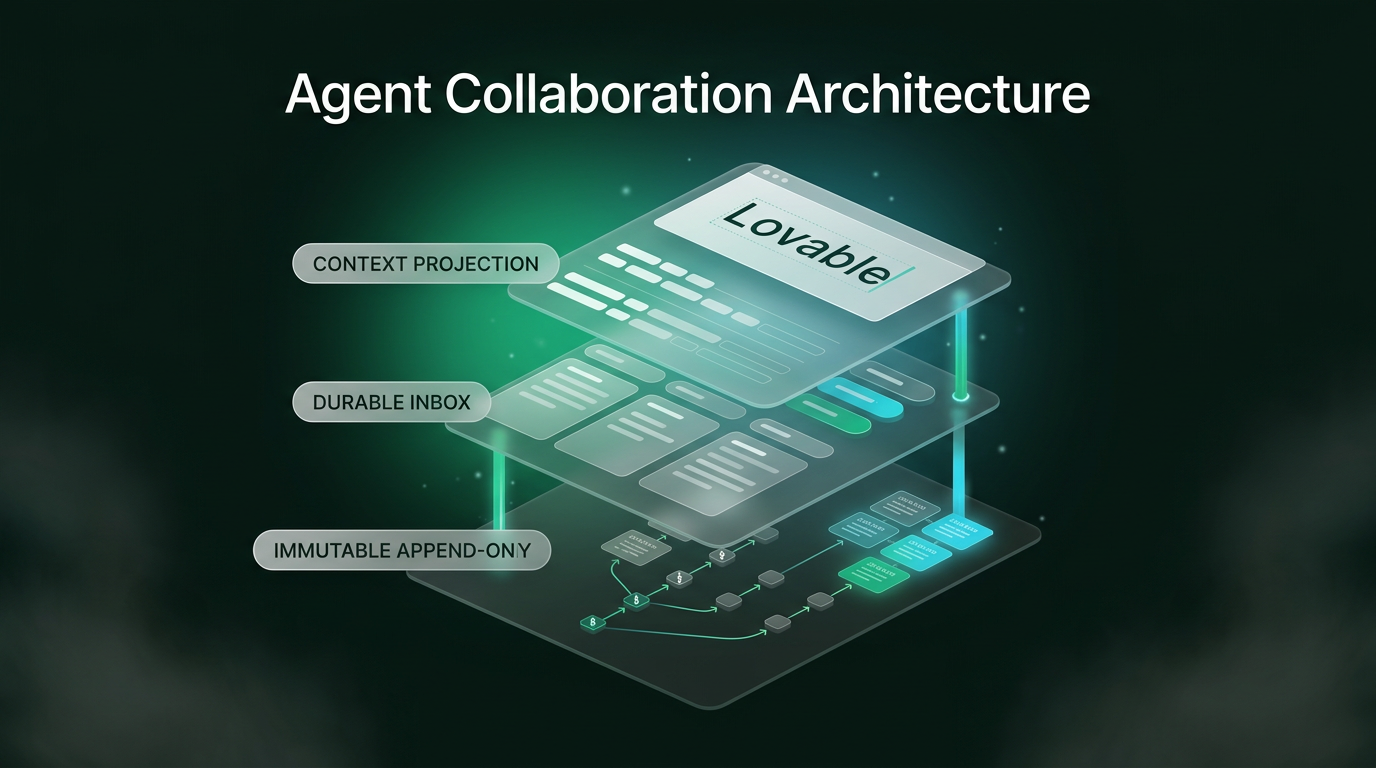
Lovable addresses this by modeling agent conversations after Git commit trees. Every action, user message, tool validation, tool execution, and internal thinking step is recorded as an immutable event in an append-only log known as a trajectory. Each event maintains a single parent pointer pointing back to the preceding step. When an agent needs to generate its next turn, an internal prompt builder walks this tree backward and projects only the necessary context for that specific model call.
Because the log is append-only, actions are never overwritten or deleted. Even rolling back an action is recorded as a dedicated revert event. This design ensures that the underlying event log serves as an indisputable audit trail, while the prompt sent to the LLM remains concise and task-specific.
Branching and Side Trajectories in Agent Collaboration Architecture
Conventional Git systems permit merging branches together, but agent workflows cannot cleanly merge two separate streams of thought, tool calls, and outputs. In this agent collaboration architecture, trajectories are strictly forkable trees that never merge. Every fork begins with a configuration event that points directly to an existing parent boundary, meaning no past events need to be duplicated.
This branching structure enables background tasks without stalling user interaction. A primary example is context compaction. Instead of pausing an agent while an LLM summarizes earlier steps, a background summarizer branches onto a side trajectory. The main agent continues executing its tasks without delay. Once the summarizer completes its work, the main agent admits the resulting summary at its next iteration boundary, writing an end event to its own log.
When subsequent prompt projections occur, the backward walk recognizes the compaction boundaries. It includes the summarized token block in place of older raw events, preserving memory limits without dropping essential context. The same mechanism allows developer subagents to inherit parent history instantly and evaluate code modifications on isolated side branches.
Managing Asynchronous Communication with Durable Inboxes
Multi-agent coordination breaks down if agents attempt to write directly into one another’s active execution contexts. To prevent race conditions, the architecture assigns two distinct logs to every running agent: an inbox and the agent trajectory itself.
- The inbox: Receives inbound notifications, scheduled wake-ups, and finished outputs from subagents or control systems.
- The trajectory: Documents the internal thought loops, tool executions, and direct responses of that specific agent.
- The activation cycle: Pulls unprocessed inbox items into the primary trajectory only at controlled iteration boundaries.
- Streaming partials: Delivers live token deltas to user browsers via an ephemeral side channel without corrupting the durable event log.
By buffering external events in an inbox, an active agent can complete its current thinking cycle uninterrupted. When ready, the agent copies unhandled inbox entries onto its own trajectory. This separation keeps execution reliable even when multiple asynchronous notifications arrive simultaneously.
Designing Real-World Systems with Agent Collaboration Architecture
Engineering teams building production automations can extract practical design rules from this structure. While small applications often manage with basic webhooks and single-thread prompts, complex agent setups demand durable state isolation.
Decoupling the storage log from the prompt generation step prevents prompt bloat. It allows different models within the same workflow to consume the exact same underlying event history through tailored lenses. A code-auditing subagent might ingest only tool inputs and execution errors, whereas a client-facing assistant reads summarized business decisions derived from the identical trajectory.
Handling user-facing text through live partial events also keeps database layers clean. Streaming tokens directly to interfaces while holding the complete event record until completion avoids writing half-formed steps into persistent storage. For organizations looking to construct robust workflows, adopting an agent collaboration architecture that separates event recording, context generation, and execution timing is essential.
Where This Fits in Automation Projects
Wasif applies these structural concepts when designing multi-step AI workflows and custom integrations for businesses. While Lovable uses these mechanics for software development workspaces, similar principles govern reliable business operations built with tools like Make.com, custom APIs, and agentic AI systems. In production environments, isolating system logs from operational prompts ensures that customer-facing agents avoid hallucinating or stalling during complex multi-app handoffs.
When structuring client operations across AI automation pipelines or syncing CRM tasks via Go High Level, Wasif uses durable messaging queues and strict event logging. This prevents dropped tasks when third-party endpoints experience latency or return unexpected data.
FAQs
What is the primary benefit of an agent collaboration architecture?
The primary benefit of an agent collaboration architecture is maintaining strict data integrity and context clarity across multiple independent agents. By separating event histories from individual model prompts, systems prevent context degradation, eliminate race conditions, and keep token costs under control.
Why should an agent collaboration architecture avoid merging branches?
Merging independent agent trajectories creates conflicting chronological orders between separate streams of thought, tool calls, and results. Instead of merging histories, an agent collaboration architecture keeps event logs branching only, using structured inboxes and message passing to exchange findings between agents cleanly.
How does context compaction work without pausing active agents?
Context compaction runs as an asynchronous background loop on an isolated side trajectory. The main agent continues processing new instructions, only incorporating the generated summary into its main log once the background loop completes and reaches an iteration boundary.
If you want to implement dependable automated workflows or agent setups in your business, explore how Wasif Ahmed can assist by visiting the contact page.